
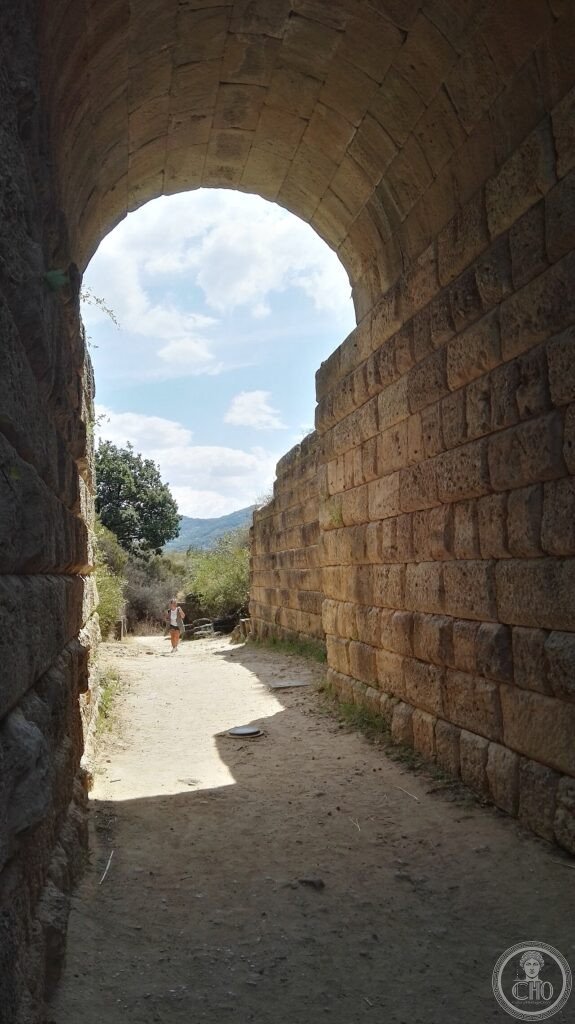
A Phocaean Greek colonial city on the Cilento coast, founded in 540 BCE by refugees from Phocaea in Asia Minor, where Parmenides and Zeno established the Eleatic school of philosophy and where the best-preserved Hellenistic arch in Italy still frames the Mediterranean horizon.
At a glance
Elea (Velia in Latin) was founded around 540 BCE by Greek colonists from Phocaea (western Asia Minor), who had fled the Persian conquest of their homeland. Situated on a headland between two rivers on the Cilento coast, the city controlled a natural harbour and productive agricultural hinterland. It reached its maximum extent in the fifth and fourth centuries BCE, when its two greatest citizens — Parmenides (c. 515–450 BCE) and his student Zeno (c. 490–430 BCE) — developed the Eleatic school of philosophy, establishing the first rigorous logical argument for the unity and immutability of Being.
The site is part of the UNESCO inscription “Cilento and Vallo di Diano National Park with the Archaelogical Sites of Paestum and Velia, and the Certosa di Padula” (1998, ref. 842). Excavations have been ongoing since 1947 and have progressively revealed the grid layout of the Hellenistic city, including the acropolis, the Porta Rosa, and extensive residential quarters.
Key facts
- Foundation: c. 540 BCE, by Phocaean Greek refugees from Asia Minor
- Greatest citizens: Parmenides (c. 515–450 BCE) + Zeno of Elea (c. 490–430 BCE), founders of Eleatic philosophy
- Porta Rosa: c. 350–300 BCE — best-preserved Hellenistic arch in Italy
- UNESCO inscription: 1998, ref. 842 — “Cilento and Vallo di Diano National Park”
- Location: Ascea (SA), Cilento coast, Campania
- GPS: 40.1568, 15.1542 — Google Maps
History
The Phocaeans were among the most adventurous Greek navigators of the archaic period, establishing colonies at Massalia (Marseille), Emporion (Empúries in Catalonia), and Alalia (Corsica) before the Persian conquest of 546 BCE forced a diaspora from their homeland. The group that founded Elea arrived on a south-facing headland between the rivers Alento and Fiumarella and rapidly established a prosperous city that would remain inhabited for nearly a thousand years.
Parmenides of Elea, born around 515 BCE, wrote his philosophical poem On Nature in hexameter verse, arguing that reality is one, unchanging, and that plurality and change are illusory — a position that defined subsequent Greek metaphysics, challenged directly by Plato (whose dialogue Parmenides stages a meeting between Parmenides and the young Socrates) and influenced indirectly every subsequent Western philosophical tradition. Zeno’s paradoxes — Achilles and the Tortoise, the Arrow — were among the first logical demonstrations of the problems of infinity and continuity.
The city declined under Roman rule and was gradually abandoned in the early medieval period. The Porta Rosa, rediscovered and excavated from 1964, proved to be a barrel-vaulted arch in cut stone of extraordinary sophistication — predating the Roman development of the arch and demonstrating the technical capacity of Hellenistic construction.
What you see
The Porta Rosa is the site’s centrepiece: a barrel-vaulted arch in roughly cut limestone blocks, approximately 3 metres wide and 5 metres high, set into the hillside of the lower city. The name comes from the pinkish tint of the stone; the vault itself is intact, spanning a former road that connected the lower agora to the residential districts above. To stand beneath it is to experience a spatial quality — the compression of the vault, the precision of the radial blocks — that belongs entirely to Hellenistic stone construction, without plaster or ornament.
The acropolis commands a view of the Tyrrhenian coast from the Cilento promontory to Capo Palinuro in the south; the remains of the Ionic temple from the fourth century BCE are visible as foundation courses. The lower city excavations, still ongoing, have revealed sections of the grid-plan streets and houses of the fourth–second century BCE period.
Gallery
Practical information
- Opening: Daily 9:00 to one hour before sunset; varies seasonally.
- Admission: c. €5; reduced for EU 18–25; combined ticket with Paestum possible.
- Duration: 2–3 hours; the acropolis path is steep (good shoes essential).
- Museum: A small antiquarium on site displays finds; major collections at Paestum museum (25 km north).
- Guides: Site guides available; philosophy walks to Porta Rosa offered seasonally.
Getting there
Velia is 5 km south of Ascea on the SP430 (Ascea–Pisciotta road). By car: from Salerno A3 motorway exit Battipaglia, then follow SS18 south to Ascea (~90 km, 1h30). By train: Ascea station (on the Salerno–Reggio Calabria line); 5 km from the site by taxi or local bus. The site is within the Cilento National Park; no shuttle from the station. From Naples: 130 km, ~2 hours by car; 2h30 by train to Ascea (with change at Battipaglia). Summer bus services from Ascea village to the site exist but are infrequent.
Nearby
- Paestum — the supreme Magna Graecia site, 25 km north; three Doric temples (548–450 BCE) and the Tomba del Tuffatore
- Certosa di Padula — Cistercian charterhouse UNESCO 1998 (same inscription), 40 km east
- Punta Licosa — headland with nature reserve, 20 km north; best Tyrrhenian snorkelling in Campania
Sources
- UNESCO World Heritage Centre: whc.unesco.org/en/list/842
- Wikipedia EN: Velia (ancient city)
- Parmenides of Elea: On Nature (fragments), tr. Burnet, 1892
- Kron, Uta: Die Kulte des Stadtstaates Velia, Heidelberg, 1971
Gallery
Find it on the map
See this place and what’s around it →📷 Become a Cultural Heritage Online photographer
Share your photos of places: they stay published under your name as the author. The more they're seen, the more you get noticed — and soon a contest will reward the most appreciated photos.
Log in or sign up free to add a photoIs this page about you?
This page is read by travellers and heritage enthusiasts who find it on Google. Tell us how you are connected to this place and we will take it from there.