
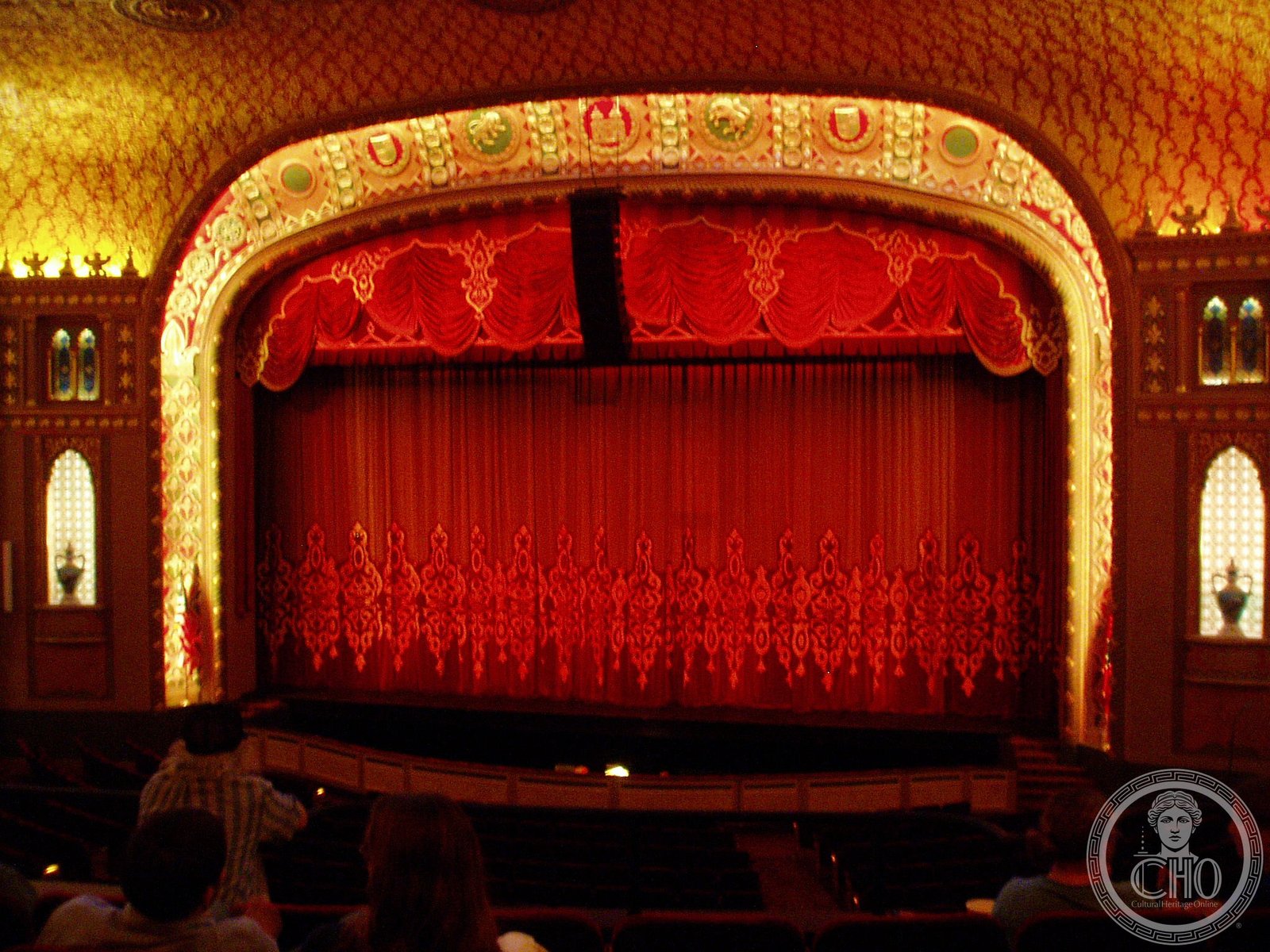
Designed in the Spanish-Moorish atmospheric tradition by the Chicago firm Graven & Mayger, the Tennessee Theatre opened in 1928 as Knoxville’s grandest entertainment palace and now serves as the city’s cultural anchor and home of the Knoxville Symphony Orchestra.
At a glance
The Tennessee Theatre opened on Gay Street in 1928, placing Knoxville on the circuit of grand movie palaces then radiating outward from Chicago and New York to every significant American city. The Chicago architects Graven & Mayger — who also designed major theatres in the Midwest — filled the auditorium with Moorish arches, Arabesque plasterwork and a painted dome that simulates an open Mediterranean sky at dusk. Audiences seated beneath that ceiling could forget that they were in a Tennessee coal town and imagine themselves in a Moorish courtyard, which was precisely the point of the atmospheric style. The building has survived near-demolition, Depression-era programming changes and the suburban flight of the postwar years; today it is operated by the Tennessee Theatre Foundation and hosts the Knoxville Symphony Orchestra, Knoxville Opera and a busy calendar of live events.
Key facts
- Opened: 1928, Knoxville, Tennessee
- Architects: Graven & Mayger, Chicago
- Style: Spanish-Moorish atmospheric — painted dome, Arabesque plasterwork, horseshoe arches
- Capacity: approximately 1,600 seats
- Address: 604 S Gay Street, Knoxville, TN 37902
- GPS: 35.9668°N, 83.9207°W
- Status: National Register of Historic Places; Tennessee State Historic Landmark; active cultural venue
History
Knoxville in the mid-1920s was a prosperous commercial city, enriched by the coal and textile trades of the broader Appalachian region, and its downtown business corridor on Gay Street competed successfully with those of Nashville and Chattanooga for department stores, banks and entertainment venues. The Tennessee Theatre arrived near the top of that prosperity curve, opening as one of the most ornate buildings the city had ever seen.
The atmospheric style that Graven & Mayger applied here was pioneered by John Eberson, who argued that audiences would pay more for the experience of sitting beneath a sky — painted clouds, twinkling projected stars — than beneath a conventional ceiling. The Tennessee’s dome reproduced this effect within a specifically Moorish architectural vocabulary: horseshoe arches, intricate tile patterns and plaster muqarnas translated the Alhambra into a Gay Street entertainment palace.
The arrival of talking pictures in the late 1920s, followed by the Depression, changed the economics of the theatre business across the country, and the Tennessee was not immune. It survived by adapting its programming, shifting toward touring shows and community events as single-screen movie palaces gave way to multiplex suburban cinemas. A preservation campaign in the 1990s led to the formation of the Tennessee Theatre Foundation, which now operates the building and completed a restoration that returned the dome, plasterwork and original Mighty Wurlitzer organ to active life.
What you see
The Gay Street facade is a restrained Spanish Renaissance composition in brick and terra cotta, with a pair of octagonal towers flanking the central entrance marquee. Inside, the lobby transitions immediately into the atmospheric world: painted columns with Moorish capitals, inlaid tilework in amber and cobalt, and plaster screens that simulate a Moorish garden wall. The auditorium itself is the revelation. The walls are articulated as an open courtyard facade — balconied windows, climbing vines rendered in plaster, wrought-iron lanterns suspended at intervals — while the ceiling above is the Spanish sky, painted in the warm deep blue of a Mediter-ranean evening, scattered with stars. The dome at the centre is surrounded by low plaster battlements, completing the illusion that the audience is seated outdoors within a palace courtyard.
The Mighty Wurlitzer theatre pipe organ — one of the instruments that accompanied silent-film screenings in the 1920s — was restored along with the theatre and is still played at select performances. Box seating is arranged in two tiers along the side walls, framed by Moorish arches whose carved plaster capitals are among the most detailed in the building.
Practical information
- Access: 604 S Gay Street, Knoxville TN 37902 — in the heart of downtown Knoxville, between Clinch and Union Avenues
- Tours: the Tennessee Theatre Foundation offers occasional public tours; check the theatre website for dates
- Events: Knoxville Symphony Orchestra concerts, Knoxville Opera productions, touring Broadway, film screenings and live music
- Parking: public garages on Gay Street and adjacent State Street; metered street parking
- Time needed: 1 hour for a lobby visit or guided tour; 2.5–3.5 hours for an evening performance
Getting there
The Tennessee Theatre sits at the centre of Knoxville’s downtown strip on Gay Street, two blocks from Market Square. McGhee Tyson Airport (TYS) is approximately 13 miles south via I-75 and I-140 — 20–25 minutes by car or rideshare. Knoxville is on the I-40 corridor linking it to Nashville (180 miles west) and Asheville NC (115 miles east); the Gay Street exit deposits arrivals within walking distance of the theatre. The University of Tennessee campus is 10 minutes on foot west of Gay Street across the Tennessee River via the Gay Street Bridge.
Nearby
- Market Square — Knoxville’s pedestrianised town square and farmers’ market, two blocks west on Market Street; the social heart of downtown.
- Museum of Appalachia — Comprehensive folk history museum 12 miles north in Norris, Tennessee — Tennessee’s most significant cultural heritage site outside the urban core.
- Sunsphere (1982) — The gold-glazed geodesic globe built for the 1982 World’s Fair, visible from Gay Street, 5 minutes by foot west of the theatre.
- Old City — Knoxville’s restored Victorian-era commercial district, two blocks east of Gay Street, now home to restaurants, galleries and music venues.
Sources
- Tennessee Theatre Foundation official site — history, restoration and events
- National Register of Historic Places nomination, Tennessee Theatre, Knoxville
- Ben Hall, The Best Remaining Seats: The Golden Age of the Movie Palace (1961)
- Knoxville News Sentinel archives — opening week coverage and restoration reporting
- Historic American Buildings Survey (HABS) documentation, Tennessee Theatre
Find it on the map
See this place and what’s around it →📷 Become a Cultural Heritage Online photographer
Share your photos of places: they stay published under your name as the author. The more they're seen, the more you get noticed — and soon a contest will reward the most appreciated photos.
Log in or sign up free to add a photoIs this page about you?
This page is read by travellers and heritage enthusiasts who find it on Google. Tell us how you are connected to this place and we will take it from there.