
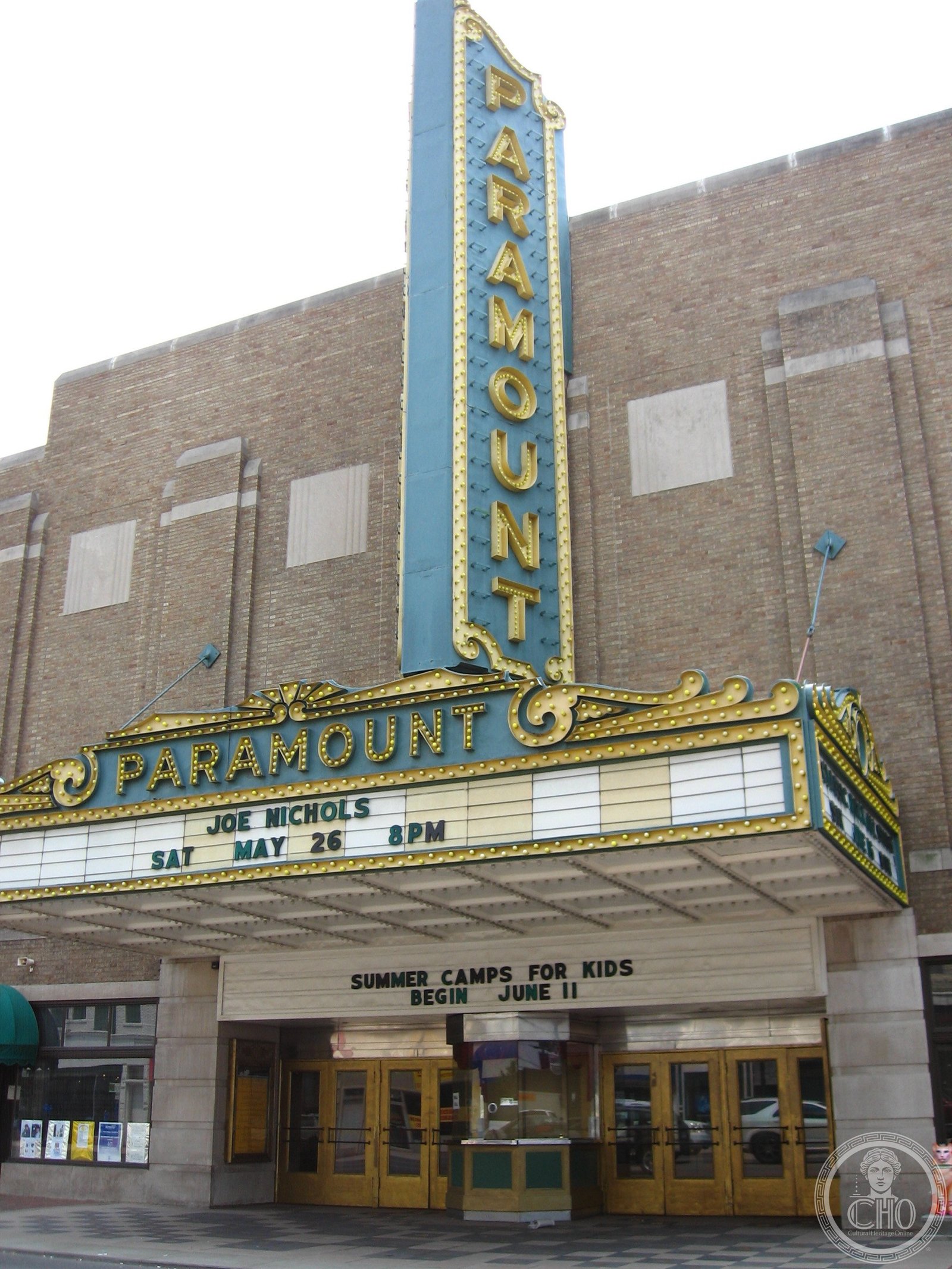
Opened in 1931 on Winchester Avenue in Ashland, Kentucky’s primary commercial artery, the Paramount Arts Centre has served the Tri-State area — where Kentucky, Ohio, and West Virginia converge at the confluence of the Ohio and Big Sandy rivers — as the region’s principal performing arts venue for nearly a century.
At a glance
Ashland occupies a distinctive geographic position: it sits at the northeastern corner of Kentucky, where the state’s border with Ohio and West Virginia forms at the Ohio River. The economy that built Winchester Avenue and supported a major Art Deco theater in 1931 was the industrial economy of the Tri-State region: Ashland Oil, Armco Steel, and the industrial infrastructure that had grown up along the Ohio River corridor in the late nineteenth and early twentieth centuries. The Paramount opened in the Depression’s first year, a timing that underlines the commitment the building represents — a substantial Art Deco cinema in a small industrial city is a statement of ambition and cultural identity, not merely a commercial calculation. The building has operated as a performing arts center since the decline of its original cinema role, hosting Broadway touring productions, concerts, and community cultural events for the communities of Boyd County, Kentucky and the neighboring counties of Lawrence County, Ohio and Cabell and Wayne Counties in West Virginia.
Key facts
- Built: 1931
- Style: Art Deco
- Address: 1300 Winchester Avenue, Ashland, Kentucky 41101
- Region: Tri-State area (Kentucky, Ohio, West Virginia)
- Current use: Performing arts center — Broadway tours, concerts, community events
- GPS: 38.4783° N, −82.6379° W
History
Ashland was founded in the 1850s and named for Henry Clay’s estate outside Lexington, a gesture toward Kentucky identity in a city that was economically and geographically oriented toward the Ohio River system rather than the Bluegrass heartland. By the 1920s, Ashland Oil — founded in 1924 and headquartered in the city — and the steel industry had made the Tri-State region a significant industrial corridor, with a population large enough to support the kind of downtown entertainment infrastructure that mid-sized American cities built during the 1920s and early 1930s.
The Paramount’s opening in 1931 placed it in the first generation of sound-film cinemas — the conversion to talkies had happened in 1927-1929, and the theaters built or renovated in the early 1930s were designed from the outset for the new technology. The Art Deco styling was the standard vocabulary of the period’s entertainment architecture, applied here with a consistency of detail that suited the ambitions of a city that measured itself against the larger industrial cities of the Ohio Valley.
The subsequent decades followed the familiar trajectory of American urban cinemas: first-run house through the golden age, competition from suburban theaters and television, and eventually conversion to a performing arts venue. The Paramount Arts Centre role was established in the late twentieth century as the building found a second life as the region’s primary professional performance space.
What you see
The Paramount facade on Winchester Avenue is a coherent Art Deco composition in brick and terracotta: the vertical display of the theater’s name, the horizontal banding and geometric ornament above the entrance, and the proportions of the entrance canopy that announce a building designed for pedestrian engagement at street level. The entrance vestibule preserves elements of the original cinema design; the auditorium has been adapted for live performance use while retaining the spatial volume of the original single-screen house.
Winchester Avenue in 1931 would have been the commercial spine of Ashland’s downtown; the Paramount’s placement on this street signaled the cinema’s role as a civic institution as much as an entertainment business. The building’s survival on this street marks the continuity between the industrial Ashland that built it and the post-industrial Ashland that maintains it.
Practical information
- Events: Broadway touring productions, concerts, community events; check the Paramount Arts Centre calendar
- Tickets: available online and at the box office
- Parking: street parking on Winchester Avenue; city parking lots within walking distance
- Time needed: allow time for the performance plus a walk along Winchester Avenue’s historic commercial blocks
Getting there
Tri-State Airport (KHTS) in Huntington, West Virginia is approximately 18 miles northeast via US Route 60; the airport connects to Charlotte, Atlanta, and Washington Dulles. Ashland is accessible from Interstate 64 at the US Route 23 interchange; US-23 serves as the principal north-south corridor connecting Ashland to the Kentucky interior. The Ohio River here forms the Kentucky-Ohio border; Ironton, Ohio is immediately across the river, connected by the Oakley C. Collins Memorial Bridge.
Nearby
- Huntington, West Virginia — the Tri-State area’s largest city, approximately 20 miles northeast; home to the Keith-Albee Performing Arts Center (1928) and Marshall University
- Central Park, Ashland — a large municipal park in the center of Ashland’s residential district, with a restored bandstand and seasonal events; 1 mile southwest of the theater
- Carter Caves State Resort Park — a 2,000-acre park in the Knobs region of Kentucky with extensive cave systems; approximately 35 miles southwest via US Route 60
- Catlettsburg, Kentucky — the oldest incorporated city in eastern Kentucky (1848) and an Ashland Oil historical site; 5 miles northwest at the confluence of the Big Sandy River and the Ohio
Sources
- Paramount Arts Centre, Ashland — operating history and programming
- Boyd County Historical Society — Ashland commercial and industrial history
- Kentucky Heritage Council — eastern Kentucky architectural surveys
- Ashland Area Convention and Visitors Bureau — Tri-State regional documentation
- Wikimedia Commons — building image
Find it on the map
See this place and what’s around it →Record researched and written by Luigi De Marchi for Cultural Heritage Online, 2026.
📷 Become a Cultural Heritage Online photographer
Share your photos of places: they stay published under your name as the author. The more they're seen, the more you get noticed — and soon a contest will reward the most appreciated photos.
Log in or sign up free to add a photoIs this page about you?
This page is read by travellers and heritage enthusiasts who find it on Google. Tell us how you are connected to this place and we will take it from there.