
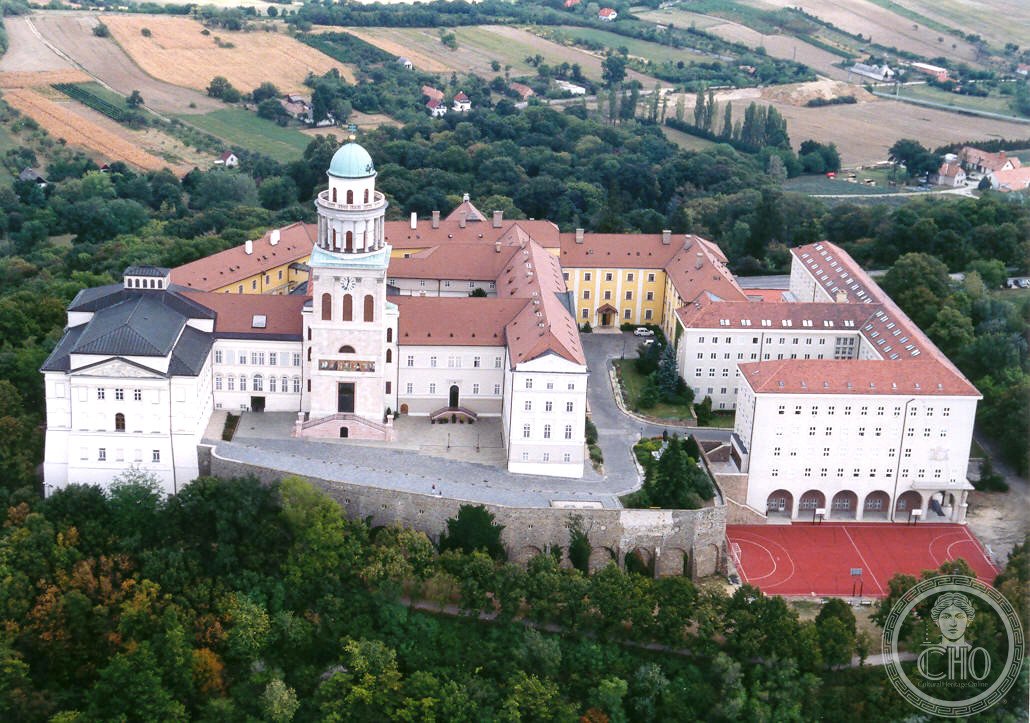
On the Sacred Hill (Mons Sacer) of Pannonia, 282 metres above the Hungarian plain, Pannonhalma Archabbey holds a thousand unbroken years of Benedictine monastic life. Founded in 996 — the year the Hungarian state was born — by Saint Stephen I and his father, Duke Géza, it is among the oldest monasteries still living in Central Europe, a UNESCO site since 1996 together with its natural surroundings. It keeps a library of 300,000 volumes and a school that has taught since 1055.
At a glance
Pannonhalma Archabbey (Pannonhalmi Főapátság) is a Benedictine monastery on Sacred Hill (Mons Sacer) in Győr-Moson-Sopron county, western Hungary. Founded in 996 AD under Prince Géza and his son Stephen (later King Stephen I, the first king of Hungary), it is one of the oldest continuously inhabited monastic sites in Central Europe. The complex grew through the medieval and baroque periods and today includes a Romanesque-Gothic basilica (the oldest surviving building in Hungary still in its original state), a cloister, and a remarkable library of over 300,000 volumes dating from the 9th century. UNESCO inscribed Pannonhalma and its natural environment in 1996.
Key facts
- UNESCO: World Heritage since 1996 (Millenary Benedictine Abbey of Pannonhalma and its Natural Environment, ref. 758)
- Founded: 996 AD by Prince Géza and Stephen I of Hungary
- Library: over 300,000 volumes; includes 9th–10th-century manuscripts and the 1055 Deed of Foundation of Tihany Abbey (the oldest document with Hungarian words)
- Basilica: Romanesque-Gothic; the crypt dates to the 11th century
- Still active: c. 60 Benedictine monks; the abbey runs a school founded 1055 CE
- Height: 282 m above sea level on Sacred Hill; visible across the Pannonian Plain
History
Hungary’s Christianisation is inseparable from Pannonhalma. Around 996, Prince Géza invited Benedictine monks from the Prague monastery of St. Martin and granted them the “Sacred Hill” in Pannonia. His son, later King Stephen I (r. 1000–1038), completed the foundation and made Pannonhalma the spiritual and intellectual centre of the emerging Hungarian kingdom. The monastery’s scriptorium produced the Deed of Foundation of Tihany Abbey (1055), the oldest document containing Hungarian words — a milestone in Hungarian literacy.
The abbey survived the Mongol invasion of 1241 (taking refuge behind its walls), the Ottoman conquest of most of Hungary in the 16th–17th centuries, and the dissolution of monasteries under Emperor Joseph II (suppressed 1786, restored 1802). The present complex reflects continuous building from the 11th to the 19th century: Romanesque crypt, Gothic cloister, baroque towers and a neoclassical library completed in 1825. The abbey school, uninterrupted since 1055, is one of the oldest in the world still in operation.
What you see
The visible complex, crowning the hill like an acropolis, is dominated by the 13th-century Gothic south tower and the baroque north tower. Inside: a Gothic basilica with a Romanesque crypt (c. 1055) and an 11th-century door frame. The cloister connects the church to the library hall — a neoclassical space of extraordinary elegance filled with illuminated manuscripts, incunabula and Reformation-era pamphlets. A visitors’ route takes in the basilica, cloister, library and treasury; the monks’ quarters are off limits.
The surrounding UNESCO buffer zone encompasses terraced vineyards on the hillside (the abbey produces wine from its own grapes), orchards and a small lake — a classic Central European monastery landscape.
Practical information
- Hours: open daily to visitors (except during services); guided tours in Hungarian and English
- Library: included in the guided tour; no individual browsing of manuscripts
- Winery: the abbey winery offers tastings; wine shop on site
- Best time: year-round; summer and early autumn for vineyards; Christmas for the decorated basilica
Getting there
Pannonhalma is 21 km south-east of Győr by road (Route 82). From Budapest, take the M1 motorway to Győr (130 km) then head south. Local bus runs from Győr bus station. GPS: 47.55° N, 17.76° E.
Nearby
- Győr — the nearby Baroque city with its own historic centre, cathedral and bishop’s palace, 21 km north
- Fertő/Neusiedlersee Cultural Landscape (UNESCO) — the shared Hungarian-Austrian lake landscape, 60 km north-west
- Visegrád and the Danube Bend — medieval royal palace and dramatic river gorge, 90 km east
Sources
- UNESCO World Heritage Centre — “Millenary Benedictine Abbey of Pannonhalma and its Natural Environment” (ref. 758)
- Encyclopaedia Britannica — Pannonhalma Abbey
- Official abbey website — bences.hu
Find it on the map
See this place and what’s around it →
📷 Become a Cultural Heritage Online photographer
Share your photos of places: they stay published under your name as the author. The more they're seen, the more you get noticed — and soon a contest will reward the most appreciated photos.
Log in or sign up free to add a photoIs this page about you?
This page is read by travellers and heritage enthusiasts who find it on Google. Tell us how you are connected to this place and we will take it from there.