
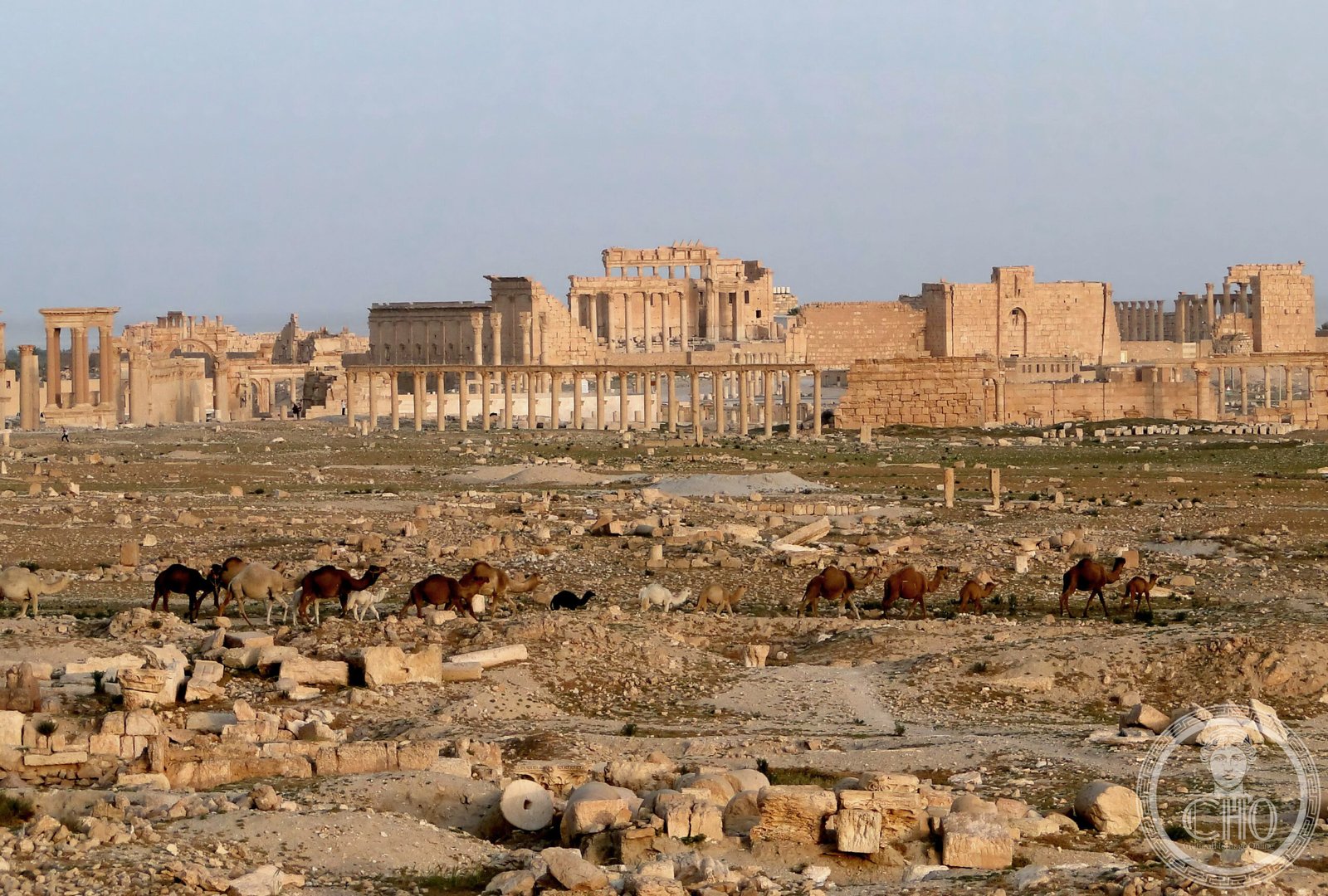
For two thousand years Palmyra was the place where Rome met Persia — a desert oasis that turned the Silk Road into stone colonnades and carved tomb towers. In 2015, it was attacked again.
At a glance
Palmyra (Tadmor in Aramaic) stands 215 kilometres northeast of Damascus in the Syrian desert, at the edge of an oasis fed by the Efqa spring. For roughly four centuries it served as the indispensable transit point between the Mediterranean world and the trade routes running east toward Parthia, Persia, and Central Asia. Its merchants built a city of Greco-Roman colonnades, Mesopotamian tower tombs, and hybrid temples that belonged fully to neither world — an architecture that could only have been invented here, where the westbound caravans stopped to rest and pay their dues.
History
Palmyra enters written record in the early second millennium BC as Tadmar. By the 1st century AD it was a Roman province, formally annexed under Tiberius, yet it operated with substantial autonomy — the Palmyrenes collected their own tolls and governed their own trade guilds. The city grew rich on the differential between what goods cost in the east and what the Roman market would pay. Its merchants are documented from Roman Britain to the Persian Gulf.
The defining episode came in 260 AD, when King Odaenathus — a Palmyrene nobleman allied with Rome — defeated the Sasanian emperor Shapur I after his capture of the Roman emperor Valerian, a humiliation Rome could not avenge. Odaenathus was assassinated in 268, and his widow Queen Zenobia assumed power as regent for their son. She did not govern quietly. By 270 she had conquered Egypt and much of Asia Minor, declaring independence from Rome and styling herself “Queen of the East.” Emperor Aurelian marched east in 272 and defeated her forces at Immae; Palmyra was sacked, and Zenobia was taken to Rome. A subsequent Palmyrene revolt prompted Aurelian to raze the city more thoroughly. Emperor Diocletian later rebuilt it at reduced scale as a frontier garrison. The temples were converted to churches, then to mosques after the 7th-century Arab conquest. Timur’s forces destroyed it again in 1400.
In 2015, fighters of the Islamic State captured Palmyra. Their campaign against the site was methodical. The Temple of Bel, a 1st-century AD structure that combined a Mesopotamian cella with a Greco-Roman colonnade peristyle, was demolished with explosives in August 2015. The Temple of Baalshamin, dedicated to the Phoenician sky god, was destroyed weeks later. The Arch of Triumph was blown up in October. Khaled al-Asaad, who had served as director of the Palmyra Museum and head of antiquities for 40 years, was captured, detained, and interrogated for weeks about the locations of artefacts he had helped evacuate before the city fell. He knew where things were hidden. He refused to say. On 18 August 2015, aged 82, he was publicly beheaded in the main square. His body was hung from a column. The antiquities he had protected were not found. He is buried in Palmyra.
Syrian government forces retook the city in March 2016, only for ISIS to recapture it briefly in December of that year. Government forces held it again from March 2017. Subsequent political changes brought further military transitions; the Syrian Free Army entered in December 2024. UNESCO and international teams conducted damage assessments throughout. The arch was partly reconstructed in digital and physical replicas by the Institute for Digital Archaeology, displayed in London, New York, and Dubai. The Temple of Bel and Temple of Baalshamin no longer exist.
What you see
The Great Colonnade stretches 1.2 kilometres from the monumental arch westward to the Camp of Diocletian. Corinthian columns line both sides; many still stand, some with the corbels that once supported bronze portrait statues of the merchants who paid for them. The Temple of Bel precinct survives in damaged form — the outer walls stand, the inner sanctuary is destroyed. The ancient theatre, partially reconstructed in the 1950s, remains. The Valley of the Tombs west of the city contains the tower tombs unique to Palmyra: four-storey structures with burial loculi stacked in the walls, each family’s dead arranged above one another in the Syrian desert light. The funerary portrait busts that once sealed each niche — haunting stone faces, painted and sculpted with remarkable individuality — are the objects ISIS most systematically looted for the international antiquities market.
Key facts
- Location: Tadmur, central Syria, 34.55°N 38.27°E — Google Maps
- Period: 2nd century BC – 3rd century AD at peak; occupied from Neolithic onward
- UNESCO WHS: 1980 (status: endangered)
- Key structures destroyed 2015–2016: Temple of Bel, Temple of Baalshamin, Arch of Triumph
- Khaled al-Asaad: Director of Palmyra antiquities 1963–2003; killed 18 August 2015
- Queen Zenobia’s reign: 268–272 AD (as regent); defeated by Aurelian 272
- The Great Colonnade: 1.2 km; Corinthian order; 1st–3rd century AD
- The Temple of Bel: Dedicated 32 AD; one of the best-preserved temples in the Near East before 2015
Practical information
- Access to Palmyra remains restricted and unpredictable; check current travel advisories before any visit
- The site is in the Syrian desert; summer temperatures exceed 40°C; spring and autumn are more viable
- The modern town of Tadmur, relocated in 1932 from within the ancient site, lies adjacent to the ruins
- The Palmyra Museum held major collections of portrait busts and funerary sculpture; collection status post-2015 is partially unclear
Getting there
Palmyra lies 215 km northeast of Damascus on the road to Deir ez-Zor. Pre-conflict, the drive from Damascus took 3–4 hours; bus services ran regularly. The nearest airport is Damascus International. Given current conditions, travel to the area requires direct consultation with current advisories and, if possible, local guides familiar with road access.
Nearby
- Qasr al-Hayr al-Gharbi — Umayyad desert castle 80 km west; frescoes and mosaics now in the Damascus National Museum
- Apamea — another Roman colonnaded city in western Syria; its great cardo ran 1.85 km
- Deir Mar Musa al-Habashi — 6th-century monastery in the Anti-Lebanon mountains, northeast of Damascus, with remarkable Byzantine frescoes
Sources
Find it on the map
See this place and what’s around it →📷 Become a Cultural Heritage Online photographer
Share your photos of places: they stay published under your name as the author. The more they're seen, the more you get noticed — and soon a contest will reward the most appreciated photos.
Log in or sign up free to add a photo