
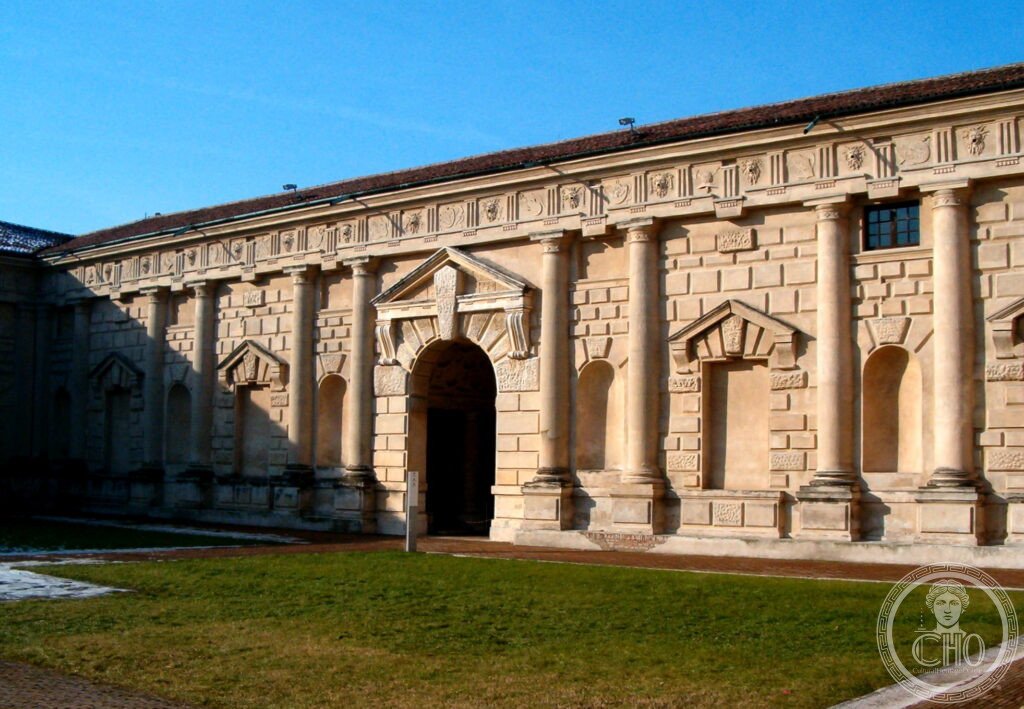
The most subversive building of the Italian Renaissance — a “pleasure palace” built for Federico II Gonzaga by Giulio Romano between 1524 and 1535, whose every facade breaks the classical rules it cites, and whose Camera dei Giganti is a room designed to terrify the visitor with painted walls that appear to collapse inward.
At a glance
Palazzo Te stands on an artificial island at the south edge of Mantova, connected to the city by a causeway — a suburban retreat separate from the Palazzo Ducale in the city centre, intended for leisure, equestrian activities, and the entertainment of distinguished guests. Federico II Gonzaga commissioned it for his favourite mistress, Isabella Boschetti, and as a training stables for his celebrated horses; the programme of fresco decoration that Giulio Romano (c. 1499–1546) designed and in large part executed is a sustained exercise in wit, erudition, and deliberate transgression of Renaissance decorum.
The building is part of the UNESCO “Mantova e Sabbioneta” inscription (2008, ref. 1287), which recognises both cities as the creation of the Gonzaga family — Mantova the ancient seat, Sabbioneta (40 km south-west) the ideal Renaissance new town built by Vespasiano Gonzaga from 1556. Palazzo Te is among the most important Mannerist buildings in existence and one of the few Italian princely pleasure houses to survive substantially intact.
Key facts
- Architect: Giulio Romano (c. 1499–1546), former assistant to Raphael
- Construction: 1524–1535, for Federico II Gonzaga, fifth Marquis of Mantua
- Key rooms: Camera dei Giganti (Room of the Giants), Camera di Psiche (Room of Psyche), Camera delle Aquile (Room of the Eagles)
- UNESCO inscription: 2008, ref. 1287 — “Mantova e Sabbioneta”
- Current use: Museum and exhibition space (Civici Musei di Palazzo Te)
- GPS: 45.1394, 10.7806 — Google Maps
History
Giulio Romano arrived in Mantova in 1524, called by Federico II Gonzaga after the death of his master Raphael in 1520. He had worked in Raphael’s studio since youth and had inherited a significant portion of the workshop’s preparatory drawings; he was arguably the most technically complete Italian painter of his generation. Federico gave him carte blanche to design a new pleasure house on the island of the Teieto, south of the city, where the Gonzaga kept their stables.
The architecture of Palazzo Te is a sustained provocation. Romano used the vocabulary of Bramante’s High Renaissance — pilasters, triglyphs, keystones, pediments — but deployed it in ways that make the eye uncertain: triglyphs that appear to slide out of their friezes, keystones that seem to be falling from arches, rustication applied to surfaces where smoothness is expected. This is Mannerism in its precise etymological sense — an art of maniera, of wilful style, in which the violation of the rule is the point. The Camera dei Giganti takes this to its logical extreme: a room in which the frescoed giants of mythology are painted tumbling down walls and ceiling in an illusion that the entire architectural space is collapsing around the viewer.
The frescoes of the Camera di Psiche — the story of Psyche and Amor, drawn from Apuleius — were executed largely by Giulio Romano himself (1527–1528) and contain some of the most frank erotic imagery in Italian Renaissance painting, including a version of the banquet scene in which gods and mortals mix in explicit abandon.
What you see
The building is a single-storey square with a central courtyard garden; the rooms open off the interior loggia. The Camera dei Giganti is the terminal room of the visitor circuit and the one that has stopped every serious visitor since the sixteenth century: the walls and ceiling are entirely covered in frescoes of falling giants — the myth of the Giants’ assault on Olympus, Zeus crushing them with his thunderbolts — painted in a continuous illusion in which the architecture of the room appears to be collapsing inward and the giants’ bodies are tumbling from all sides onto the visitor. Vasari called it “the most redoubtable room in Europe.”
The Camera di Psiche contains twelve narrative scenes from the Apuleius story, the largest panels painted directly on the vault; the erotic register is sustained throughout. The Camera delle Aquile (Room of the Eagles) is the small private room where Federico received his most intimate guests; its painted ceiling with the eagle medallions is among Romano’s finest decorative work. The central courtyard garden, visible from all four loggie, preserves some of the original box parterres and has a small central fountain.
Gallery
Practical information
- Opening: Daily 9:00–18:00 (last entry 17:30); Monday from 13:00. Closed 25 December, 1 January.
- Admission: ~€12; reduced for 12–18. Combined tickets with Palazzo Ducale available.
- Museum: The Civici Musei di Palazzo Te share the building; exhibition programme varies.
- Duration: 1.5–2 hours to see the main fresco rooms; 3 hours for the museum.
- Cycling: Mantova is flat and well-cycled; bike hire available near the station; the trip from the centre to Palazzo Te is 15 minutes by bicycle.
Getting there
Palazzo Te is 15 minutes on foot from the Mantova railway station (follow Via Principe Amedeo then Via Te), or 10 minutes by bicycle. Mantova is on the Verona–Modena line (Trenitalia); 25 minutes from Verona; 30 minutes from Modena. By car: A22 exit Mantova Nord or A46 exit Mantova Ovest; the palazzo is at the southern edge of the city, clearly signed. Limited car parking around the building. From Milan: 130 km, 1h30 by car or 2h by train (change at Verona or Cremona).
Nearby
- Palazzo Ducale di Mantova — 2 km north in the city centre; Camera degli Sposi with Mantegna’s illusionistic fresco ceiling (1465–1474), one of the great masterworks of the Italian Renaissance
- Sabbioneta (UNESCO 2008) — 40 km south-west; the “little Athens” planned city of Vespasiano Gonzaga, with its Teatro Olimpico-precursor theatre and grid of palaces
- Lago di Garda — 40 km west; the most popular lake in Italy; Sirmione with the Grotte di Catullo accessible by ferry or car
Sources
- UNESCO World Heritage Centre: whc.unesco.org/en/list/1287
- Wikipedia EN: Palazzo Te
- Hartt, Frederick: Giulio Romano, 2 vols, New Haven, Yale UP, 1958
- Civici Musei di Palazzo Te: palazzote.it
Find it on the map
See this place and what’s around it →
📷 Become a Cultural Heritage Online photographer
Share your photos of places: they stay published under your name as the author. The more they're seen, the more you get noticed — and soon a contest will reward the most appreciated photos.
Log in or sign up free to add a photoIs this page about you?
This page is read by travellers and heritage enthusiasts who find it on Google. Tell us how you are connected to this place and we will take it from there.