
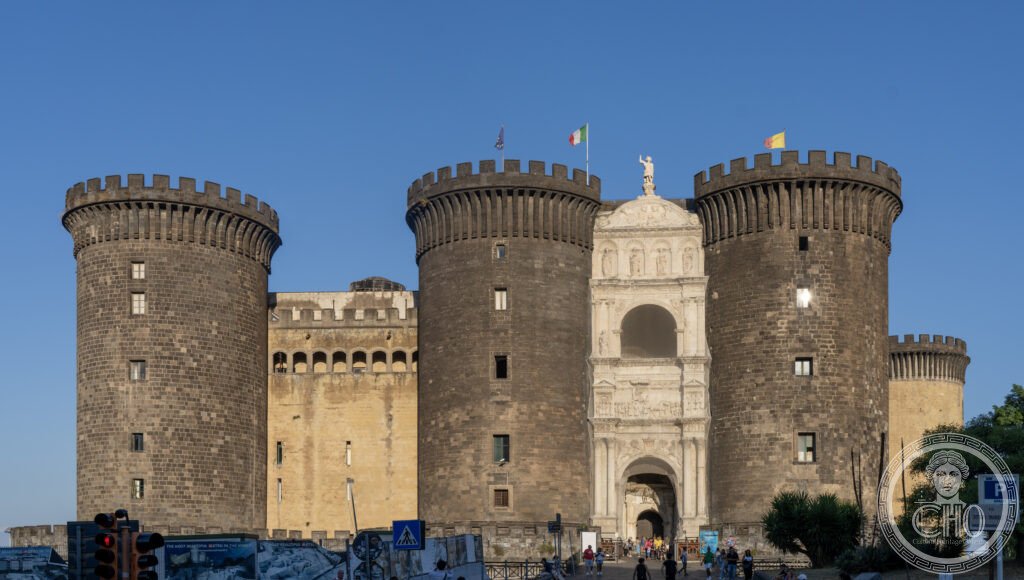
The fortress of the Angevin and Aragonese kings of Naples — five cylindrical towers on the port waterfront, built by Charles I of Anjou from 1279, whose triumphal arch inserted between two towers by Alfonso I of Aragon in 1443 is the finest early Renaissance carved arch in existence outside Rome.
At a glance
Castel Nuovo (the “New Castle,” to distinguish it from the older Castel Capuano and Castel dell’Ovo) stands on the seafront at the western edge of Naples’ historic centre, at the point where the Via Toledo reaches the port. Built from 1279 on Charles I of Anjou’s order as the new royal seat of the Angevin kingdom of Naples, it replaced the older Norman and Hohenstaufen royal residences further inland. Its five cylindrical towers, in dark volcanic tuff stone, define the Naples waterfront view and have been recognised as a landmark since the medieval period.
The building is part of the UNESCO “Historic Centre of Naples” inscription (1995, ref. 726), which encompasses the entire ancient city grid from the Greek-era decumani to the Bourbon-era parks. Castel Nuovo was the political centre of the Angevin and later Aragonese kingdom of Naples — the seat where Alfonso I of Aragon received Petrarch, where Pietro Martire d’Anghiera was hosted, and where the Aragonese cultural programme that brought classical learning to the medieval south was organised.
Key facts
- Begun: 1279, by Charles I of Anjou (first Angevin king of Naples)
- Tower configuration: Five cylindrical towers in Angevin dark tuff, c. 1279–1282
- Triumphal arch: 1443–1471, for Alfonso I of Aragon (“The Magnanimous”), earliest large marble arch of the Italian Renaissance
- Sculptors of the arch: Francesco Laurana, Pietro da Milano, Domenico Gagini (attributed workshop)
- UNESCO inscription: 1995, ref. 726 — “Historic Centre of Naples”
- GPS: 40.8362, 14.2535 — Google Maps
History
Charles I of Anjou (1226–1285), younger brother of Louis IX of France, took the kingdom of Naples from the Hohenstaufen in 1266 and immediately began constructing a new royal residence worthy of his dynastic ambitions. The site he chose — a promontory on the seafront, commanding the port and visible from incoming ships — was both strategically and symbolically dominant. The five towers, connected by curtain walls, enclosed a royal court that served as the seat of the Angevin kingdom for over a century.
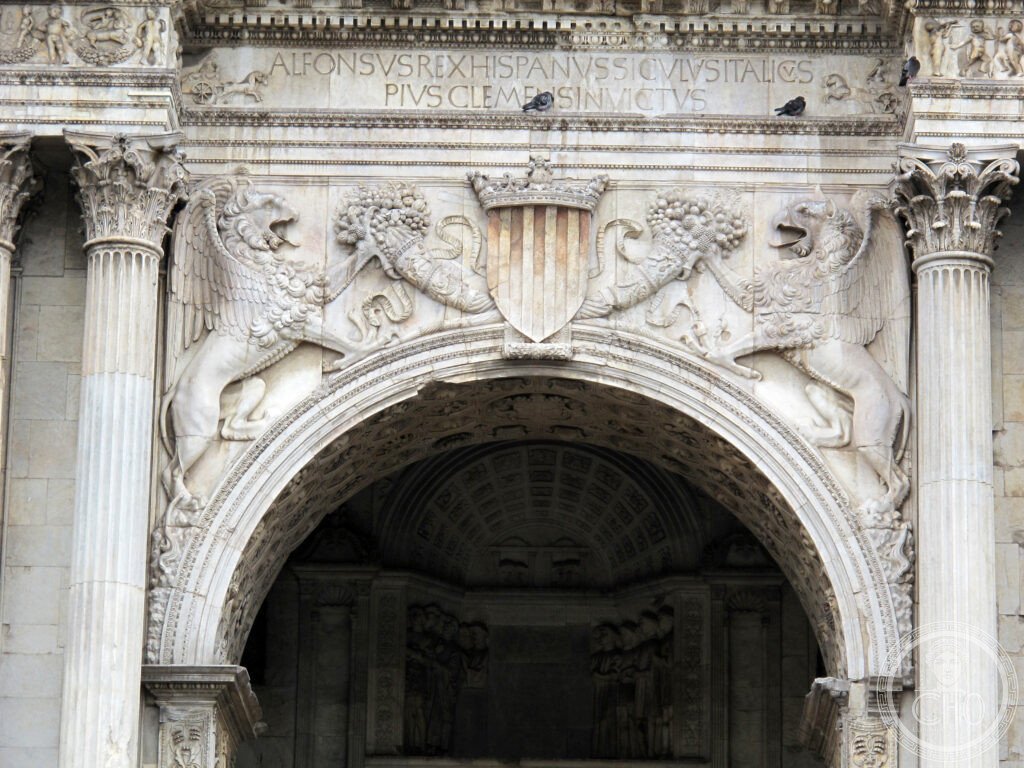
The Aragonese took Naples in 1442, when Alfonso I (“The Magnanimous”) entered the city after a twenty-year struggle against the Angevin faction. To mark his entry and legitimise his rule, Alfonso commissioned a triumphal arch to be inserted between the two central towers of Castel Nuovo — a deliberate quotation of Roman imperial triumphal arches (the Arch of Constantine, the Arch of Septimius Severus), translated into the marble carving language of the early Italian Renaissance. The arch, executed between 1443 and 1471 by a workshop including Francesco Laurana and Pietro da Milano, is the first large-scale Renaissance triumphal arch in existence and the key monument of early Aragonese Naples: its reliefs show Alfonso’s triumphal entry into Naples in 1443, with allegorical figures and classical architectural framing.
What you see
The external view of Castel Nuovo from the port or from Via Acton is one of the defining images of Naples: the mass of dark tuff towers framing the brilliant white marble of the triumphal arch between them. The contrast — rough military stonework and refined classical marble — captures precisely the historical tension between the two dynasties who built the castle and the arch.
The arch itself, when seen close up, reveals a two-register programme: in the lower arch, a relief of Alfonso’s triumphal entry on a chariot; in the upper register, Alfonso enthroned between personifications of virtues; in the flanking niches, river gods and military trophies. The sculptural quality varies across hands (the workshop attribution debates are ongoing among art historians) but several individual figures — particularly the river gods — are among the finest sculpture of their decade anywhere in Italy.
Inside, the Palatine Chapel of Santa Barbara (c. 1307, under Charles II of Anjou) preserves its Gothic structure and some fresco fragments; the museum (Museo Civico) on the upper floors has Neapolitan paintings from the fourteenth to nineteenth centuries.
Gallery
Practical information
- Opening: Monday–Saturday 9:00–19:00; Sunday 9:00–13:00. Closed major public holidays.
- Admission: ~€6; Campania Artecard includes entry.
- Duration: 1 hour for arch and museum; 1.5 hours for a thorough visit.
- Best view of the arch: From the courtyard; the external view from the port gives the full scale but the arch detail is best seen from inside the entrance gateway.
Getting there
Piazza del Municipio, facing the port of Naples. Metro: Municipio (Lines 1 and 6, new stations completed 2015, with significant Roman archaeological finds visible through glass floors). Ferry terminal is 200 m from the castle; the large Beverello terminal serves Capri, Ischia, Procida, and coastal ferry routes. On foot from Piazza del Plebiscito: 5 minutes. From Naples Centrale station: 20 minutes on foot via Piazza Garibaldi and Via Dep. Colella, or 10 minutes by Metro Line 1 Garibaldi→Municipio.
Nearby
- Piazza del Plebiscito — 5 minutes on foot; the largest square in Naples, with the Bourbon Palazzo Reale and the neoclassical San Francesco di Paola
- Via Toledo and Quartieri Spagnoli — 5 minutes; the great commercial street and the grid of Spanish-era alleyways behind it
- Museo Nazionale di San Martino — 30 minutes by cable car (Funicolare Centrale from Via Toledo); panoramic views of the city, the best collection of Neapolitan Christmas cribs, and Baroque paintings
Sources
- UNESCO Historic Centre of Naples: whc.unesco.org/en/list/726
- Wikipedia EN: Castel Nuovo
- Di Mauro, Leonardo: Castel Nuovo, Napoli, 1994
- Hersey, George: The Aragonese Arch at Naples, 1443–1475, New Haven, Yale UP, 1973
Find it on the map
See this place and what’s around it →📷 Become a Cultural Heritage Online photographer
Share your photos of places: they stay published under your name as the author. The more they're seen, the more you get noticed — and soon a contest will reward the most appreciated photos.
Log in or sign up free to add a photoIs this page about you?
This page is read by travellers and heritage enthusiasts who find it on Google. Tell us how you are connected to this place and we will take it from there.