
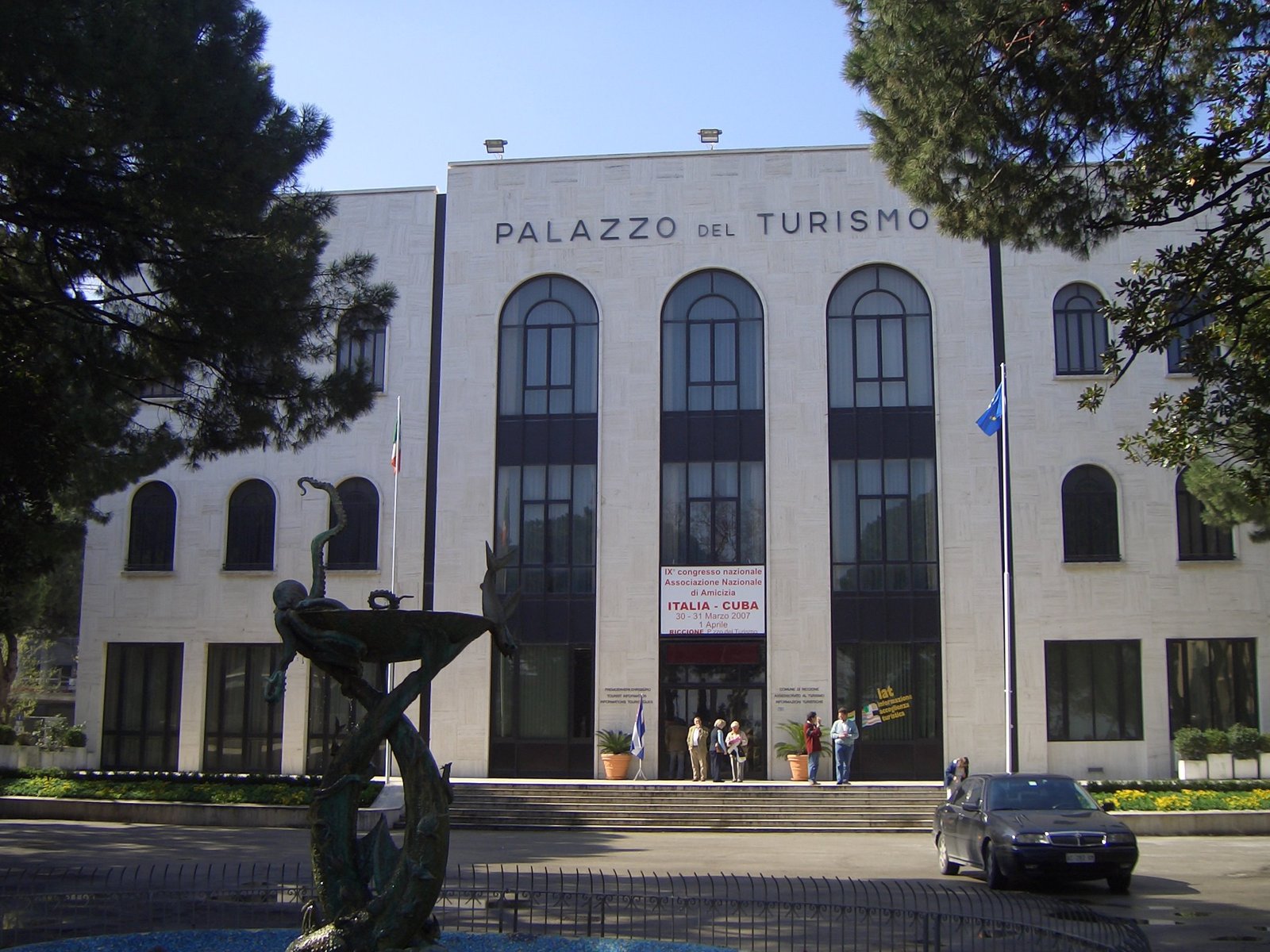
Inaugurated on 28 October 1938, the Palazzo del Turismo is widely regarded as the first building on the Adriatic Riviera conceived specifically for tourism promotion and seaside entertainment. The design is attributed to the Rimini-born surveyor and illustrator Gogliardo Ossani (1908–1984), with works directed by surveyor Carlo Piccioni. A reinforced concrete frame faced in travertine slabs, it translates the monumental language of the Italian rationalism of the late ventennio into the scale of a small coastal town, and still anchors the civic axis of Piazzale Ceccarini.
- Address
- Piazzale Ceccarini 10, 47838 Riccione (RN), Emilia-Romagna, Italy
- Period
- Designed 1937; inaugurated 28 October 1938
- Architects
- Gogliardo Ossani (1908–1984), attributed; works directed by Carlo Piccioni
- Client
- Comune di Riccione (Azienda Autonoma di Soggiorno)
- Style
- Italian Rationalism (Razionalismo italiano), late ventennio
- Function
- Originally tourism authority headquarters and entertainment hall; today a civic and congress venue hosting exhibitions, conferences and cultural events
- Structure
- Reinforced concrete frame (pilastri e travi in cemento armato), infill masonry, travertine cladding
- Status
- Protected by binding decree, under the Soprintendenza Archeologia, Belle Arti e Paesaggio per le province di Ravenna, Forlì-Cesena e Rimini
- Coordinates
- 44.0027° N, 12.6575° E
Visit on the map
Piazzale Ceccarini 10, 47838 Riccione (RN) · 44.0027° N, 12.6575° E
Download for your navigator
A single waypoint, ready for GPS apps, navigators, and contacts.
Story
The Palazzo del Turismo was commissioned in the late 1930s by the Azienda Autonoma di Soggiorno of Riccione, the municipal tourist authority that, since the town’s separation from Rimini in 1922, had been investing in the infrastructure of a planned bathing resort. The site chosen was the head of Viale Ceccarini, the tree-lined boulevard linking the railway station to the sea, and the building was designed to close that axis with a civic landmark visible from both ends. The project, drawn by surveyor Carlo Piccioni with facades and decorative scheme attributed to Gogliardo Ossani, was approved in 1937 and the works completed in time for the official inauguration on 28 October 1938. Beyond housing the tourist office, the programme included a large multi-purpose hall for concerts, conferences and dances, betting on entertainment as a year-round draw and not only a summer accessory.
Architecturally, the palazzo is one of the clearest provincial declensions of late Italian rationalism on the Adriatic coast. The structure is a reinforced concrete frame of pillars and beams, infilled with masonry and then dressed in regular slabs of travertine, the stone that the regime had elevated to a quasi-official material after the Roman precedents of the Palazzo delle Esposizioni and EUR. The street front is organised as a long horizontal block with a clear base, a piano nobile marked by a regular rhythm of openings, and a stripped cornice; the central body steps forward to define a portico and frame the entrance. Decoration is reduced to the essential: incised lettering, low-relief signage, simple metal grilles. The vocabulary is austere, monumental in proportion rather than in mass, and intentionally legible against the open sky of the seafront.
After the Second World War the building was retained by the municipality and progressively re-tooled for civic use. Restorations through the late twentieth and early twenty-first century have preserved the travertine envelope while modernising the interior halls, today employed for congresses, exhibitions, public ceremonies and the cultural calendar of the Comune di Riccione. The Palazzo is protected by binding decree under the Soprintendenza Archeologia, Belle Arti e Paesaggio for the provinces of Ravenna, Forlì-Cesena and Rimini, which monitors any intervention on facades and primary spaces. It remains, with the contemporary colonie scattered along the coast between Cattolica and Milano Marittima, one of the principal documents of the rationalist season on the Romagna Riviera.
Resources & References
Editorial picks across institutional catalogues, photo archives, and municipal sources.
Find it on the map
See this place and what’s around it →Record researched and written by Stefano Vigolo for Cultural Heritage Online, 2026.
📷 Become a Cultural Heritage Online photographer
Share your photos of places: they stay published under your name as the author. The more they're seen, the more you get noticed — and soon a contest will reward the most appreciated photos.
Log in or sign up free to add a photoIs this page about you?
This page is read by travellers and heritage enthusiasts who find it on Google. Tell us how you are connected to this place and we will take it from there.