
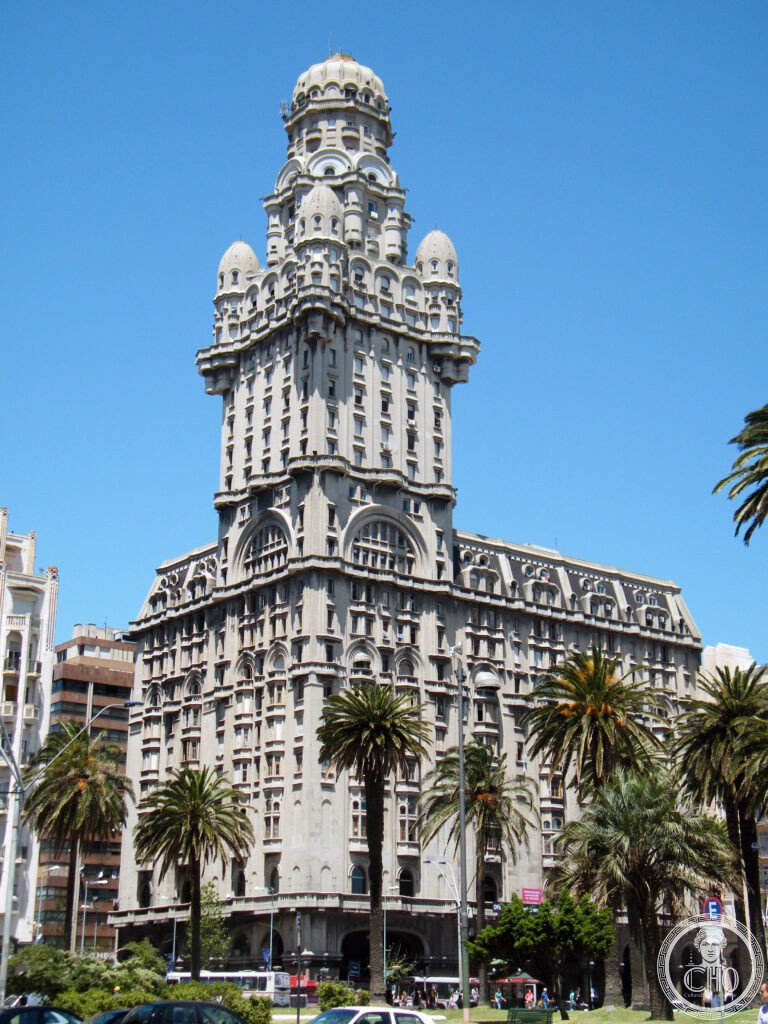
When it opened in 1928, the Palacio Salvo was the tallest building in South America — Mario Palanti’s 27-storey eclectic tower rising above Montevideo’s central square with the same ambition and Dante-influenced symbolism he had expressed five years earlier in Buenos Aires’ Palacio Barolo.
At a glance
The Palacio Salvo stands at the intersection of Avenida 18 de Julio and Plaza Independencia in the Centro neighbourhood of Montevideo, Uruguay — the principal square of the city and the meeting point of its two main thoroughfares. Commissioned by the Salvo brothers (Ángel, José, and Lorenzo), a family of Catalan-Uruguayan businessmen, and designed by the Italian-Argentine architect Mario Palanti, it was built between 1922 and 1928. For several years after its completion it was the tallest building in South America. Palanti had already built the Palacio Barolo in Buenos Aires (1923) on a similar programme; the Salvo became its counterpart across the Río de la Plata estuary. The building is now one of the most recognised silhouettes in Uruguayan urban history.
Key facts
- Architect: Mario Palanti (Italian-Argentine)
- Commissioned by: Ángel, José and Lorenzo Salvo (businessmen)
- Built: 1922–1928
- Height: 27 storeys (approximately 100 m to the top of the tower)
- Style: Eclectic (Gothic, Romanesque, Art Nouveau, Renaissance elements)
- Location: 18 de Julio 1474 / Plaza Independencia, Centro, Montevideo
- GPS: −34.9067, −56.1983 — Google Maps
- Status: Mixed-use (offices, residential, restaurant, hotel)
History
Mario Palanti arrived in Buenos Aires in 1907 as a young Italian architect and found his career in the grand commission. His Palacio Barolo, built between 1919 and 1923, expressed a complex symbolic programme derived from Dante’s Divina Commedia — the building’s height (100 metres, 100 cantos), its tripartite organisation (Inferno/Purgatory/Paradise), and its culminating lighthouse tower designed so that its beam would be visible across the estuary from a corresponding building in Montevideo. That corresponding building became the Palacio Salvo.
The Salvo brothers, wealthy Catalan-Uruguayan entrepreneurs, commissioned Palanti in 1922 to design a mixed-use tower at the most prominent corner in Montevideo. The programme was ambitious: hotel rooms, offices, apartments, and commercial space stacked in 27 storeys above a double-height street-level arcade. Palanti developed a design that reprised the eclectic ornamental language of the Barolo — Gothic arches, Romanesque columns, Art Nouveau botanical relief panels, and a central tower that read as a lighthouse from the Río de la Plata — scaled and adapted to a different site and a different civic register.
Construction was completed in 1928, and for several years the Palacio Salvo was the tallest building on the continent. It has since been surpassed many times over, but it remains Montevideo’s most iconic skyline element and one of the most photographed buildings in Uruguay. Various uses have occupied its floors over the decades: hotel, offices, residential apartments, and since the 2000s, a renovated hotel at its upper levels.
What you see
From Plaza Independencia, the Palacio Salvo presents a vertical composition of extraordinary ornamental density: the lower storeys open to the street through arched arcades whose Gothic tracery frames commercial activity, while the upper floors accumulate in a succession of set-backs, balconies, corner turrets, and carved relief panels of botanical and figural motifs. The transition from the orthogonal lower block to the octagonal tower above the twentieth floor is handled through a series of sculptural acroteria and corner pavilions that give the building its characteristic silhouette at any distance.
The central tower — an octagonal lantern that crowns the building — was designed with a lighthouse in mind, and at night its illumination makes it visible from the Río de la Plata. The ornamental language throughout alternates between Gothic pointed arches, Romanesque rounded arches, and Art Nouveau sinuous relief panels — a deliberately eclectic vocabulary that was Palanti’s personal version of the decorated skyscraper.
Practical information
- The ground floor arcade and entrance hall are accessible during business hours.
- The building contains a hotel, offices, and apartments; hotel guests have access to the upper floors and views over the Río de la Plata.
- The exterior is best seen from the centre of Plaza Independencia, looking north.
- A statue of José Gervasio Artigas (the national hero) stands in the centre of the plaza directly in front of the building.
Getting there
The Palacio Salvo is on Plaza Independencia at the end of Avenida 18 de Julio, in central Montevideo. The plaza is accessible by bus from the main bus terminal (Terminal de Omnibus, 3 km north) and by bus and taxi from Carrasco International Airport (MVD, 20 km east). The historic Ciudad Vieja neighbourhood begins just west of the plaza.
Nearby
- Plaza Independencia — the central civic square of Montevideo, with the Artigas mausoleum
- Puerta de la Ciudadela — the surviving gate of Montevideo’s colonial fortification, on the plaza
- Ciudad Vieja (Old City) — UNESCO-tentative heritage district, 5-minute walk west
- Teatro Solís — Montevideo’s 1856 Neoclassical opera house, 300 m west on Plaza Independencia
Sources
- Wikipedia (EN): Palacio Salvo — eclectic skyscraper, Plaza Independencia / Av. 18 de Julio, finished 1928, 27 storeys, Salvo brothers commission, GPS −34.906725/−56.198308
- Wikipedia (EN): Palacio Barolo — Mario Palanti biography, Dante programme, Barolo/Salvo correspondence across the Río de la Plata
- Wikidata Q1519373 — P18 image (Palaciosalvouruguay.jpg)
Find it on the map
See this place and what’s around it →📷 Become a Cultural Heritage Online photographer
Share your photos of places: they stay published under your name as the author. The more they're seen, the more you get noticed — and soon a contest will reward the most appreciated photos.
Log in or sign up free to add a photoIs this page about you?
This page is read by travellers and heritage enthusiasts who find it on Google. Tell us how you are connected to this place and we will take it from there.