
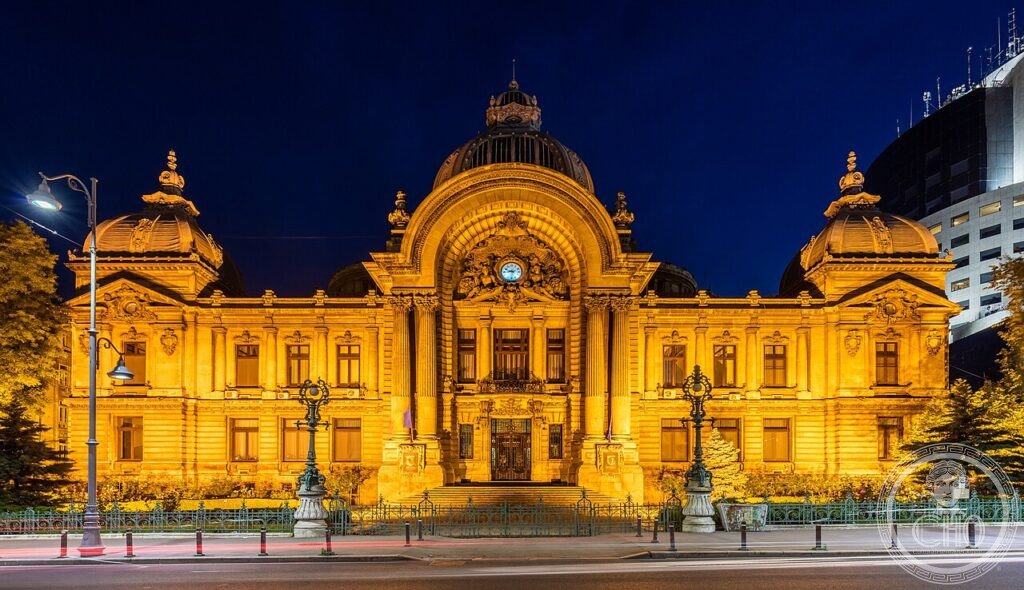
Paul Gottereau’s 1900 savings bank palace anchors the southern end of Calea Victoriei with the most assured Beaux-Arts statement in Romania: a monumental composition of carved stone, arched windows, and a glass dome that has presided over Bucharest’s principal boulevard for 125 years.
At a glance
The CEC Palace — Palatul CEC in Romanian — stands on Calea Victoriei opposite the National Museum of Romanian History, at the point where Bucharest’s ceremonial boulevard meets the old city of Lipscani. Built between 8 June 1897 and 1900 at a cost of 30 million lei to a design by the French architect Paul Gottereau, it was constructed as the headquarters of the Casa de Economii şi Consemnaţiuni — the CEC, Romania’s state savings bank, founded in 1864. Gottereau had already designed several major Bucharest buildings for the Romanian state; the CEC Palace was his most ambitious commission and became the definitive statement of the French academic style in Romanian institutional architecture. It remains the headquarters of CEC Bank to this day.
Key facts
- Architect: Paul Gottereau (project), Ion Socolescu (construction supervision)
- Client: Casa de Economii şi Consemnaţiuni (CEC Bank)
- Built: 8 June 1897 – 1900
- Cost: 30 million lei
- Style: Beaux-Arts (French academic)
- Location: Calea Victoriei 13, opposite the National Museum of Romanian History, Bucharest
- GPS: 44.4320, 26.0965 — Google Maps
- Status: Operating bank headquarters (CEC Bank)
History
Paul Gottereau (1843–1926) was a French architect who made his career largely in Romania, where he arrived in the 1870s and worked for nearly five decades producing institutional buildings for the new Romanian Kingdom. His clients included the Romanian royal family, the National Bank, and various ministries. The CEC commission came in the mid-1890s, when the savings bank — founded in 1864 by Alexandru Ioan Cuza’s government as a modernising financial institution for small depositors — required a headquarters that would project the security and permanence of the institution to its customers.
Gottereau’s solution was a direct adaptation of the French Second Empire / Third Republic institutional idiom: a building that communicates stability through the weight of its stone, its classical orders, and the rational clarity of its composition, while reserving the centrepiece — the iron-and-glass dome — for the most theatrical possible expression of the banking hall beneath. The construction phase was supervised by the Romanian architect Ion Socolescu, and the building opened in 1900 at a final cost of 30 million lei — a considerable sum that reflected the ambition of the project.
In the twentieth century the building survived the political upheavals that transformed Bucharest around it: the royal period, the fascist interlude, the communist era (during which the CEC continued to operate as a state savings institution), and the post-1989 privatisation era. It was listed as a historic monument and continues in its original function as the CEC Bank’s central office.
What you see
The façade on Calea Victoriei presents the full grammar of French Beaux-Arts institutionalism: a rusticated base, piano nobile marked by arched windows with carved stone surrounds, and an attic storey surmounted by a balustrade. The central three-bay entrance pavilion projects slightly from the flanking wings and is crowned by the building’s most distinctive element: the iron-and-glass dome — octagonal in plan, its ribs of bolted steel framing panels of glass — which rises above the roofline to create the building’s most recognisable silhouette on the Calea Victoriei skyline.
The interior banking hall — visible through the entrance — is lit from above by the dome and organised around the counter arrangement typical of large savings banks of the period: a principal hall with tellers’ windows along the perimeter and a central open floor for public circulation. The carved ornamental detail of the exterior continues through the entrance vestibule and into the main hall, maintaining the Beaux-Arts register of formal, carved stone and classical mouldings throughout.
Practical information
- The building is an operating bank; the main hall is accessible during banking hours (Monday–Friday).
- The exterior is freely visible from Calea Victoriei and the adjacent Piața Națiunilor Unite at all hours.
- The dome is most dramatic when viewed from directly in front on Calea Victoriei, or from the steps of the National Museum of Romanian History (directly opposite).
- The National Museum of Romanian History — housed in the former Central Post Office, also a Beaux-Arts building — is directly across the street and worth combining with a visit to the CEC.
Getting there
The CEC Palace is on Calea Victoriei 13 in Bucharest’s historic centre, 5 minutes’ walk from Piața Unirii metro (Lines M1 and M3) and 10 minutes from Piața Universității (M1 and M2). The National Museum of Romanian History is directly opposite. From Henri Coandă Airport (OTP, 16 km), metro or express bus to the city centre takes 45–60 minutes.
Nearby
- National Museum of Romanian History — directly opposite on Calea Victoriei, in the former Central Post Office (also Beaux-Arts)
- Old Town Lipscani district — 5-minute walk east, medieval and early-modern commercial district
- Romanian Athenaeum — 20-minute walk north, Albert Galleron’s 1888 Neoclassical concert hall
- Cantacuzino Palace / George Enescu Museum — 1.5 km north on Calea Victoriei, Ion Berindey’s 1906 Beaux-Arts palace
Sources
- Wikipedia (EN): CEC Palace — architect Paul Gottereau (project) + Ion Socolescu (construction); built 8 June 1897 – 1900; cost 30 million lei; Beaux-Arts style; location Calea Victoriei opposite National Museum of Romanian History; GPS 44.4320/26.0965 (Wikipedia infobox)
- Wikipedia (EN): Paul Gottereau — French architect active in Romania, 1843–1926; major institutional commissions for the Romanian state
- Wikipedia (EN): CEC Bank — history of the savings institution founded 1864
Find it on the map
See this place and what’s around it →📷 Become a Cultural Heritage Online photographer
Share your photos of places: they stay published under your name as the author. The more they're seen, the more you get noticed — and soon a contest will reward the most appreciated photos.
Log in or sign up free to add a photoIs this page about you?
This page is read by travellers and heritage enthusiasts who find it on Google. Tell us how you are connected to this place and we will take it from there.