
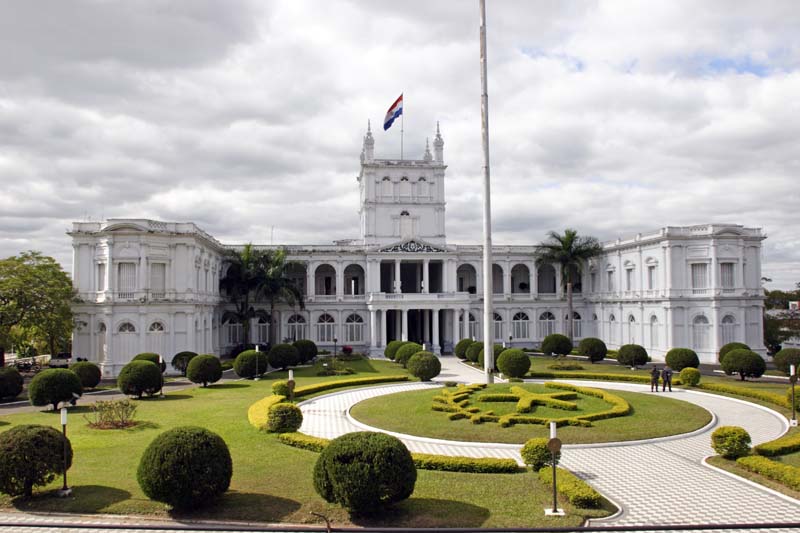
Paraguay’s presidential palace was begun under the first constitutional president and completed as his son plunged the country into the most catastrophic war in South American history, a building whose beauty is inseparable from the tragedy that surrounded its birth.
At a glance
- Type
- Presidential palace
- Period
- 1857-1867
- Style
- Italian Renaissance Revival
- Location
- Avenida Presidente Franco, Asuncion, Paraguay
- Coordinates
- -25.2820, -57.6345
- Architect
- Alonzo Taylor (English)
Overview
The Palacio de Los Lopez, officially the Palacio de Gobierno, is the presidential palace and executive seat of Paraguay, the most significant 19th-century public building in the country. Designed by English architect Alonzo Taylor and built between 1857 and 1867, it commands a prominent position on the bank of the Paraguay River overlooking the Bay of Asuncion. Its two-story Italian Renaissance Revival facade, with round-arched windows, rusticated pilasters, and a ceremonial balcony, was conceived to announce Paraguay’s ambitions as a modernizing republic. The palace’s history is bound up with the Lopez dynasty that built it and the catastrophic war that nearly destroyed the nation during its construction.
History
Construction began in 1857 under President Carlos Antonio Lopez, Paraguay’s first constitutional president, who sought to modernize the country with railways, telegraphs, and monumental public buildings. When Carlos Antonio Lopez died in 1862 the palace was unfinished, and his son Francisco Solano Lopez took power. The younger Lopez completed the building in 1867 in the midst of the War of the Triple Alliance (1864-1870), a conflict he had triggered against Brazil, Argentina, and Uruguay. The war proved catastrophic: Paraguay’s male population was reduced by an estimated 60-70%, with some regions losing nearly all adult men. Brazilian and Argentine forces occupied Asuncion in 1869, looting and damaging the palace. After the war the building was restored and has remained the working presidential residence ever since. It takes its colloquial name from the two Lopez presidents who built and occupied it.
Architecture and Design
Alonzo Taylor’s design follows the Italian Renaissance Revival vocabulary fashionable in mid-19th-century South America: a symmetrical two-story facade in dressed stone, the ground floor with round-arched openings separated by rusticated pilasters, the upper floor with taller windows topped by shallow triangular pediments. A wide projecting balcony at the center of the upper story, supported on ornamental brackets, is the building’s most public feature, used for presidential addresses. The roofline is punctuated by a low balustrade with decorative urns. The interior preserves period state rooms including a formal reception hall and a presidential study. The building faces a formal garden running down to the riverfront esplanade along Avenida Costanera. The adjacent Manzana de la Rivera, a block of restored colonial and 19th-century houses, provides historical context.
Cultural significance
The Palacio de Los Lopez is the pre-eminent monument of Paraguayan national identity, the building where the country’s most consequential decisions have been made for 160 years. Its history encapsulates the central trauma of Paraguayan nationhood: the War of the Triple Alliance remains the deadliest interstate conflict in Latin American history, and the Palacio stands as both memorial to ambition and witness to destruction. The building also marks Paraguay’s connection to European modernity: Carlos Antonio Lopez hired English engineers, French architects, and Paraguayan artisans to build an infrastructure that briefly made landlocked Paraguay one of the more technically advanced countries in the region. The ceremonial balcony of the Palacio is the most recognizable image in Paraguayan political culture.
Visiting today
The Palacio is open for free guided tours on Saturdays; visitors present identification at the entrance gate on Avenida Presidente Franco. Tours cover the exterior, the formal gardens, and selected ground-floor reception rooms. The adjacent Manzana de la Rivera complex (a row of restored historic houses on the same block) contains cultural spaces open throughout the week. The riverfront Costanera promenade alongside the palace is one of Asuncion’s most pleasant public spaces. The historic center of Asuncion, while less intact than Quito or Cartagena, contains several other 19th-century landmarks within walking distance including the Cathedral and the Cabildo cultural center.
Getting there
Silvio Pettirossi International Airport is approximately 15 km northeast of the city center; taxis take 25-40 minutes depending on traffic, with no direct metro or bus connection. From the city center the Palacio is best reached on foot or by taxi; it faces Avenida Costanera at the riverfront, a 10-minute walk from Plaza de los Heroes (the main central square). Ride-sharing apps (Uber, InDriver) operate in Asuncion. The historic center is compact and the Palacio is the natural anchor point for exploring downtown Asuncion on foot.
Sources and resources
Find it on the map
See this place and what’s around it →Record researched and written by Luigi De Marchi for Cultural Heritage Online, 2026.
📷 Become a Cultural Heritage Online photographer
Share your photos of places: they stay published under your name as the author. The more they're seen, the more you get noticed — and soon a contest will reward the most appreciated photos.
Log in or sign up free to add a photoIs this page about you?
This page is read by travellers and heritage enthusiasts who find it on Google. Tell us how you are connected to this place and we will take it from there.