

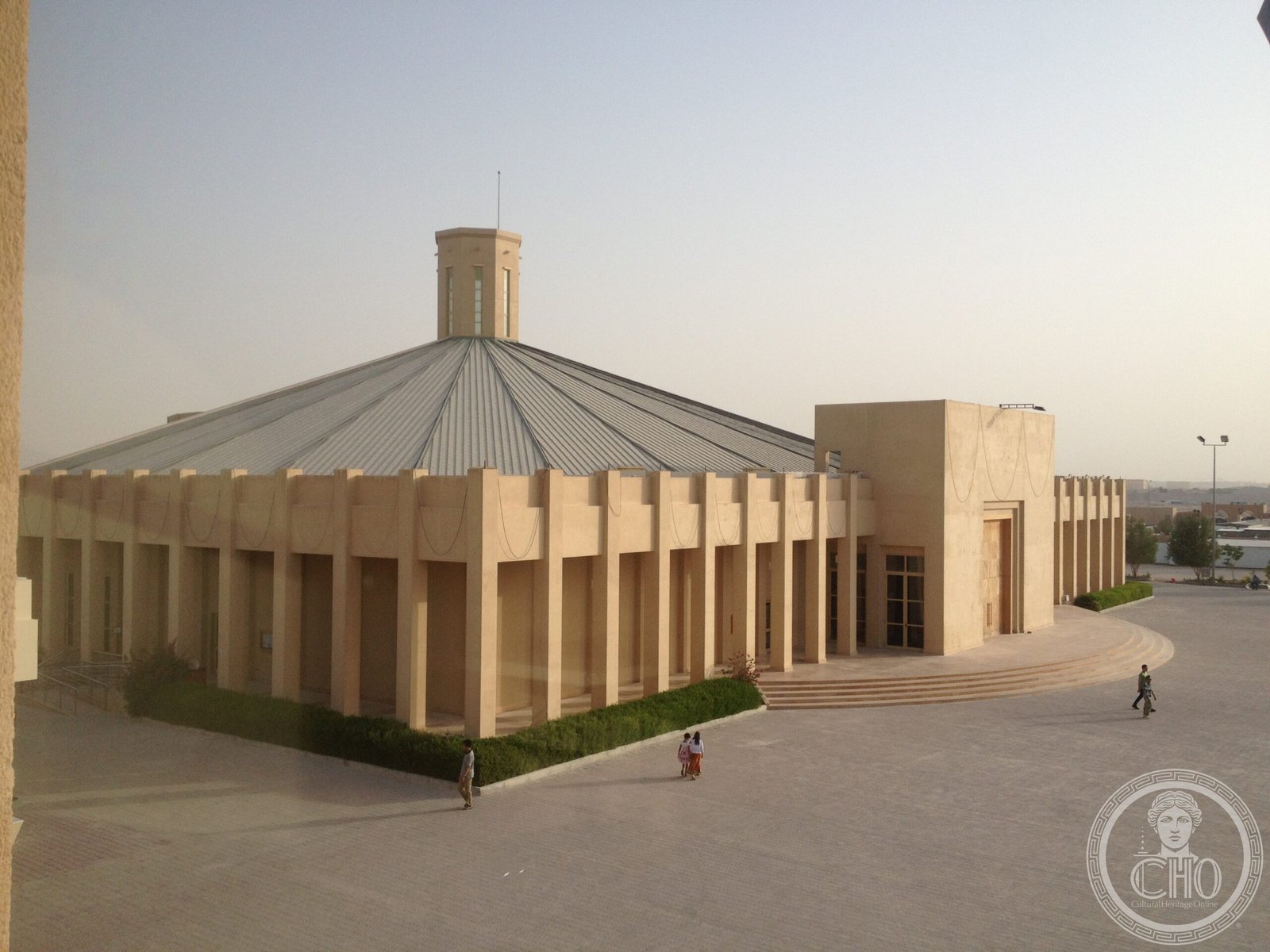
In Doha this Catholic church is described by the sources as the first Christian building raised in the country since the Islamic conquests of the 7th century. The legal turning point came with an agreement of May 2005, when representatives of six Christian denominations signed with the Qatari government, under Emir Hamad bin Khalifa Al Thani, a fifty-year concession for a plot in the Mesaimeer-Abu Hamour district, in a religious compound informally known as «Church City». The agreement followed the establishment of diplomatic relations between the Holy See and Qatar, on 18 November 2002. The church was consecrated on 14 or 15 March 2008, depending on the source, by Cardinal Ivan Dias, then prefect of the Congregation for the Evangelisation of Peoples, acting as papal legate. He handed the emir a personal greeting from Pope Benedict XVI together with a chalice as a gift, and laid a relic of Padre Pio in the altar. Between ten thousand and fifteen thousand people attended by the estimates, among them the Qatari deputy prime minister of the time, Abdullah bin Hamad Al-Attiyah. The cost of the building is put at around twenty million dollars, on land given by the emir, and it seats about two thousand seven hundred. By law the building shows no crosses, bells or bell towers visible from outside, nor any sign identifying it as a Christian place of worship from the street, as documented in the reports of the United States State Department on religious freedom. The whole religious compound, which holds six churches of different denominations, lies about twenty minutes from the centre of Doha and is deliberately unsignposted, with buildings that look from outside like ordinary villas. Proselytising towards Muslims is a criminal offence in Qatar, punishable by up to five years in prison. This arrangement places Qatar, together with neighbouring Kuwait, in a middle position in the Gulf: more permissive than Saudi Arabia, where no legal public church exists, but more restrictive than the United Arab Emirates, where churches such as Saint Mary in Dubai, open as early as 1967, show visibly ecclesiastical fronts. The church belongs today to the apostolic vicariate of Northern Arabia, whose seat is the cathedral of Our Lady of Arabia at Awali, in Bahrain, and not to the vicariate of Southern Arabia, which since 2011 takes in only Oman, the Emirates and Yemen. The present apostolic vicar is Aldo Berardi. On 1 January 2024 Bishop Berardi celebrated the New Year Mass there, with a total attendance estimated at about thirty thousand of the faithful over the course of the day, described by Vatican sources as a sign of hope and unity for the Catholic community of Qatar.
About Our Lady of the Rosary Church
In Doha, Qatar, this Catholic church is described by multiple sources as the first Christian building constructed in the country since the Islamic conquests of the 7th century. The legal breakthrough came in May 2005, when representatives of six Christian denominations signed a 50-year land agreement with the Qatari government, under Emir Hamad bin Khalifa Al Thani, for a plot in the Mesaimeer-Abu Hamour district — an informally named “Church City” religious complex — following the establishment of diplomatic relations between the Holy See and Qatar on 18 November 2002.
Key facts
- May 2005: a 50-year land agreement grants six Christian denominations a shared compound.
- March 2008: consecrated by Cardinal Ivan Dias as papal legate for Pope Benedict XVI.
- Estimated cost around $20 million, seating roughly 2,700.
- No exterior crosses, bells, steeples, or street signage, by law.
- Part of the Apostolic Vicariate of Northern Arabia, seated in Bahrain.
- 1 January 2024: New Year’s Mass draws an estimated 30,000 worshippers across the day.
History
Consecrated in 2008 as Qatar’s first Christian building in roughly thirteen centuries, this church sits inside a deliberately unmarked religious compound where six denominations share land granted under a 50-year lease — a legal breakthrough that followed the 2002 establishment of Vatican-Qatar diplomatic relations. It occupies a middle position in the Gulf’s spectrum of religious tolerance: more permissive than Saudi Arabia, which permits no public churches at all, but far more restrained architecturally than the UAE, where church buildings openly display crosses on their facades.
What you see
A sand-colored building with a conical corrugated-metal roof and lantern spire rises above a colonnaded arcade and a large wooden entrance door, deliberately free of any cross, bell, or steeple visible from outside, set within an unmarked compound reached well back from Doha’s public roads.
Practical information
- Opening hours: generally open daily outside services; check current hours before visiting.
- Address: Religious Complex, Mesaimeer/Abu Hamour, Doha, Qatar.
Getting there
The church stands within the Abu Hamour religious complex, roughly 20 minutes from central Doha.
Nearby
- St. Thomas Syro-Malabar Church — a second Catholic church within the same religious complex.
Sources
- Wikipedia — “Church of Our Lady of the Rosary (Doha)” and “Apostolic Vicariate of Northern Arabia”
- Gulf News (2008) and Vatican News/Agenzia Fides — coverage of the 2008 dedication and 2024 New Year’s Mass.
- US State Department — International Religious Freedom Report, Qatar.
- Wikipedia — “Apostolic Nunciature to Qatar,” on 2002 Holy See-Qatar relations.
- Open Doors and Wikipedia — comparative Gulf religious-freedom reporting.
Find it on the map
See this place and what’s around it →📷 Become a Cultural Heritage Online photographer
Share your photos of places: they stay published under your name as the author. The more they're seen, the more you get noticed — and soon a contest will reward the most appreciated photos.
Log in or sign up free to add a photo