
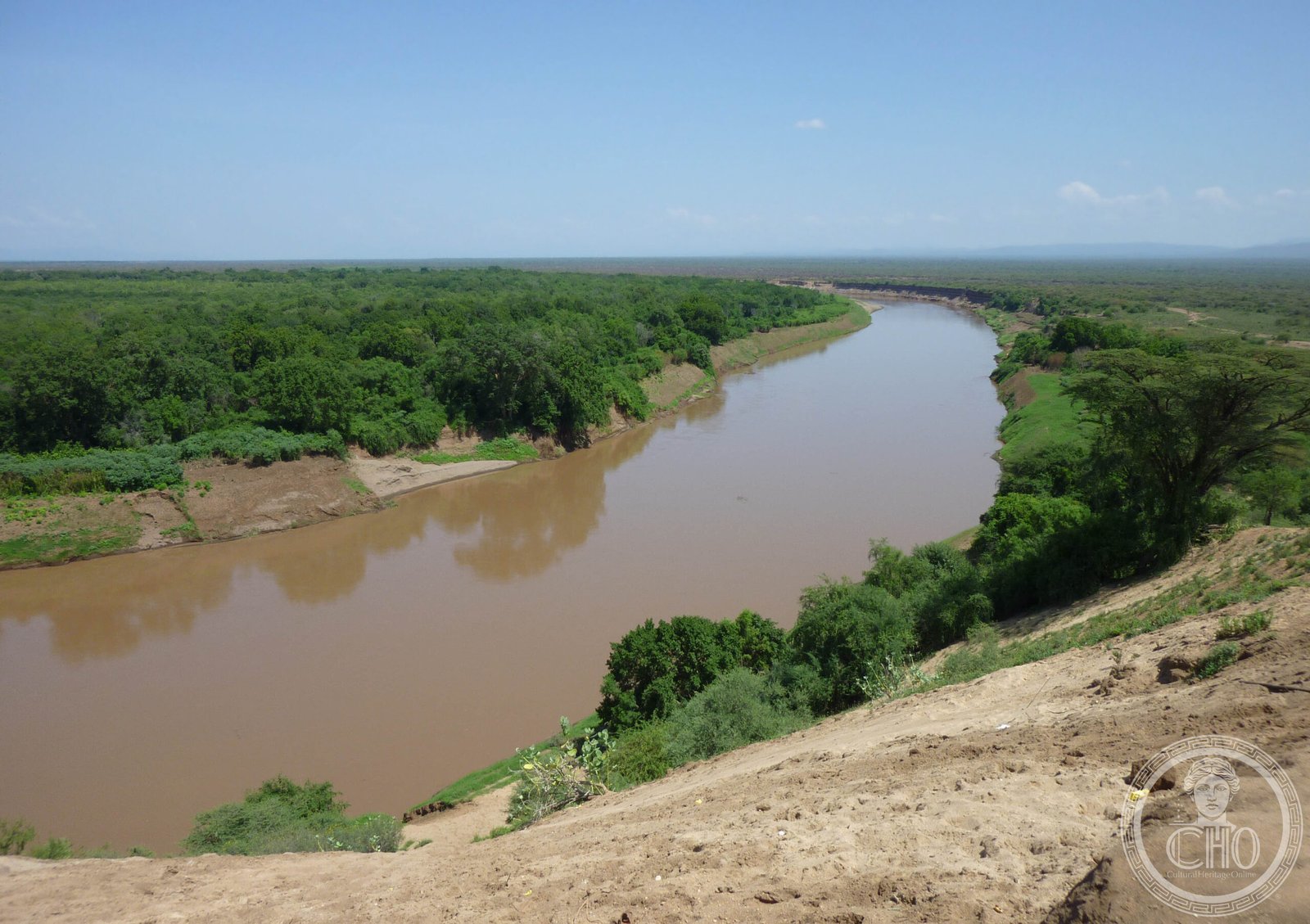
Southern Ethiopia’s greatest river outside the Nile Basin, the Omo flows entirely within Ethiopian borders before emptying into Lake Turkana on the Kenyan frontier. Its valley ranks among the world’s most significant sources of early human remains and stone tools.
At a glance
The Omo River drains the Turkana Basin, an endorheic system of immense paleontological importance. The river’s course spans southern Ethiopia, forming a natural boundary with Kenya at its terminus. Its valley has yielded extraordinary evidence of human evolution spanning millions of years.
History
The Omo river basin has been a focal point for human development since the earliest stages of hominid evolution. Systematic archaeological surveys beginning in the mid-twentieth century uncovered dense concentrations of fossils and artifacts. These discoveries transformed scientific understanding of human origins and early cultural development in Africa.
What you see
The landscape reveals the Omo Valley’s geological and paleontological character. Exposed sedimentary layers along the riverbanks document millions of years of environmental change. Visitors encounter a dramatic terrain shaped by the river’s erosive force, with badlands and escarpments that expose ancient deposits containing fossils and stone tools.
Cultural significance
The Omo River valley stands as one of humanity’s most important archaeological sites. Its fossils have illuminated the evolutionary pathway from early hominids to modern humans. The river basin’s artifacts demonstrate the development of tool-making technology and human adaptation across vast stretches of time, making it indispensable to paleoanthropology and human history.
Key facts
- Country: Ethiopia
- Nearest city: Jinka
- Coordinates: 7.81°N, 36.90°E
- UNESCO World Heritage Site: inscribed 1980
- Designation: Omo Lower Valley and Surrounding Regional Landscape
Practical information & getting there
The Omo valley is accessible from Jinka, in Ethiopia’s Southern Nations, Nationalities, and Peoples’ Region. Travel to the site requires planning; road conditions can be challenging. Visitors should arrange transportation and permits through established tourism operators familiar with the region. Local guides enhance understanding of both the landscape and ongoing research.
Sources & resources
Find it on the map
See this place and what’s around it →📷 Become a Cultural Heritage Online photographer
Share your photos of places: they stay published under your name as the author. The more they're seen, the more you get noticed — and soon a contest will reward the most appreciated photos.
Log in or sign up free to add a photo