

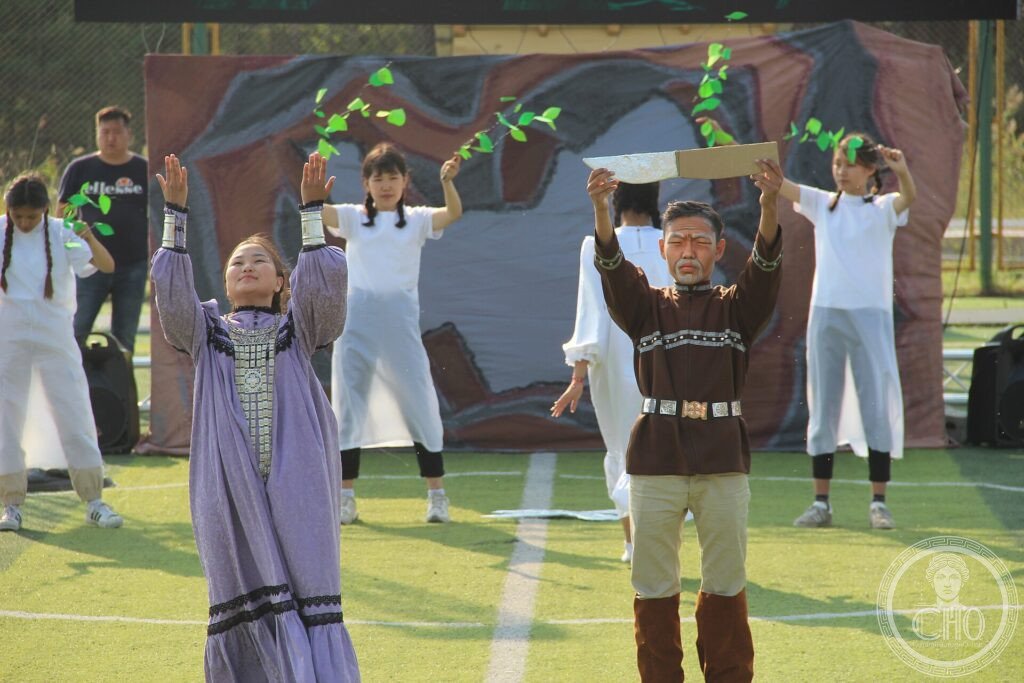
An ancient Yakut and Dolgan oral epic tradition spanning over one hundred recorded heroic poems, some containing tens of thousands of verses, transmitted through generations of master storytellers in the Russian Far North.
In UNESCO’s words
One of the oldest epic arts of the Turkic peoples, the termOlonkho refers to the entire Yakut epic tradition as well as its central epic.Today, it is still incidentally performed in the Sakha Republic, situated in the far east of the Russian Federation. The poetic tales, which vary from 10 to 15,000 verses in length, are performed by the Olonkho singer and story-teller in two parts: a sung part in verse alternates with the prosaic part composed of recitatives. In addition to possessing good acting and singing skills, the narrator must be a master of eloquence and poetic improvisation. The epic consists of numerous legends about ancient warriors, deities, spirits and animals, but also addresses contemporary events, such as the disintegration of nomadic society. Given that each community had its own narrator with a rich repertoire, numerous versions of Olonkho circulated. The tradition was developed within the family context for entertainment and as a means of education. Reflecting Yakut beliefs, it also bears witness to the way of life of a small nation struggling for survival at times of political unrest and under difficult climatic and geographical conditions. The political and technological changes in twentieth-century Russia have threatened the existence of the epic tradition in the Sakha Republic. Although there has been a growing interest in Olonkho since the perestroika years, this tradition is endangered in view of the very low number of practitioner, all of old age.
Official description, UNESCO Intangible Cultural Heritage List — Olonkho, Yakut heroic epos
At a glance
Olonkho is the epic tradition of the Yakut people, one of the oldest epic arts among Turkic peoples. Performed orally by a single narrator, these poetic tales range from 10 to 15,000 verses in length. Each performance alternates between sung verses and spoken recitatives, requiring the narrator to combine singing and acting skills with eloquence and poetic improvisation. The epics recount legends of ancient warriors, deities, spirits and animals, and also address contemporary events such as the disintegration of nomadic society.
Origins & history
Olonkho developed within the family context for entertainment and education, with each community maintaining its own narrator and repertoire, creating numerous versions of the tradition. The epic reflects Yakut beliefs and documents the way of life of a people struggling for survival under difficult climatic and geographical conditions and during times of political unrest.
The practice
A skilled narrator, or olonkhosut, performs Olonkho by alternating between sung verses and prosaic recitatives. The performer must master acting, singing, eloquence, and poetic improvisation. The narrator draws on a rich repertoire to tell these lengthy tales, which can span many verses. The performance format allows each narrator to develop individual artistry while maintaining the core narrative.
Cultural significance
Olonkho serves as a means of transmitting Yakut cultural knowledge, beliefs, and values across generations. The tradition is now endangered, however, due to twentieth-century political and technological changes in Russia. Though interest has grown since the perestroika years, very few practitioners remain, all of advanced age, threatening the survival of this ancient epic art.
Key facts
- Country: Russian Federation
- Inscribed: 2008
- UNESCO list: Representative List of the Intangible Cultural Heritage of Humanity
- UNESCO reference: 00145
- UNESCO vocabulary: Epic poetry; Story telling; Vocal music
- Map: Sakha Republic — the locality named in UNESCO’s official description of this element
- Related World Heritage site: Lena Pillars Nature Park (a different UNESCO designation, not the place of the tradition)
Where to experience it
Olonkho performances can still be encountered in the Sakha Republic, situated in Russia's Far East, where this ancient epic tradition continues among its aging practitioners. Visitors interested in experiencing the art may seek out local cultural institutions and regional organizations that document and occasionally present performances of these lengthy poetic tales. Given the endangered status of the tradition and the scarcity of trained narrators, advance inquiry with Sakha cultural authorities is recommended to learn of performance opportunities and venues where this remarkable Yakut heritage remains alive.
Sources & resources
- UNESCO — official element page: Olonkho, Yakut heroic epos
- UNESCO — open data record: Intangible Heritage List, reference 00145
- UNESCO — official video: UNESCO film on this element — embedded on this page
- UNESCO — official photograph: Photograph of this element — Y. V. Ignateva — 2009 by the National Committee on UNESCO affairs of the Sakha Republic (Yakutia)
- Reference — Wikipedia (secondary): Olonkho — consulted as a secondary reference, not as confirmation
- Cultural Heritage Online: Our archive and city guides

Find it on the map
See this place and what’s around it →📷 Become a Cultural Heritage Online photographer
Share your photos of places: they stay published under your name as the author. The more they're seen, the more you get noticed — and soon a contest will reward the most appreciated photos.
Log in or sign up free to add a photo