

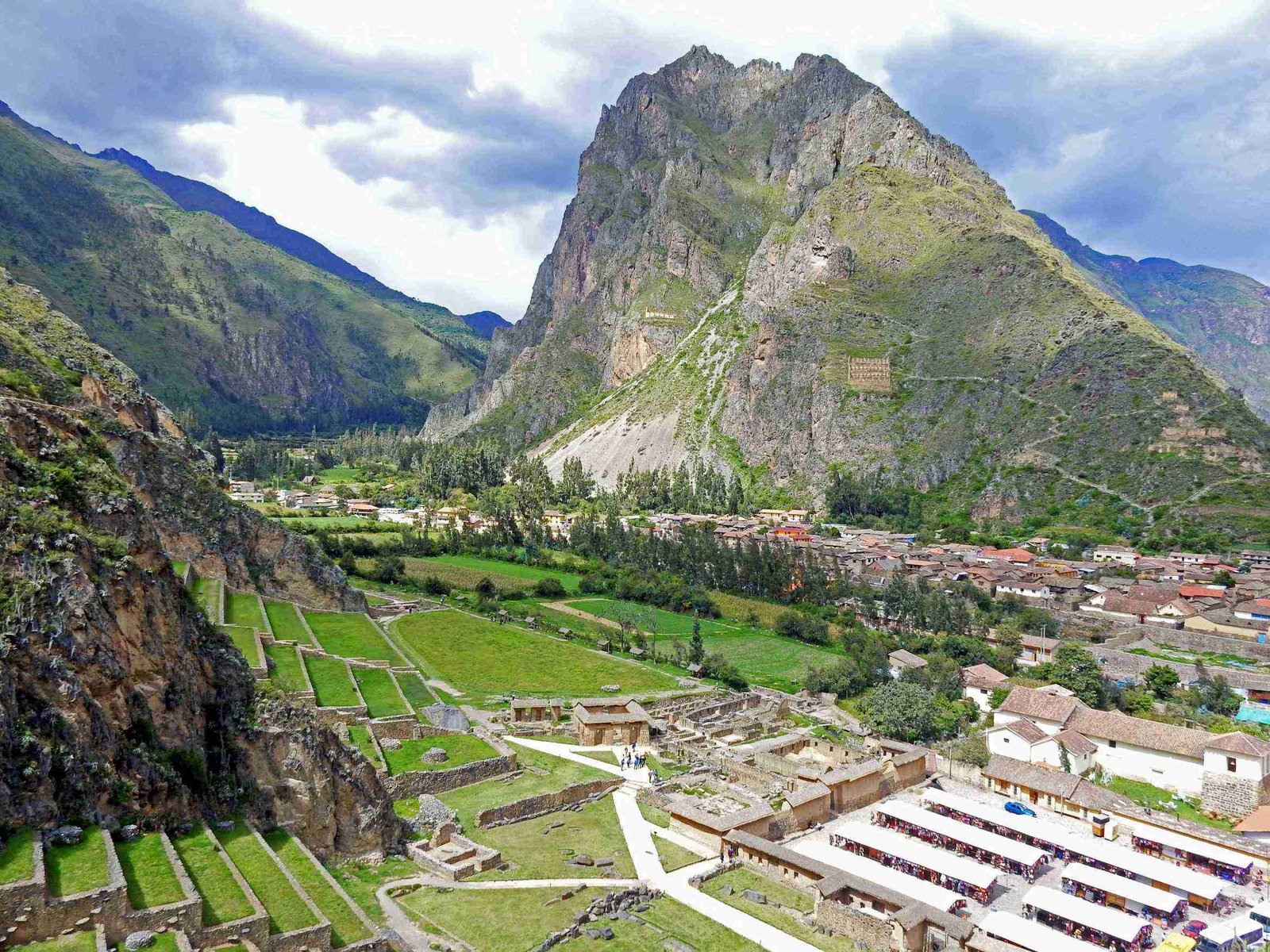
The oldest continuously occupied planned settlement in the Americas — its original Inca street grid and canal system still in everyday use by 3,000 inhabitants — and simultaneously a massive unfinished construction site frozen mid-execution when the Spanish conquest ended the Inca state and its entire labour mobilisation system in a single decade.
At a glance
At the western end of the Sacred Valley of the Incas, 72km northwest of Cusco and 2,792 metres above sea level, Ollantaytambo is one of the most remarkable sites in the Inca world: simultaneously the best-preserved Inca town in existence, a massive unfinished construction site revealing the Inca architectural process frozen mid-execution, and the location of one of the Inca Empire’s rare military victories over the Spanish conquistadors. The site rises above the town in tiers of massive agricultural terraces leading to a fortified hilltop and the Temple of the Sun — six enormous rose-porphyry monoliths, each weighing approximately 50 tonnes, fitted together with extraordinary precision from a quarry 6km away across the Urubamba River.
Key facts
- Coordinates: 13.2589 S, 72.2631 W — western end of the Sacred Valley, 72km northwest of Cusco, 2,792 metres above sea level
- Period of construction: c. 1440–1536 AD, under Pachacuti and his successors; construction interrupted by Spanish conquest
- Living town: The original Inca street grid and irrigation canals remain in everyday use by approximately 3,000 inhabitants
- Temple of the Sun monoliths: Six rose-porphyry stones, each approximately 50 tonnes, quarried 6km away at Cachicata across the Urubamba River
- Abandoned stones: Many transport stones remain scattered along the 6km route, abandoned mid-journey when the conquest ended the Inca state
- Military significance: January 1537 — Manco Inca defeated Hernando Pizarro’s expedition here, one of the very few Spanish military defeats during the conquest
- Altitude: 2,792 metres above sea level; altitude acclimatisation is required
History and the Inca state
Ollantaytambo was built under the Sapa Inca Pachacuti, who transformed the Inca from a small highland polity around Cusco into the largest empire in pre-Columbian America. The Sacred Valley was one of the most agriculturally productive zones in the Inca world, and Ollantaytambo controlled its western approach — a military and administrative gateway between the highland capital at Cusco and the jungle lowlands of the Amazon basin. The town was built as a planned royal estate: a grid of exactly rectangular blocks called canchas, each enclosed by a single perimeter wall with one entrance, containing multiple households and a central courtyard. This urban grid remains unchanged and inhabited, making Ollantaytambo the only Inca town where the original street pattern survives in daily use.
Construction of the Temple of the Sun appears to have begun around 1440 AD and was never completed. Dozens of stones were cut at the Cachicata quarry across the river and moved to the site using wooden sledges, earthen ramps, and thousands of mit’a workers. When Manco Inca retreated from Cusco after his failed siege in 1536, he used Ollantaytambo as his base and defeated Hernando Pizarro’s expedition here in January 1537. The Spanish regrouped and Manco Inca retreated into the jungle of Vilcabamba, where a reduced Inca state survived for another 35 years. The stones that never made it across the river still lie in the fields between the quarry and the site, exactly where the workers put them down.
What you see
The site rises in three distinct zones. The agricultural terraces below the main complex are massive stepped retaining walls, each approximately 3 metres tall and built in precisely fitted stone, converting a steep hillside into level cultivation platforms. Above them, the main fortress platform overlooks the valley with carved niches and storehouses. The Temple of the Sun itself crowns the escarpment: the six standing monoliths of rose porphyry, each fitted to its neighbours with precision joints, are connected by I-shaped stone clamps — a characteristically Inca method for earthquake-proofing stone construction. The joints between the monoliths are so fine that a business card cannot be inserted between them.
The town below is equally extraordinary. The canchas — the rectangular residential blocks — survive intact, their single entrance gates still functional, the original water channels still running with Andean snowmelt. Walking the streets of the lower town is a genuine encounter with a living Inca settlement: the walls are original, the proportions are unchanged, and the integration between ancient infrastructure and contemporary Andean life is complete.
The battle of Ollantaytambo
In January 1537, Manco Inca used Ollantaytambo to defeat a Spanish expedition led by Hernando Pizarro — one of the very few military defeats suffered by the Spanish in the Americas during the conquest period. The Inca defenders flooded the valley floor by opening the irrigation canals, making cavalry charges impossible, and coordinated slings, arrows, and fire from the terraces above. Hernando Pizarro was forced to withdraw. The victory demonstrated that Spanish military superiority was not absolute — their advantage lay in cavalry, steel, and disease, all of which could be partially countered by terrain, fortification, and intelligent tactics. But the Spanish returned in greater numbers, and Manco Inca abandoned the position to retreat into the jungle of Vilcabamba, where a reduced Inca state would survive for another 35 years until the execution of Tupac Amaru I in 1572.
Practical information
- Location: Ollantaytambo district, Urubamba Province, Cusco Region, Peru; 72km northwest of Cusco via the Sacred Valley highway
- Entry: Part of the Cusco Boleto Turistico — the regional tourist pass covering most major archaeological sites in the Cusco area
- Opening hours: Typically 07:00–18:00 daily
- Physical demands: Significant climbing on uneven stone steps; altitude of 2,792 metres requires acclimatisation; allow 1–2 days in Cusco before visiting
- Best time: May–October dry season; accessible year-round but heavy rain makes stones slippery
- Visit duration: 2–3 hours for the archaeological site; allow a full day to include the town and train connections
Getting there
From Cusco, shared or private taxis and minibuses run along the Sacred Valley highway to Ollantaytambo, approximately 1.5–2 hours. Ollantaytambo is also the departure point for train services to Aguas Calientes and Machu Picchu, operated by Peru Rail and Inca Rail. The town is a natural overnight stop for travellers beginning the classic 4-day Inca Trail on foot. The nearest major airport is Alejandro Velasco Astete International Airport in Cusco.
Nearby
- Machu Picchu — 112km northwest by train and bus, the most visited Inca site in the world; Ollantaytambo is the train departure point
- Moray — circular Inca terracing installations 15km east, likely used for agricultural experimentation
- Salineras de Maras — salt pans in active use since pre-Inca times, 5km east
- Pisac — Inca fortress and market town 45km east at the other end of the Sacred Valley, with extensive terracing
Sources
- Protzen, Jean-Pierre. Inca Architecture and Construction at Ollantaytambo. Oxford University Press, 1993.
- D’Altroy, Terence N. The Incas. Blackwell Publishing, 2002.
- Hemming, John. The Conquest of the Incas. Harcourt Brace Jovanovich, 1970.
- Wikipedia contributors. “Ollantaytambo.” Wikipedia, The Free Encyclopedia. Accessed 2026.
- Ministerio de Cultura del Peru — official site documentation and Boleto Turistico information.
Find it on the map
See this place and what’s around it →📷 Become a Cultural Heritage Online photographer
Share your photos of places: they stay published under your name as the author. The more they're seen, the more you get noticed — and soon a contest will reward the most appreciated photos.
Log in or sign up free to add a photo