
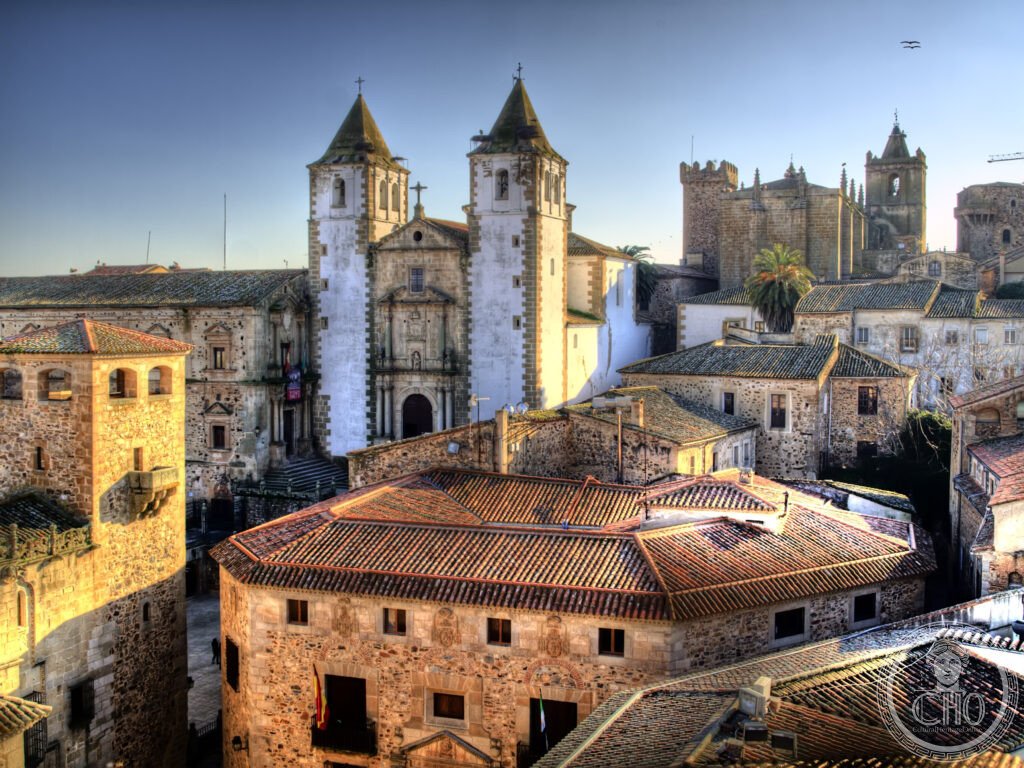
The most completely preserved walled city in Spain and the finest surviving accumulation of Hispano-Muslim, Gothic, and Renaissance urban architecture in the Iberian Peninsula. Cáceres (Roman Norba Caesarina, Moorish Qazris, the capital of Extremadura) is enclosed within 12th-century Islamic walls reinforced with approximately 30 medieval towers and contains within those walls a density of Gothic and Renaissance nobleman’s palaces unmatched in Spain: each palace was built with the wealth brought back from the Americas by an Extremaduran conquistador in the 16th century.
At a glance
Cáceres (population approximately 96,000) is the capital of the Province of Cáceres in the Extremadura region of western Spain, near the Portuguese border, 290 km south-west of Madrid. The Ciudad Monumental (Monumental City — the official name for the historic walled core) covers approximately 4,700 m² on a granite hill (called the “isla monumental”, the monumental island) and contains approximately 30 medieval towers, 11 Gothic-Renaissance palaces of the major Extremaduran noble families, 12 churches and convents, and the original circuit of 12th-century Islamic walls reinforced with Almohad and later Christian defensive additions. UNESCO inscribed the Old City of Cáceres in 1986. The city is also known internationally as a filming location for the television series Game of Thrones (seasons 6, 7, and 8, where Cáceres stood in for the Free City of Braavos and King’s Landing), The House of the Dragon (prequel to Game of Thrones, 2022), and other productions.
Key facts
- The walls and towers (12th–15th century): the most intact Almohad (North African Islamic dynasty, 12th century) wall circuit in Spain. The walls of Cáceres were built by the Almohad rulers of al-Andalus in the 12th century as a provincial fortress town on the frontier between Islamic and Christian Spain. After the Christian reconquest of the city in 1229 by Alfonso IX of León, the walls were maintained and supplemented with Christian towers. The approximately 30 surviving towers include the iconic Torre de Bujaco (12th century, the southwest corner tower visible from the Plaza Mayor, the most famous image of Cáceres), the Torre de la Hierba, the Torre del Horno, and the massive Moros Tower. After the end of the Reconquista (1492) and the onset of the Extremaduran conquest of the Americas, the towers lost their defensive function and many were topped or reduced in height by order of Queen Isabel I (who distrusted the power of the independent Extremaduran noble families — this royal command is why many Cáceres towers end in flat platforms rather than pointed roofs).
- The conquistador palaces (15th–16th century): the most concentrated assembly of early-Spanish-Renaissance (Plateresque) noble architecture in Spain. The wealth of the Americas came to Cáceres primarily through the Extremaduran families who led the conquest. Francisco Pizarro, conqueror of Peru, was born in Trujillo, 47 km east of Cáceres, and his family built the Casa de los Pizarro within the city walls. Hernando de Ovando, conqueror of the Caribbean, was born in Cáceres itself. Hernán Cortés, conqueror of Mexico, was born in Medellín, 70 km south, then a province of Cáceres. Juan de Toledo-Moctezuma married Isabel de Moctezuma, daughter of the Aztec emperor: his Casa de los Toledo-Moctezuma, with its Mudéjar-Gothic arched entrance and the Aztec-inspired medallions on its tower, is the most dramatic symbol of the encounter between Extremadura and America. The palaces are Plateresque — literally “in the manner of a silversmith” — a Spanish Renaissance idiom of extremely fine sculptural ornament on stone façades, as if carved by a silversmith rather than a mason. The finest example in Cáceres is the Palacio de los Golfines de Abajo (where Queen Isabel I and King Fernando II of Aragon received the banners of the conquistadors).
- Plaza Mayor: Cáceres’s most photographed space and one of the most dramatic public squares in Spain. The arcaded Plaza Mayor is not within the walls but immediately adjacent to the main gate (the Arco de la Estrella, an 18th-century Baroque gateway through the ancient wall, wide enough for a carriage), giving a view from below of the Torre de Bujaco and the wall parapet that is the defining first image of Cáceres for visitors. The square is bordered on three sides by arcaded porticoes under which the restaurants and bars operate and on the fourth side (east) by the Arco de la Estrella gateway and the walls and towers rising behind it. The towers are floodlit at night and the square is the centre of the city’s social and gastronomic life (Cáceres cuisine — Iberian ham, Torta del Casar cheese, migas, lamb) from late afternoon to midnight.
- Game of Thrones filming: Cáceres was used as a filming location for the television series Game of Thrones (HBO, 2011–2019) in seasons 6, 7, and 8. The Plaza de San Jorge (the main square within the monumental city, with the Convento de San Francisco on one side) and the surrounding streets stood in for the streets of King’s Landing and the Free City of Braavos. The Palacio de los Golfines de Abajo provided interior spaces for scenes set in Dragonstone. The absence of modern intrusions in the walled city (no power cables, no anachronistic shop fronts, no modern street furniture within the walls — the entire monumental zone has been purged of non-medieval visual elements) made Cáceres uniquely suitable for period filming. The House of the Dragon (2022) continued using Cáceres for similar locations.
- Torta del Casar and Iberian ham: the great food products of the Province of Cáceres. (1) Torta del Casar (from the village of Casar de Cáceres, 20 km north of the city): a round, slightly flattened soft-ripened sheep’s milk cheese with a liquid, almost runny interior (the paste flows when the cheese is cut open from the top, which is the traditional way to serve it — cutting the lid and dipping bread inside). Made from the milk of Merino sheep using a thistle (cardo) coagulant (which gives it a slightly bitter, complex flavour) and aged for a minimum of 60 days. Torta del Casar DO is considered by many Spanish food critics the finest artisan cheese in Spain. (2) Jamón Dehesa de Extremadura (Iberian ham from acorn-fed black pigs raised in the oak dehesa woodland of Extremadura): along with Jabugo and Guijuelo hams, the dehesa hams of Extremadura (cured 24–36 months, DOP protected) are among the three finest Iberian hams in Spain.
- Heritage: UNESCO World Heritage Site, Old City of Cáceres, inscribed 1986.
- GPS: 39.4752° N, 6.3717° W.
History
The hill on which Cáceres stands was occupied by the Vettones (a pre-Roman Celtic-Iberian people, who also built the original oppida around Ávila) before Roman conquest. The Romans established Norba Caesarina on the hill as a municipium on the Via de la Plata (Silver Road, the main Roman north-south road connecting Mérida/Augusta Emerita to Salamanca and the north), and Roman remains are preserved beneath the medieval buildings (visible in several palaces’ cellars). The Visigoths used the site until the Moorish conquest of 713 AD established Qazris as a provincial fortress town of al-Andalus. The Almohad dynasty built the surviving wall circuit in the 12th century. Alfonso IX of León reconquered the city in 1229 as part of the broader Reconquista advance into Extremadura.
The pivotal period in Cáceres’s history was the 16th century, when the Extremaduran families who had settled in the fertile plateau lands around the city and whose younger sons and distant relatives formed the majority of the early conquistador expeditions to the Americas returned with extraordinary wealth. In the course of a single generation (approximately 1520–1570), the blank limestone and granite walls of the medieval ciudad were covered with the carved medallions, armorial shields, and Plateresque ornament of a dozen new noble palaces. The city reached its cultural peak in this period and then froze, as subsequent generations maintained but did not substantially alter the fabric. The 18th-century addition of the Arco de la Estrella gateway through the old wall is the only significant later intervention in the monumental core.
What you see
The Ciudad Monumental is entered from the Plaza Mayor through the Arco de la Estrella gateway (18th century Baroque arch designed by Manuel de Lara y Churriguera). Once inside the walls, the streets are paved in granite and the buildings are in their original 15th–16th century fabric (no shop signs, no power cables, minimal street furniture). The standard circuit: Torre de Bujaco (exterior view from the Plaza Mayor; the tower has a small museum inside accessible from the Plaza Mayor, though the exterior view is the essential image). Arco de la Estrella. Plaza de Santa María (the religious and ceremonial heart of the monumental city, with the Concatedral de Santa María, the Palacio de los Ovando, and the Palacio de los Golfines de Abajo — all three are outstanding examples of Extremaduran Gothic and Plateresque; the concatedral interior contains the 16th-century retablo and a crucifix attributed to the young Alonso Cano). Casa de los Toledo-Moctezuma (turn right from the Plaza de Santa María into the Cuesta de Aldana; the tower of the Toledo-Moctezuma palace is visible from most of the upper town). San Mateo church (the second most important church in the monumental city, with Gothic arches and a Renaissance interior, on the highest point of the island monumental).
The best overall views of the towers and walls from outside: the El Calvario viewpoint (immediately north of the walls, above the Arco del Cristo gate — the best daytime view of the north face of the towers). The Mirador del Río Guadiloba (the meadow below the west face of the walls, best at sunset or sunrise when the golden granite catches the low light). The Plaza Mayor itself at night (the towers are floodlit and the view from the arcades across the square to the Torre de Bujaco is the most atmospheric night view in Extremadura).
Practical information
- Admission: the monumental city is freely walkable at all times (the streets within the walls are public). Torre de Bujaco museum approximately €2.50. Concatedral de Santa María approximately €3 (includes rooftop access — the rooftop walk between the buttresses of the cathedral with views over the monumental city is highly recommended). Palacio de las Cigüeñas (the only tower with battlements, still in military use as a garrison headquarters — open for guided tours at scheduled times). Most churches within the walls free or donation. The Plaza Mayor is freely accessible 24h. Tourist office on the Plaza Mayor offers a printed walking guide. Game of Thrones filming location map available from the tourist office.
- Getting there: Cáceres is not on a high-speed rail line (the AVE Extremadura line is under construction and expected to connect Madrid–Cáceres from 2027). Current train options: direct Alvia from Madrid Chamartín (3h 30 min–4h, approximately €25–45, approximately 3 services/day). Direct bus from Madrid Estación Sur (4h, approximately €17, Avanza, approximately 6 services/day). By car from Madrid (290 km west on the A-5, 3h). From Salamanca (220 km south-west via the N-630 or Autovía de la Plata A-66, 2h 30 min). From Seville (280 km north on the A-66, 2h 45 min). Cáceres train and bus stations are 3 km south of the monumental city (taxi or bus 1 to the city centre). The city has a small but adequate selection of hotels within or adjacent to the walled city, including the Parador de Cáceres (an Extremaduran Gothic palace within the walls — the most atmospheric hotel option in the city).
- The Extremadura circuit: Cáceres is the northern terminus of the Extremadura heritage circuit: Cáceres → Mérida (70 km south, 50 min by bus or car; UNESCO WHS 1993, the finest Roman city in Spain — the Roman Theatre, the Amphitheatre, the Temple of Diana, the Museum of Roman Art — all intact and fully visible; the most concentrated Roman heritage of any Spanish city outside Rome itself) → Badajoz (120 km south-west of Cáceres, 1h by car; on the Portuguese border, with the Alcazaba Moorish fortress) → Trujillo (47 km east of Cáceres, 40 min by bus; the home town of Francisco Pizarro, conqueror of Peru, with his equestrian statue in the Plaza Mayor; the Palacio de los Pizarro and the castle are open). Guadalupe (90 km east of Cáceres, 1h 30 min by car; the Monastery of Guadalupe, UNESCO WHS 1993, with the most important collection of Zurbarán paintings outside Seville, the Black Virgin of Guadalupe venerated by all Spanish-speaking Christians from Mexico to Chile, and an extraordinary Mudéjar-Gothic cloister).
Getting there
Train from Madrid (3h 30min–4h, Alvia, ~€25–45). Bus from Madrid (4h, ~€17). By car from Madrid (3h, A-5). GPS: 39.4752, -6.3717.
Nearby
- Mérida. 70 km south of Cáceres (50 min by car or bus). The finest Roman city in Spain and the capital of the Roman province of Lusitania (established 25 BC by Augustus). The Roman Theatre (Teatro Romano de Mérida, 24 BC, capacity 6,000, the best-preserved Roman theatre facade in the western Empire; still used for annual Classical drama festival in July). The Roman Amphitheatre (15,000 capacity, adjacent to the theatre). The Temple of Diana (Templo de Diana, 1st century AD, 6 of the original Corinthian columns standing to full height). The remarkable 792-metre Roman bridge over the Guadiana River (Puente Romano, 1st century AD, 60 arches, still in daily use for pedestrian traffic until 1991, now closed to vehicles). The Museo Nacional de Arte Romano (designed by Rafael Moneo, 1985, one of the finest contemporary museum buildings in Spain, with its exposed Roman archaeology in the basement) and the extraordinary mosaic collection within. All in a town of 60,000 people. Mérida is the most concentrated Roman heritage site in Spain and genuinely rivals Nîmes or Arles in its completeness.
- Trujillo. 47 km east of Cáceres (40 min by car or bus). The town of Francisco Pizarro (1478–1541, conqueror of Peru — the most consequential military campaign in the history of the Americas, which brought 200 Spaniards against the Inca Empire of 12 million people and succeeded in 1532 through a combination of military technology, epidemic disease, and the capture of the Inca emperor Atahualpa) and his extended family (the Pizarro clan had four brothers who participated in the Peru expedition). The equestrian statue of Pizarro by Charles Rumsey (an American sculptor, 1927) dominates the Plaza Mayor. The Pizarro family palace (Palacio de los Pizarro) and the ancestral farmhouse of Orellana (the discoverer of the Amazon River) are within the walled old town. The castle of Trujillo (a Moorish fortress rebuilt by the Christians, 10th–15th century) offers a panoramic view of the Extremaduran plain.
- Monastery of Guadalupe. 90 km east of Cáceres (1h 30 min by car; no direct bus from Cáceres, must change at Trujillo). The most important pilgrimage site in Extremadura and the shrine of the Black Virgin of Guadalupe. The Monastery of Guadalupe (Real Monasterio de Santa María de Guadalupe, UNESCO WHS 1993) was founded in 1340 on the site where a shepherd found a buried image of the Virgin. The monastery became the richest in Spain after the Catholic Monarchs donated the wealth of the first voyages of Columbus (whose Niña and Pinta were funded by the monastery, and who named the Caribbean island of Guadeloupe for the shrine). The monastery contains the most important collection of Zurbarán paintings outside Seville (eight large canvases of Hieronymite monks in the sacristy, painted 1638–1639). The Mudéjar cloister (14th century) is one of the finest examples of Moorish-Christian architectural syncretism in Spain.
Sources
- Wikipedia, Cáceres, Spain. Ciudad Monumental de Cáceres. Torre de Bujaco, accessed June 2026.
- UNESCO, Old City of Cáceres, WHS reference 384, inscribed 1986.
- Juan Tena Fernández, Trujillo histórico y monumental, Cáceres, 1967.
- Ángel Bernal Estévez, El poblamiento medieval de la tierra de Cáceres, Institución Cultural “El Brocense”, 1998.
Find it on the map
See this place and what’s around it →📷 Become a Cultural Heritage Online photographer
Share your photos of places: they stay published under your name as the author. The more they're seen, the more you get noticed — and soon a contest will reward the most appreciated photos.
Log in or sign up free to add a photo