
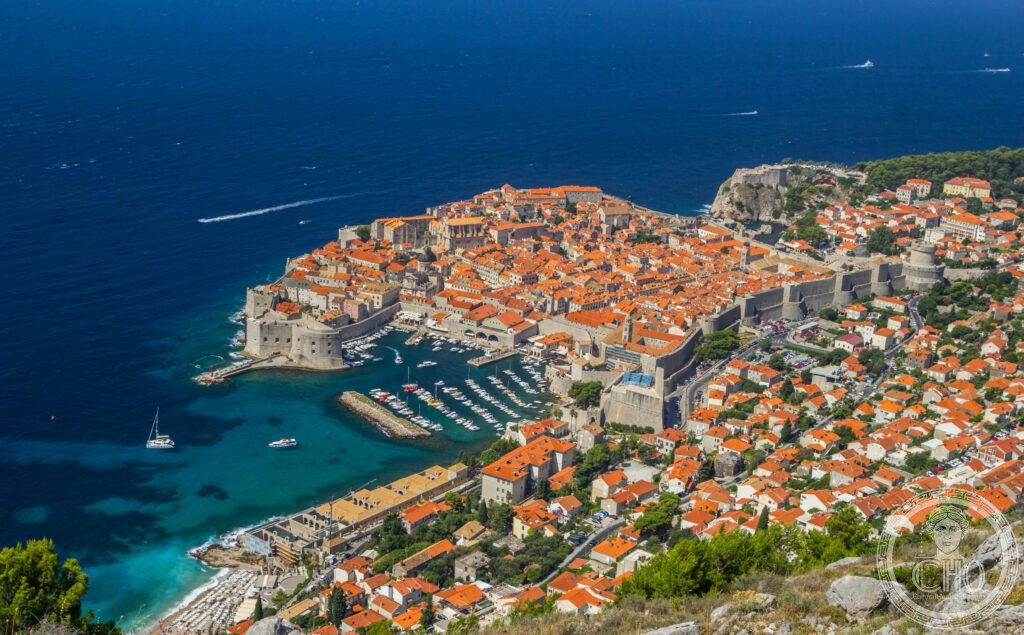
Old Town of Dubrovnik
The most perfectly preserved medieval walled city in Europe and the most dramatic urban landscape on the Adriatic — the Old Town of Dubrovnik, a former independent maritime republic that maintained its sovereignty for 450 years by diplomacy and trade while surrounded by the great empires of the Ottoman east and the Venetian west, is enclosed by walls that can be walked in their entirety and is built on white limestone so reflective it needs sunglasses even on an overcast day.
At a glance
The Old Town of Dubrovnik (Stari Grad; the historic core; a promontory of limestone approximately 650 × 300 metres projecting into the Adriatic Sea; UNESCO WHS 1979) was the capital of the Republic of Ragusa, an independent city-state that existed from 1358 to 1808 (when Napoleon abolished it) and that was one of the most successful trading states in European history; Ragusa achieved its independence from Venice in 1358, maintained peaceful and profitable relations with the Ottoman Empire (paying a tribute to the Sultan, which it used as a protection racket against Venice), abolished slavery in 1416 (one of the first states in Europe to do so), and operated one of the most sophisticated diplomatic services in Renaissance Europe; the Republic’s motto, “Non bene pro toto libertas venditur auro” (“Freedom is not sold for all the gold in the world”), is still inscribed on the entrance to the Rector’s Palace; the historic core is a UNESCO WHS primarily because of the completeness and authenticity of its medieval and Renaissance architecture and its historic street plan, which survived virtually unchanged from the 14th to the 20th century.
Key facts
- The city walls: the most complete medieval fortification circuit in Europe — the circuit of Dubrovnik’s walls (total length 1,940 metres; between 1.5 and 6 metres thick; up to 25 metres high at the section facing land; the seaward sections are thinner, as the cliffs themselves provide natural defence; 2 round towers, 14 square towers and bastions, 3 external forts — Fort Lovrijenac (a freestanding triangular fort perched on a 37-metre cliff just outside the main walls; the inscription above the entrance reads “Non bene pro toto libertas venditur auro” — Non bene pro toto libertas venditur auro), Fort Minčeta (the largest tower on the walls; a round tower on the north-west corner; the view from the top encompasses the entire Old Town below), and Fort Revelin (east end)) can be walked in their entirety on the wall walk (a circuit of approximately 2 km; 45–90 min; the views from the wall include: the terracotta rooftops of the Old Town from above, the Adriatic Sea on the south and east, the island of Lokrum directly opposite, and the karst hills to the north; entry to the wall walk is approximately EUR 30–35; limited to 8,000 per day in peak season; best walked in the early morning before the crowds and the heat)
- The Stradun (Placa): the most beautiful main street in any walled European city — the Stradun (also called Placa; 300 metres long; 8 metres wide; paved in polished white limestone that has been walked smooth over 700 years; the stone is so reflective that the street glows in strong sunlight and needs sunglasses to walk comfortably; flanked on both sides by identical 3-storey Baroque stone buildings with arched doorways at street level and matching windows above — built after the earthquake of 1667 destroyed the previous medieval buildings, to a unified architectural plan; Onofrio’s Large Fountain at the west end (a 16-sided fountain built in 1438 by the Neapolitan engineer Onofrio della Cava to supply fresh water to the city via a 12 km aqueduct from the mountains; still functioning) and the Small Fountain at the east end; the Church of Saint Blaise (Sveti Vlaho) at the east end, the patron saint of Dubrovnik (the golden statue of St. Blaise on every gate and tower holds a model of Dubrovnik as it appeared before the 1667 earthquake — the most accurate model of a pre-earthquake medieval Dalmatian city))
- The 1991–1992 bombardment: the most internationally condemned military attack on a cultural heritage site since World War II — on 6 December 1991 (the worst single day of the 1991–1992 siege of Dubrovnik), the Yugoslav People’s Army and Serbian and Montenegrin forces fired approximately 2,000 shells at the Old Town over a 12-hour period; the bombardment killed 2 people inside the Old Town and destroyed or damaged approximately 70% of the roof tiles, 114 buildings, and several historic monuments inside the walls; the damage was extensively documented by UNESCO and international observers; reconstruction took until 2000; because so many new terracotta tiles were required, the new tiles are distinguishable from the originals — the pre-1991 tiles are darker, weathered orange; the post-1991 tiles are brighter red; from the city walls, the patchwork of old and new tiles is visible as a map of the bombardment; the perpetrators of the attack were convicted by the International Criminal Tribunal for the former Yugoslavia (ICTY)
- Heritage: UNESCO World Heritage Site, Old City of Dubrovnik, inscribed 1979
- GPS: 42.6414° N, 18.1108° E
History
The settlement of Ragusa was founded c. 7th century AD by Roman refugees from the nearby town of Epidaurus; it became independent in 1358, when it threw off Venetian suzerainty and came under the nominal protection of the Kingdom of Hungary; the Republic of Ragusa flourished as a maritime trading state from the 14th to the 17th centuries; the earthquake of 1667 destroyed much of the medieval city and killed approximately 5,000 people (one-third of the population); Napoleon abolished the republic in 1808; the city was part of the Habsburg empire, then Yugoslavia, then became part of Croatia in 1991; UNESCO WHS 1979; the 1991–1992 bombardment by Yugoslav forces placed the site on the World Heritage in Danger list; removed from the Danger list in 1998 after reconstruction; Game of Thrones filmed in Dubrovnik 2011–2019.
What you see
The wall walk (the most important experience; do it first, in the morning, to orientate yourself from above before exploring the streets); the Stradun (walk the full length, from Onofrio’s Fountain to St. Blaise; 10 min); the Dominican Monastery (the east end of the Stradun; a Gothic cloister of exceptional elegance — 14th-century stone tracery in the arcade windows; the monastery museum has one of the finest collections of Gothic and Renaissance paintings in Croatia); the Rector’s Palace (the seat of government of the Republic; a blend of Gothic and Renaissance; the courtyard has a Renaissance loggia and a famous equestrian portrait of the Ragusan admiral Miho Pracat by Pietro Giacometti — the only portrait of a private citizen commissioned by the Republic in its entire history); the Sponza Palace (the only building that survived the 1667 earthquake intact; a combination of Gothic and Renaissance; currently the State Archives, where 10 centuries of Ragusan diplomatic correspondence is preserved); the Orthodox Church of the Annunciation (a reminder that Ragusa always maintained tolerance of religious minorities).
Practical information
- Getting there and crowds: Dubrovnik Airport (DBV; 20 km south of the city; connections from London, Frankfurt, Amsterdam, Zurich, and most major European hubs in summer; from Zagreb, Split, and other Croatian cities year-round); the Old Town is reached from the airport by bus (30 min; Platza bus stop at the Pile Gate entrance) or taxi (approximately EUR 35–50); the city is severely overtouristed in July–August (up to 10,000 cruise ship passengers per day arrive in the harbour, concentrated in the Old Town of approximately 900 permanent residents; the Stradun is shoulder-to-shoulder in the midday hours; the wall walk sells out by 9am; Dubrovnik municipality has implemented crowd management measures including maximum daily visitor limits on the wall walk and timed-entry systems for some sites); the off-season (October–April) is dramatically more pleasant
- Admission: city walls (wall walk): EUR 35 per person; the best view is from Fort Minčeta or from the south wall overlooking the sea; the walk takes 1–2h; the Rector’s Palace: EUR 15; the Dominican Monastery: EUR 6; several combination tickets are available; the Dubrovnik Pass covers most sites; the Elaphite Islands day-trip ferry (3 small islands north of Dubrovnik; Šipan, Lopud, and Koločep; the ferry from the Old Port takes 2–3h round trip; the islands are quieter and cooler than Dubrovnik and have small sandy beaches)
- Game of Thrones: for fans, the Old Town is essentially King’s Landing — the primary filming locations include: the Fort Lovrijenac (the Red Keep exterior), the Gradac Park (the Purple Wedding garden), the Old Port (outside the Iron Gate; scenes with ships), the Dominican Cloister (various palace interiors), and the Stradun (various street scenes); dedicated Game of Thrones walking tours depart from the Pile Gate hourly in season; the game of thrones tourism has added approximately 20% to annual visitor numbers since 2012 and has been both an economic benefit and a significant contributor to overtourism
Getting there
Dubrovnik Airport (DBV): 30 min by bus or 20 min by taxi. Ferry connections to Split, Hvar, Korčula along the Dalmatian coast. GPS: 42.6414, 18.1108.
Nearby
- Korčula Island — 3h from Dubrovnik by ferry (the Jadrolinija car ferry via Drvenik; or direct hydrofoil in summer); the best-preserved medieval town on the Dalmatian coast after Dubrovnik — Korčula (the island of approximately 16,700 people; the town of Korčula, on the eastern tip of the island, is a miniature Dubrovnik — a walled medieval town on a compact promontory, with one main street and fishbone side streets, a 14th-century cathedral, a Venetian loggia, the supposed birthplace of Marco Polo (disputed by multiple other cities but vigorously promoted by Korčula), and a traditional sword dance (the Moreška) performed outside the walls in summer; quieter, cheaper, and with better seafood than Dubrovnik; the island also has excellent beaches)
- Montenegro — Bay of Kotor — 60 km south of Dubrovnik (1h 30 min by road; no direct ferry); the most dramatic fjord-like bay in the Mediterranean — the Bay of Kotor (Boka Kotorska; the deepest bay in the Mediterranean; the city of Kotor at the innermost end is surrounded by 4.5 km of medieval Venetian walls that climb the cliff behind the city to a hilltop fortress; Kotor Old Town is UNESCO WHS 1979; the Church of Our Lady of the Rocks, a small island church built on an artificial island in the Bay that fishermen began constructing in 1452 by throwing rocks overboard on the site of a vision; the bay drive (the twisting cliff road from Kotor to Tivat, following the inner bay shore, is one of the most scenic coastal drives in the Adriatic))
- Mostar and the Stari Most — 150 km north of Dubrovnik (2h 30 min by road; Bosnia and Herzegovina); the most famous bridge in the Balkans and the symbol of post-war cultural reconstruction — the Stari Most (“Old Bridge”; UNESCO WHS 2005; a 16th-century Ottoman bridge built in 1566 by the architect Mimar Hayruddin, a student of the great Ottoman architect Mimar Sinan; 21 metres above the Neretva River; the bridge was deliberately destroyed by Croat forces during the Bosnian War on 9 November 1993 — a date chosen to match the date of the fall of the Berlin Wall, in a act of deliberate historical provocation; the bridge was rebuilt and reopened in 2004 using the same Tenelija limestone from the original quarry; the old town of Mostar on both banks of the river (Bosniak east bank, Croat west bank, still visibly segregated in some respects) is the most evocative post-war urban landscape in Europe)
Sources
- Wikipedia, Dubrovnik; Republic of Ragusa; Siege of Dubrovnik, accessed June 2026
- UNESCO, Old City of Dubrovnik, WHS reference 95, inscribed 1979
- Robin Harris, Dubrovnik: A History, Saqi Books, 2003
Find it on the map
See this place and what’s around it →📷 Diventa un fotografo di Cultural Heritage Online
Condividi le tue foto dei luoghi: restano pubblicate con la tua firma come autore. Più vengono viste, più ti fai conoscere — e presto un concorso premierà le foto più apprezzate.
Accedi o registrati gratis per aggiungere una foto