

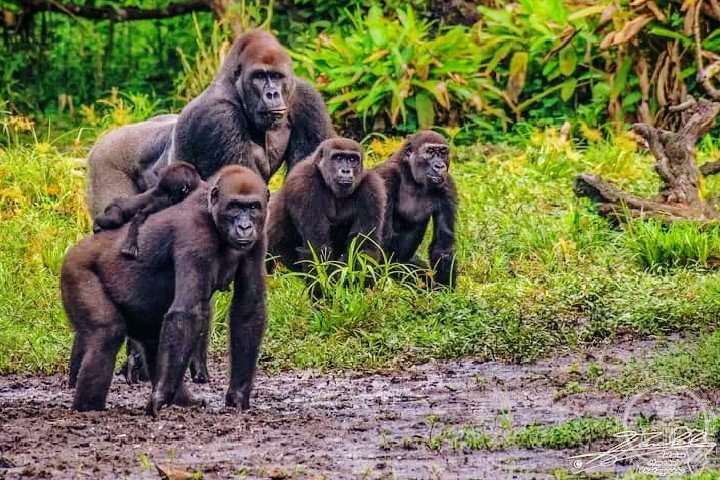
In the north-west of the Republic of the Congo, a few degrees from the Equator, Odzala-Kokoua National Park is one of the oldest in Africa (founded in 1935) and one of the most intact green lungs of the Congo Basin. 13,500 km² of equatorial rainforest, dotted with open clearings (bais) where hundreds of western lowland gorillas and herds of forest elephants converge to lick the mineral springs. A UNESCO World Heritage site since 2023, it is one of the few places in the world where gorillas come within a few dozen metres of visitors in the open clearings.
At a glance
Odzala-Kokoua National Park is a protected area of approximately 13,546 km² in north-western Republic of Congo (Congo-Brazzaville), straddling the Sangha River basin. UNESCO inscribed it in 2023 (ref. 692) for its outstanding biodiversity as one of the most intact blocks of Central African lowland rainforest. The park is home to high densities of western lowland gorillas, forest elephants, forest buffalo, bongo antelope, chimpanzees and hundreds of bird species. It is particularly notable for its network of forest clearings (bais), mineral-salt-rich glades where large mammals congregate in groups rarely seen elsewhere in equatorial Africa.
Key facts
- UNESCO: World Heritage since 2023 (Odzala-Kokoua National Park, ref. 692)
- Founded: 1935 — one of the oldest national parks in Africa
- Area: 13,546 km² of Congo Basin lowland rainforest
- Gorillas: one of the highest densities of western lowland gorillas in Central Africa; the bais allow surface-level gorilla viewing
- Forest elephants: one of the most important remaining populations; up to 200+ elephants visit the Mboko and Langoué bais
- Congo Basin: the park is part of the world’s second-largest tropical rainforest; the Congo Basin stores the equivalent of 3 years of global CO₂ emissions in its trees and soils
History
The Odzala forest has been inhabited for millennia by the Aka (BaAka) pygmy people, who live as hunter-gatherers in the forest and have profound knowledge of its ecosystems. The French colonial administration created the Odzala Reserve in 1935, making it one of the first protected areas in Central Africa. It was upgraded to a national park in 1940.
The park faced serious threats in the 1990s–2000s from poaching, armed groups and the Ebola virus (which killed large numbers of gorillas and forest elephants in this region between 1994 and 2004). Conservation efforts intensified after 2010, when African Parks Network took over management in partnership with the Republic of Congo government. Gorilla habituation programmes enabled eco-tourism that is now one of Central Africa’s premier wildlife experiences. UNESCO inscription in 2023 reflected the improved conservation status and exceptional natural value.
What you see
Odzala is most famous for its forest clearings — the bais. Mboko and Langoué bais are mineral-rich forest glades where gorillas, forest elephants, forest buffalo and bongo come to drink and mineral-lick in large groups. From raised hides at the edge of the bai, visitors observe groups of 20–50 gorillas at distances of 30–100 m, often including silverback males with infants clinging to their mothers’ backs.
Forest walks with habituated gorilla groups are also available (prior habituation by trackers). The park’s rivers are rich in dwarf crocodiles and Congo clawless otters; the forest canopy rings with the calls of grey-cheeked mangabeys and black colobus monkeys.
Practical information
- Managed by: African Parks Network in partnership with Republic of Congo government
- Accommodation: Mboko Camp and Ngaga Camp (luxury tented camps in the park, operated by Congo Conservation Company)
- Access: fly from Brazzaville to Mbomo airstrip (2 hrs by charter) or drive from Ouesso (250 km)
- Best time: June–September (dry season; bais most productive; gorillas most visible)
Getting there
From Brazzaville: charter flight to Mbomo airstrip (2 hrs) or Ouesso (1.5 hrs) then drive. International connections via Brazzaville (Maya-Maya Airport) with Air France and Ethiopian Airlines. GPS (park centre): 0.80° N, 14.90° E.
Nearby
- Dzanga-Sangha Protected Areas (UNESCO) — the contiguous Central African Republic reserve with bai elephant viewing, 200 km north
- Nouabalé-Ndoki National Park (Congo) — the other great Congo gorilla park, 300 km north-east
- Lopé National Park (UNESCO/Gabon) — the Gabon savanna/forest park, 500 km south-west
Sources
- UNESCO World Heritage Centre — “Odzala-Kokoua National Park” (ref. 692)
- African Parks Network — Odzala-Kokoua management
- Encyclopaedia Britannica — western lowland gorilla
Find it on the map
See this place and what’s around it →📷 Become a Cultural Heritage Online photographer
Share your photos of places: they stay published under your name as the author. The more they're seen, the more you get noticed — and soon a contest will reward the most appreciated photos.
Log in or sign up free to add a photo