
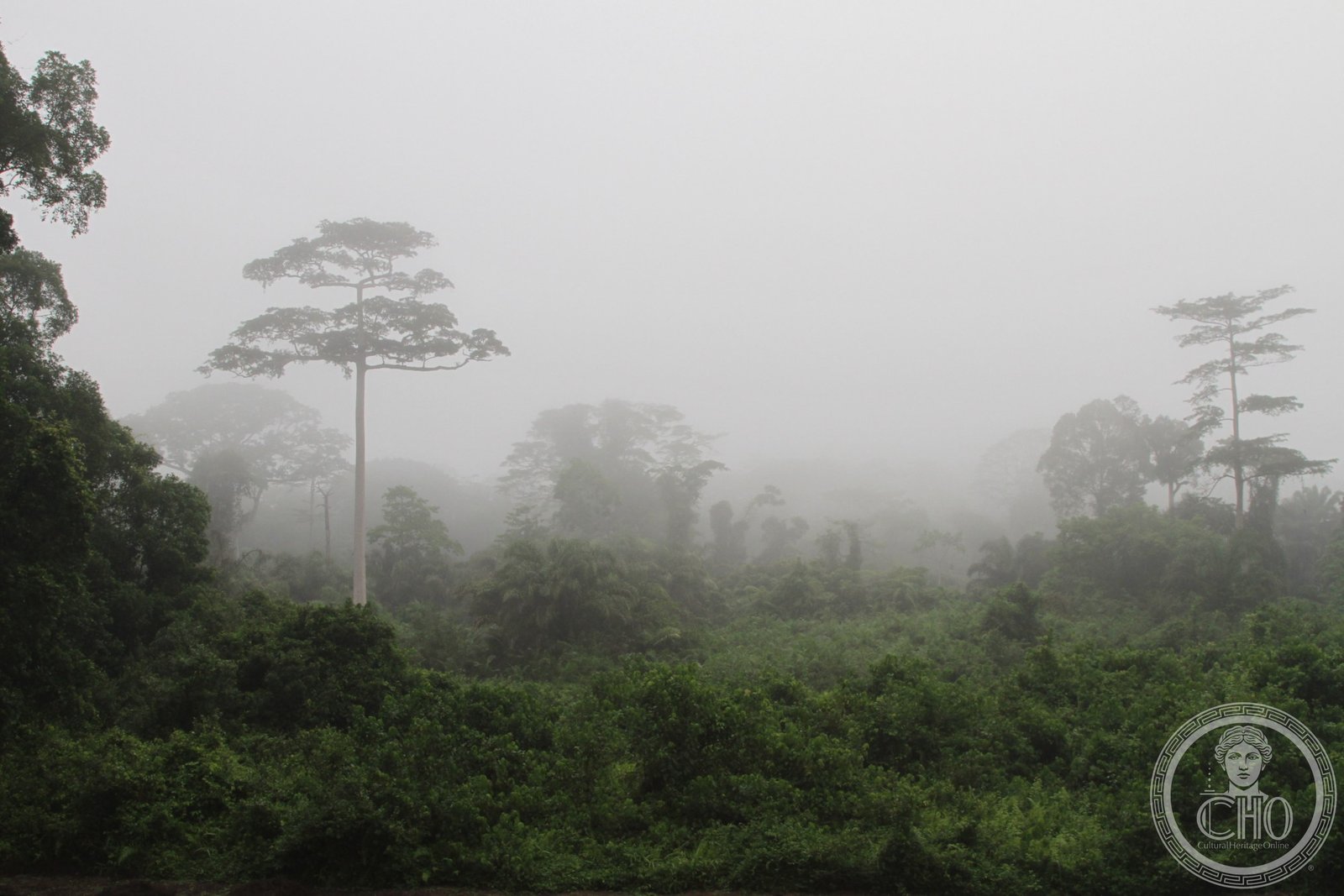
In the south-west of Côte d’Ivoire, a few kilometres from the border with Liberia, Taï National Park preserves the largest block of primary tropical rainforest left in West Africa. An irreplaceable ecosystem of 3,300 km² that is home to 5,000 chimpanzees — here not only biologically close to us but culturally so: those of Taï are one of the few populations in the world to use large stones as anvils to open Coula nuts, a behaviour handed down through generations for almost 4,000 years. With them lives the pygmy hippopotamus — the smallest species of hippopotamus, critically endangered. A UNESCO World Heritage site since 1982.
At a glance
Taï National Park covers 3,300 km² in south-western Côte d’Ivoire, near the Liberian border. UNESCO inscribed it in 1982 (ref. 195) as one of the last major remnants of primary tropical rainforest in West Africa and for its outstanding biodiversity, including 11 species of primate, the pygmy hippopotamus (Hexaprotodon liberiensis), and over 1,300 plant species. The park is most famous scientifically for its population of c. 5,000 western chimpanzees (Pan troglodytes verus), several communities of which have been observed using stone tools to crack Coula edulis nuts — a behaviour that has been continuous for at least 4,300 years, as documented by archaeological deposits of cracked nut shells.
Key facts
- UNESCO: World Heritage since 1982 (Taï National Park, ref. 195)
- Size: 3,300 km² of primary lowland and montane rainforest
- Chimpanzees: c. 5,000 western chimpanzees; stone-tool use documented for 4,300+ years
- Pygmy hippo: the most important known population; critically endangered (c. 2,500 individuals remain worldwide)
- Primates: 11 species including colobus monkeys, Diana monkeys and sooty mangabey
- Trees: over 1,300 plant species; forest contains trees up to 50 m tall with buttressed roots
History
The Taï forest has been inhabited at the margins for millennia by Wè, Oubi and other forest peoples, who practiced sustainable use of the forest. European interest began with the rubber boom of the late 19th century; Belgian and French concessions threatened the forest from the 1900s. A forest reserve was created by the French colonial administration in 1926; it was upgraded to a national park in 1972.
Scientific study began in the 1970s: field biologists Christophe and Hedwige Boesch began long-term study of the Taï chimpanzees in 1979, documenting stone-tool use, cooperative hunting and cultural transmission over decades. Archaeological excavations in the 2010s found evidence of nut-cracking with stone tools dating back 4,300 years, making it the oldest confirmed example of primate tool use in Africa. UNESCO inscription in 1982 recognised the forest’s outstanding value.
What you see
The forest interior is the definition of tropical cathedral: towering emergent trees with buttressed roots, a closed canopy filtering green light, lianas and epiphytes everywhere, and the constant sound of hornbills, colobus monkeys and forest elephants (yes, still present in Taï — one of the few places in West Africa where forest elephants survive).
Chimp habituation by researchers allows visits to wild chimpanzee groups in the northern part of the park (through the Chimpanzee Research Station). Pygmy hippos are sighted in and around rivers at dawn and dusk; they are shy and nocturnal, much harder to spot than their larger relatives.
Practical information
- Base: Taï village or Tai town on the park edge; limited guesthouses
- Chimpanzee visits: contact the Taï Chimpanzee Project for permit information; visits in research blocks only
- Best time: December–February (dry season; paths more passable; animals active)
- Access from Abidjan: 500 km west; fly to Man or San Pédro, then drive south/south-east
Getting there
From Abidjan: fly to San Pédro (1 hr) then drive north 200 km; or fly to Man and drive south. The main park entrance is at Taï village. GPS (park centre): 5.75° N, 7.67° W.
Nearby
- Sapo National Park (Liberia) — the continuation of the Taï forest complex across the border; almost no tourism but ecologically contiguous
- San Pédro — the industrial port city; gateway to the Taï region
- Comoé National Park (UNESCO) — the great savanna/forest park in north-east Côte d’Ivoire, 800 km north-east
Sources
- UNESCO World Heritage Centre — “Taï National Park” (ref. 195)
- Taï Chimpanzee Project (Max Planck Institute) — long-term research data
- Encyclopaedia Britannica — chimpanzee; Taï National Park
Find it on the map
See this place and what’s around it →📷 Become a Cultural Heritage Online photographer
Share your photos of places: they stay published under your name as the author. The more they're seen, the more you get noticed — and soon a contest will reward the most appreciated photos.
Log in or sign up free to add a photo