

Buried beneath the rice paddies of southern Vietnam, Óc Eo was the principal port city of the Funan Kingdom — the first major state in mainland Southeast Asia — where Roman coins, Indian gold, Chinese mirrors, and Sanskrit inscriptions were found together in one of the most remarkable archaeological assemblages of the ancient maritime Silk Road.
At a glance
In An Giang Province in the Vietnamese Mekong Delta, the buried remains of Óc Eo represent the principal port city of the Funan Kingdom (c. 1st–6th century AD) — the first major state in mainland Southeast Asia and the node through which Indian Ocean maritime trade between India, China, and the Indonesian archipelago passed for five centuries. The site was first identified by French archaeologist Louis Malleret in 1942–1944 through aerial photography, which revealed an extraordinary planned urban landscape of approximately 450 hectares with a grid of canals both within the city and connecting it to the Gulf of Thailand harbour 90 km away. The objects found at Óc Eo — Roman coins, Indian jewellery, Sanskrit inscriptions, Chinese mirrors, and early Buddhist bronzes — provide the most complete surviving picture of the ancient maritime Silk Road at its eastern terminus.
Key facts
- Location: Thoai Son District, An Giang Province, Mekong Delta, southern Vietnam; approx. 60 km from the Gulf of Thailand
- Period: c. 1st–7th century AD; principal city of the Funan Kingdom; continued into early Chenla period
- Area: Approximately 450 hectares of urban remains; planned grid of canals; 90 km harbour access canal to Gulf of Thailand
- Key finds: Gold medallion of Antoninus Pius (c. 152 AD); coins of Marcus Aurelius; Indian gold jewellery and intaglio gems; Sanskrit-inscribed gold plates; Chinese bronze mirrors; earliest known Southeast Asian Buddhist bronzes
- Excavation: First identified by French archaeologist Louis Malleret 1942–1944; ongoing Vietnamese excavations since 1975
- Status: National Special Relic of Vietnam; under consideration for UNESCO World Heritage nomination
- Significance: The Roman coins are among the furthest east found in a stratified archaeological context; confirms direct or indirect Roman-Southeast Asian trade contact
History
The Funan Kingdom is known primarily through Chinese chronicles of the 3rd–6th centuries, which describe a powerful and sophisticated Hindu-Buddhist state with a capital 500 li inland from the sea, controlling maritime trade between the Indian Ocean and the South China Sea. Chinese envoys who visited Funan in the 3rd century describe a prosperous urban society with writing, libraries, taxation, and a sophisticated court culture that had absorbed Indian civilisation while maintaining its own Southeast Asian roots. The port city of Óc Eo served as the maritime gateway of this kingdom: a planned city of approximately 450 hectares connected to its hinterland and to its harbour on the Gulf of Thailand by a grid of canals that both facilitated trade and hydraulically managed the flat, flood-prone Mekong Delta landscape. The 90-km canal connecting Óc Eo to the Gulf demonstrates an engineering capability and a strategic vision of extraordinary sophistication for the first centuries of the common era.
The extraordinary assemblage of objects found at Óc Eo — Roman coins and medallions dating to the 2nd century AD, Indian gold jewellery and gems, Chinese pottery and bronze mirrors, Sanskrit inscriptions on gold plates, and bronze Buddha figures of the earliest known Southeast Asian Buddhist iconographic tradition — provides the most complete surviving material evidence for the ancient maritime Silk Road at its eastern terminus. The Roman coins are among the furthest east ever found in a stratified archaeological context, confirming either direct Roman trading contact with Southeast Asia or an extensive relay trade network passing through the Persian Gulf and Indian Ocean. The city was likely abandoned or drastically reduced following the collapse of the Funan kingdom in the 7th century and the rise of the successor state of Chenla.
The site was first identified by French archaeologist Louis Malleret during aerial surveys in 1942, during the Japanese occupation of Indochina. His excavations in 1942–1944, conducted under exceptionally difficult wartime conditions, established the basic outline of the site and recovered the key objects that brought Óc Eo to scholarly attention. Systematic Vietnamese archaeological excavations since 1975 have continued to reveal the extent and complexity of the urban remains.
What you see
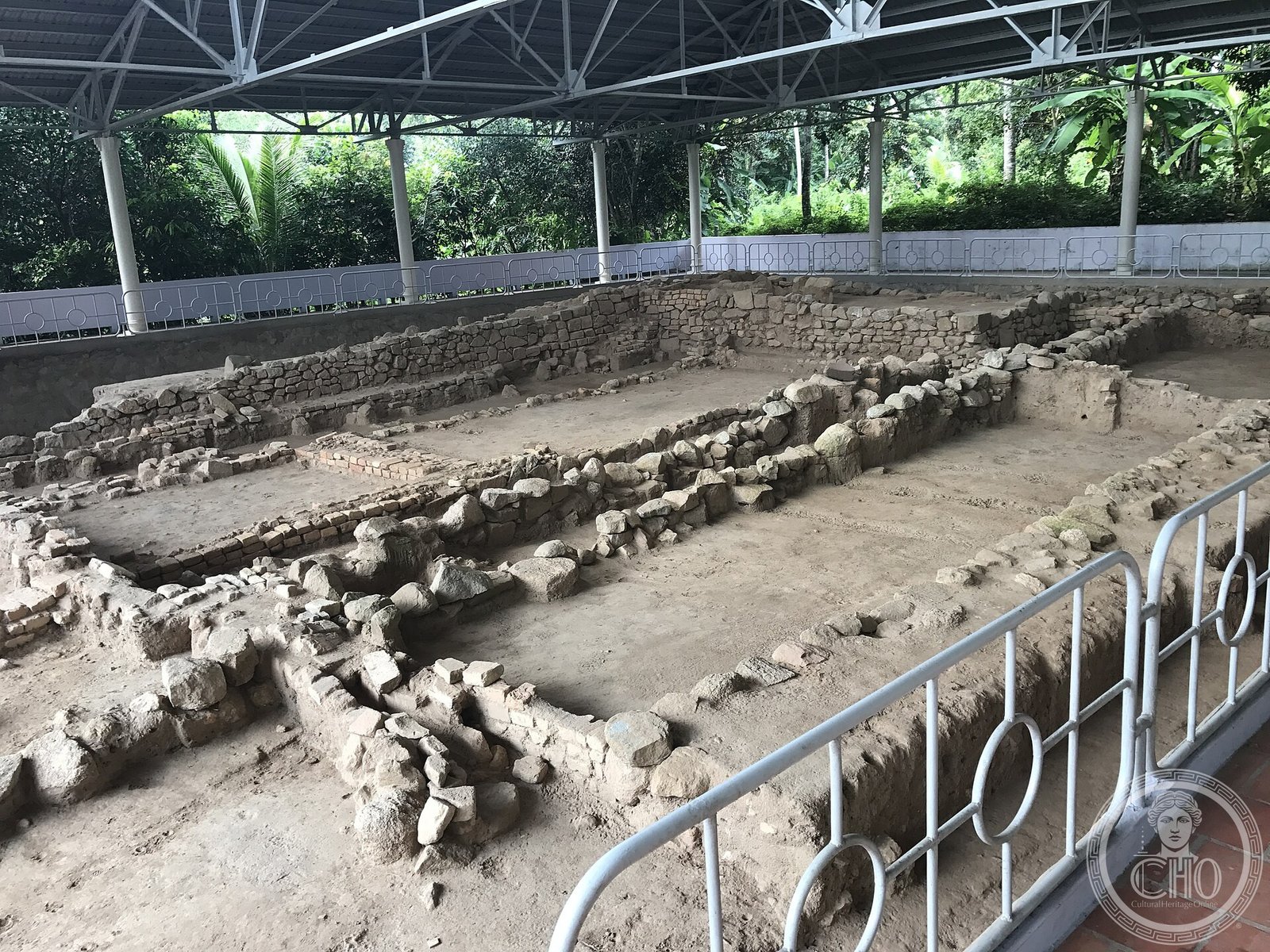
Óc Eo is primarily a below-ground archaeological site: the urban remains lie beneath the agricultural landscape of An Giang Province, and the visible archaeology is limited to excavated trenches, consolidated wall foundations, and the archaeological park developed around the principal excavation areas. The main visitor site is centred on the Nam Linh Son archaeological area, where the ruins of a significant brick structure — interpreted as a sanctuary or administrative building — are displayed in an open-air setting with interpretive panels. The canal system that once connected Óc Eo to the Mekong River network is still partially traceable in the landscape as subtle linear depressions or surviving waterways.
The Óc Eo Culture Museum in the town of Thoai Son (also known as Ba The) displays the most important portable finds from decades of excavation: Roman coins, Indian jewellery, Buddhist bronzes, Sanskrit-inscribed gold plates, Chinese ceramics, and the full range of imported and locally manufactured objects that document the extraordinary cosmopolitan culture of Funan-period Óc Eo. The nearby mountain of Nui Ba The — a granite inselberg rising sharply from the flat delta — served as a sacred site in the Funan period and contains rock-cut inscriptions and the ruins of early Hindu-Buddhist sanctuaries that are among the oldest in mainland Southeast Asia.
Practical information
- Museum: Oc Eo Culture Museum, Thoai Son town, An Giang Province; open daily except Monday; modest entrance fee
- Archaeological park: Nam Linh Son site, approximately 3 km from Thoai Son; open daily; minimal entrance fee
- Getting there: Approximately 70 km from Long Xuyen (An Giang provincial capital) or 200 km from Ho Chi Minh City; bus connections to Long Xuyen, then local transport to Thoai Son
- Best season: November–April (dry season); June–October flood season makes parts of the delta difficult to access
- Accommodation: Basic guesthouses in Thoai Son and Long Xuyen; more options in Can Tho (approximately 80 km south)
- Guides: English-speaking guides are rare locally; arrange through a Ho Chi Minh City tour operator for the most informative visit
Getting there
Óc Eo is reached from Ho Chi Minh City via highway to Long Xuyen (approximately 3.5–4 hours by bus or private car) and then south to Thoai Son district. Direct buses from Ho Chi Minh City Mien Tay bus terminal serve Long Xuyen; from Long Xuyen, local buses or motorbike taxis cover the remaining 30 km to Thoai Son. Some tour operators from Ho Chi Minh City and Can Tho offer day excursions to Óc Eo combined with other Mekong Delta sites; this is the most practical option for visitors without local language skills or knowledge of the site layout.
Nearby
- Nui Ba The (Three Peaks Mountain) — A sacred granite inselberg approximately 3 km from the main Oc Eo site; rock-cut inscriptions and ruins of early Hindu-Buddhist sanctuaries from the Funan period
- Long Xuyen — An Giang provincial capital on the Mekong; regional transport hub with better accommodation and the An Giang Museum with further Oc Eo finds
- Chau Doc — Mekong Delta town near the Cambodian border, approximately 60 km north; the floating markets and Sam Mountain are major regional attractions
- Can Tho — The main city of the Mekong Delta, approximately 80 km south; accessible floating markets and the starting point for most organised Mekong Delta tours
Sources
- Malleret, Louis. L acheologie du delta du Mekong. 4 vols. Paris: EFEO, 1959–1963. The foundational excavation report.
- Stark, Miriam T. The Transition to History in the Mekong Delta. Asian Perspectives 37(1), 1998.
- Higham, Charles. The Civilization of Angkor. London: Phoenix, 2001.
- Wikipedia contributors. Oc Eo. Wikipedia, The Free Encyclopedia. Retrieved June 2026.
- Wikipedia contributors. Funan. Wikipedia, The Free Encyclopedia. Retrieved June 2026.
Find it on the map
See this place and what’s around it →📷 Become a Cultural Heritage Online photographer
Share your photos of places: they stay published under your name as the author. The more they're seen, the more you get noticed — and soon a contest will reward the most appreciated photos.
Log in or sign up free to add a photo