

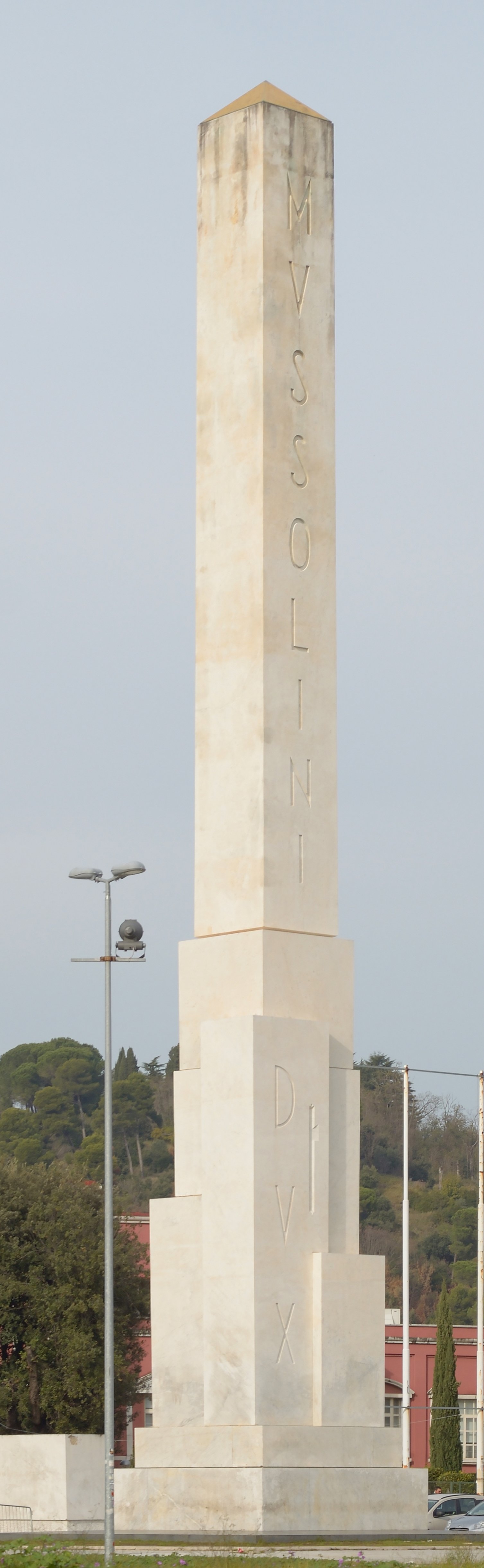
A 17.5-metre obelisk carved from a single block of white Carrara marble, erected on 29 October 1932 at the entrance of the Foro Mussolini sports complex. Its scale, its transport from the Apuan Alps to Rome and the unaltered “MVSSOLINI DVX” inscription make it one of the most discussed pieces of Italian Fascist-era architecture still standing in public space.
At a glance
The Obelisco del Foro Italico stands at the south-east entrance of the Foro Italico in Rome, on the axis of the Ponte Duca d’Aosta and at the head of a long avenue paved in black-and-white mosaic. It is one of the inaugural elements of the original Foro Mussolini, opened on 4 November 1932 alongside Palazzo H (the Fascist School of Physical Education), the Stadio dei Marmi and the future Stadio Olimpico. The shaft is a single block of white Carrara marble; the base carries the carved inscription “MVSSOLINI DVX”. The Italian Wikipedia entry, which redirects to the page of Renato Ricci, the political patron of the project, describes the monolith as the largest single block of marble ever quarried in modern times.
Key facts
- Type: commemorative obelisk (monolith)
- Material: white Carrara marble, single block from the “Carbonera” quarry
- Height: 17.5 metres above the base
- Weight at quarry: approximately 300 tonnes
- Designer of installation: Costantino Costantini, architect (commissioned 1929)
- Political patron: Renato Ricci, president of the Opera Nazionale Balilla
- Inauguration: 29 October 1932, for the tenth anniversary of the March on Rome
- Inscription: “MVSSOLINI DVX” carved on the base
History
The project originated in 1927 with Renato Ricci, deputy and government commissioner for the marble industry of Carrara, who proposed erecting an enormous monolith in Rome carved from a single Apuan block. After a long search, a suitable block was located in the “Carbonera” quarry: it measured around 19 metres in length, two metres at the base, and weighed close to 300 tonnes. It was extracted in late 1928 and, on 26 January 1929, the descent toward the coast began through the traditional Carrara technique of “lizzatura”. Thirty-six pairs of oxen were used; the operation took roughly five months to reach the sea.
At the end of June 1929 the monolith was loaded onto a specially built pontoon, the “Apuano”, at La Spezia and shipped to Fiumicino. From there it was towed up the Tiber, taking advantage of the river’s spring floods, and reached Rome on 6 May 1932. The carving of the shaft and the installation on the Foro Mussolini axis were entrusted by Ricci to the architect Costantino Costantini. The obelisk was unveiled on 29 October 1932 to mark the tenth anniversary of the March on Rome. It was originally topped by a gilt cuspid of pure gold weighing 32 kilograms, intended to protect the marble apex; the cuspid was stripped on 25 July 1943, in the hours that followed the fall of Mussolini’s government.
After the Second World War, the surrounding complex was renamed Foro Italico, but the monolith and its inscription were left in place. The obelisk has been the subject of recurring public debate over the decades: critics see the surviving “MVSSOLINI DVX” lettering as state endorsement of the Fascist regime, while preservation authorities have generally treated the ensemble of the Foro Italico as a historical and architectural document of the period. Visitors will not find a confirmed removal or modification dated in the major reference sources; the inscription is the original 1932 one.
What you see
From the Ponte Duca d’Aosta the avenue opens toward Monte Mario in a straight ceremonial line. The obelisk rises at its head, slender against the wooded slope: a polished shaft of white Apuan marble, its faces still showing the original 1932 carving rather than later additions. The proportions are deliberately classical, but the scale is not. A 17.5-metre column raised from a single piece of stone has no Roman antecedent in the city. Up close the surface reads as continuous marble: no joints, no inserts, no patched sections.
The base carries the inscription “MVSSOLINI DVX”, set in heavy capitals after Roman epigraphic models. Around the obelisk runs the black-and-white mosaic pavement of the Foro, with athletic motifs and dedicatory texts of the original Fascist programme. The setting belongs to the same coordinated project as the nearby Stadio dei Marmi, with its sixty statues of male athletes donated by the Italian provinces, and Palazzo H, the former seat of the Fascist Academy of Physical Education designed by Enrico Del Debbio.
Practical information
- Access: outdoor, free of charge, visible at all times from the public avenue
- Best light: late morning, when the south-east axis is fully lit and the polished marble reads strongly against the green slope of Monte Mario
- Time needed: 15 to 30 minutes for the obelisk and the immediate Foro Italico axis
- Combine with: a walk through the Stadio dei Marmi sculpture programme and a stop at the Stadio Olimpico esplanade
- Note: on Italian Open tennis days and major match days at the Stadio Olimpico the area is crowded and access can be regulated
Getting there
The Foro Italico lies on the right bank of the Tiber, north of the city centre. From central Rome, tram line 2 from Piazzale Flaminio runs to Piazza Mancini, a fifteen-minute walk across the Ponte Duca d’Aosta to the obelisk. The closest metro stop is Flaminio (line A), connected by tram 2. By car, the Lungotevere road runs along the river and parking is regulated around the sports complex. The obelisk stands at approximately 41.9341° N, 12.4559° E, at the southern end of the Foro Italico ceremonial avenue.
Nearby
- Stadio dei Marmi, Enrico Del Debbio’s ring of sixty marble athletes (1928-1932)
- Stadio Olimpico, originally Stadio dei Cipressi, later expanded for the 1960 Summer Olympics
- Ponte Duca d’Aosta on the Tiber, the formal entry axis of the Foro Italico
- Palazzo della Farnesina, seat of the Italian Ministry of Foreign Affairs since 1959
Sources
- Wikipedia (English), “Foro Italico”, https://en.wikipedia.org/wiki/Foro_Italico
- Wikipedia (Italian), “Renato Ricci” — section L’obelisco “Mussolini”, https://it.wikipedia.org/wiki/Renato_Ricci
- Wikimedia Commons, Category “Monolite Mussolini Dux”, https://commons.wikimedia.org/wiki/Category:Monolite_Mussolini_Dux
- Alberto Baini, “Un obelisco per il Duce”, Storia illustrata n. 360, November 1987 (cited in the Italian Wikipedia entry on Renato Ricci)
Find it on the map
See this place and what’s around it →📷 Become a Cultural Heritage Online photographer
Share your photos of places: they stay published under your name as the author. The more they're seen, the more you get noticed — and soon a contest will reward the most appreciated photos.
Log in or sign up free to add a photoIs this page about you?
This page is read by travellers and heritage enthusiasts who find it on Google. Tell us how you are connected to this place and we will take it from there.