
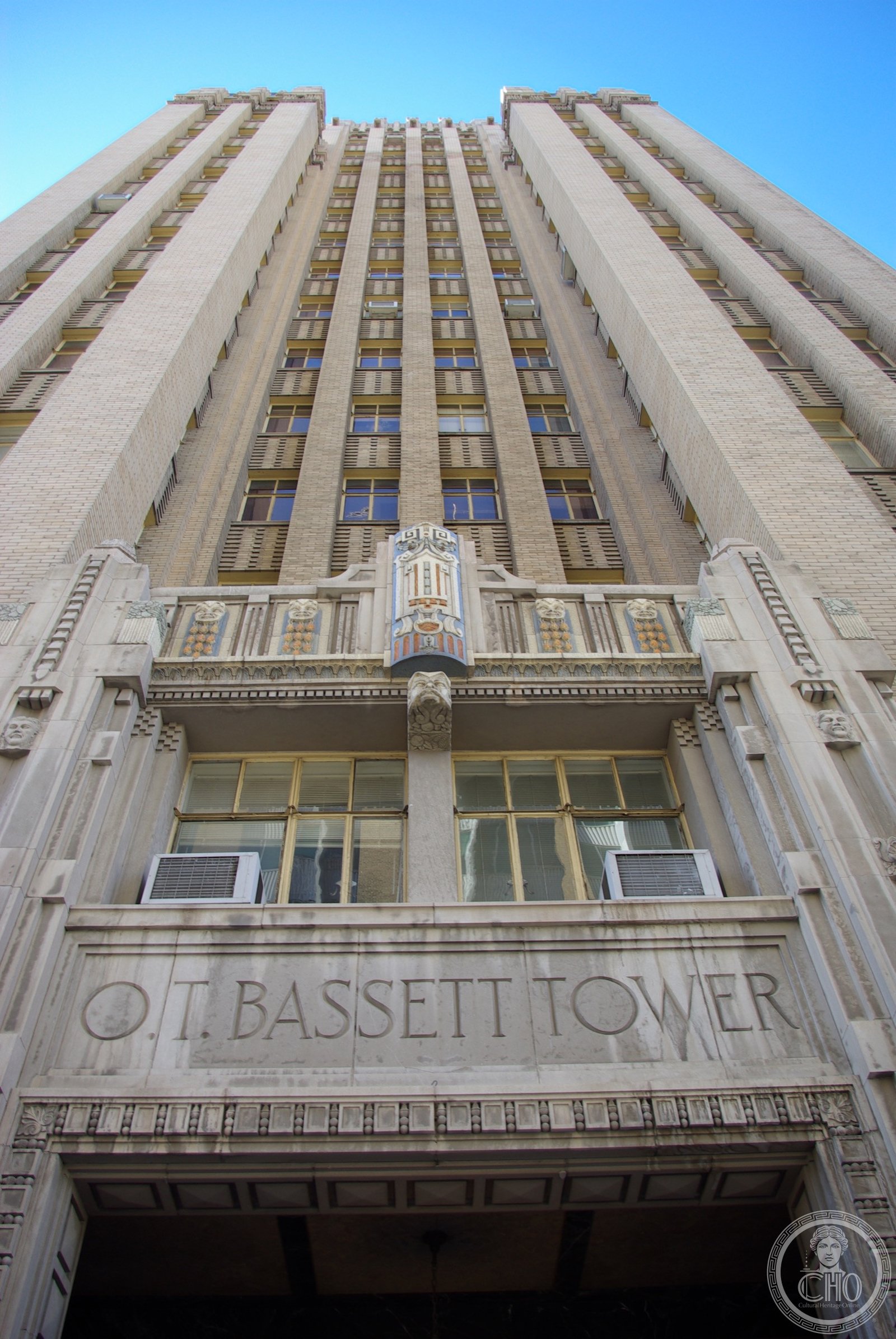
One of Henry Trost’s last commissions, this 15-story stepped Art Deco skyscraper with terra cotta ornament — including a sculpted face over the entrance believed to be Trost himself — briefly held the title of tallest building in El Paso.
At a glance
The O. T. Bassett Tower stands 217 feet on Texas Avenue in downtown El Paso, its tan brick and terra cotta facade rising in stepped setbacks at the tenth and thirteenth floors — a characteristic Art Deco massing vocabulary. Completed in 1930 as one of Henry Trost’s last commissions, it was briefly the tallest building in the city before being surpassed the same year by the Plaza Hotel. The building is listed on the National Register of Historic Places and retains its distinctive ornamental program, including a carved stone face above the main entrance widely attributed to Trost himself.
Key facts
- Completed: 1930 (construction started 1929)
- Style: Art Deco, Moderne, Stepped skyscraper
- Height: 217 feet (66 m); 15 stories
- Architect: Trost & Trost (Henry Trost — last commission)
- Contractor: Robert E. McKee
- Builder: Charles N. Bassett (named for his father, Oscar T. Bassett)
- Address: 303 Texas Avenue, El Paso, Texas
- National Register of Historic Places: September 24, 1980 (ref. 80004101)
History
Charles N. Bassett commissioned the tower to honor his father, Oscar T. Bassett, whose initials it still carries. Construction began in 1929 and the building was completed in 1930, entering a short-lived record as the tallest building in El Paso — a distinction it held only until the Plaza Hotel (later known as the Hilton Hotel) surpassed it later the same year.
The architect was Henry Trost of the firm Trost & Trost, which had shaped the architectural character of El Paso and the wider Southwest for several decades. Henry Trost designed the building in the Art Deco idiom then at its commercial peak — a vocabulary of geometric ornament, terra cotta cladding, and the setback massing that the 1916 New York Zoning Resolution had made the defining feature of American skyscraper design. The Bassett Tower was among his last major commissions; the building thus represents both the maturity of Art Deco in El Paso and the late work of one of the region’s defining architects.
The building was listed on the National Register of Historic Places in 1980, as part of a Multiple Property Submission covering the commercial structures of El Paso by Henry C. Trost. The contractor, Robert E. McKee, went on to found one of the largest construction companies in the American Southwest.
What you see
The tower’s surface is faced with tan brick veneer and ornamented with stone and terra cotta detailing. The massing follows the classic Art Deco stepped-back formula: the main shaft rises to the tenth floor, where the first setback reduces the plan on three sides; a second, smaller setback occurs at the thirteenth floor, culminating in a two-story capped section. This stepped profile, visible from multiple angles on Texas Avenue, gives the tower a sculptural presence that changes as you move around it.
The most individually striking feature is the carved stone face above the main entrance, widely believed to be a portrait of Henry Trost — an act of self-commemoration that, if accurate, places the architect’s likeness on what he knew would be among his final buildings. Terra cotta ornament appears throughout the facade in the geometric vocabulary typical of the style: angular patterns, abstracted foliage, and stepped forms that echo the setbacks of the massing.
Practical information
- Access: Office building; lobby accessible during business hours
- Exterior: Full facade visible from Texas Avenue and adjacent streets
- Key detail: Look for the carved face above the main entrance at street level
- Best time: Morning light illuminates the Texas Avenue facade; afternoon for the setback profiles
- Time needed: 20–30 minutes exterior circuit; lobby accessible if building is open
Getting there
The building stands at 303 Texas Avenue in downtown El Paso — at the intersection of Texas and Stanton Street, the core of the historic central business district. El Paso International Airport is approximately 5 miles northeast. The El Paso Streetcar (Sun Metro Brio and El Paso Streetcar) connects the downtown area. The Plaza Hotel, the building that surpassed Bassett Tower as El Paso’s tallest in 1930, stands a few blocks away on San Jacinto Plaza.
Nearby
- Plaza Hotel (1929/1930) — Hilton’s historic property that surpassed Bassett Tower as tallest building in El Paso the same year
- San Jacinto Plaza — El Paso’s historic central plaza, one block from the tower
- El Paso Museum of Art — downtown museum housing the Kress Collection of European masters
- Anson Mills Building (1910) — earlier El Paso landmark and predecessor in the city’s skyline narrative
Sources
- Wikipedia: O. T. Bassett Tower
- National Register of Historic Places — refnum 80004101 (listed September 24, 1980)
- Texas Historical Commission — NRHP Registration Form, with 1979-1980 photographs
- Multiple Property Submission: Commercial Structures of El Paso by Henry C. Trost, NRHP ref. 64000837
Find it on the map
See this place and what’s around it →Record researched and written by Luigi De Marchi for Cultural Heritage Online, 2026.
📷 Become a Cultural Heritage Online photographer
Share your photos of places: they stay published under your name as the author. The more they're seen, the more you get noticed — and soon a contest will reward the most appreciated photos.
Log in or sign up free to add a photoIs this page about you?
This page is read by travellers and heritage enthusiasts who find it on Google. Tell us how you are connected to this place and we will take it from there.