
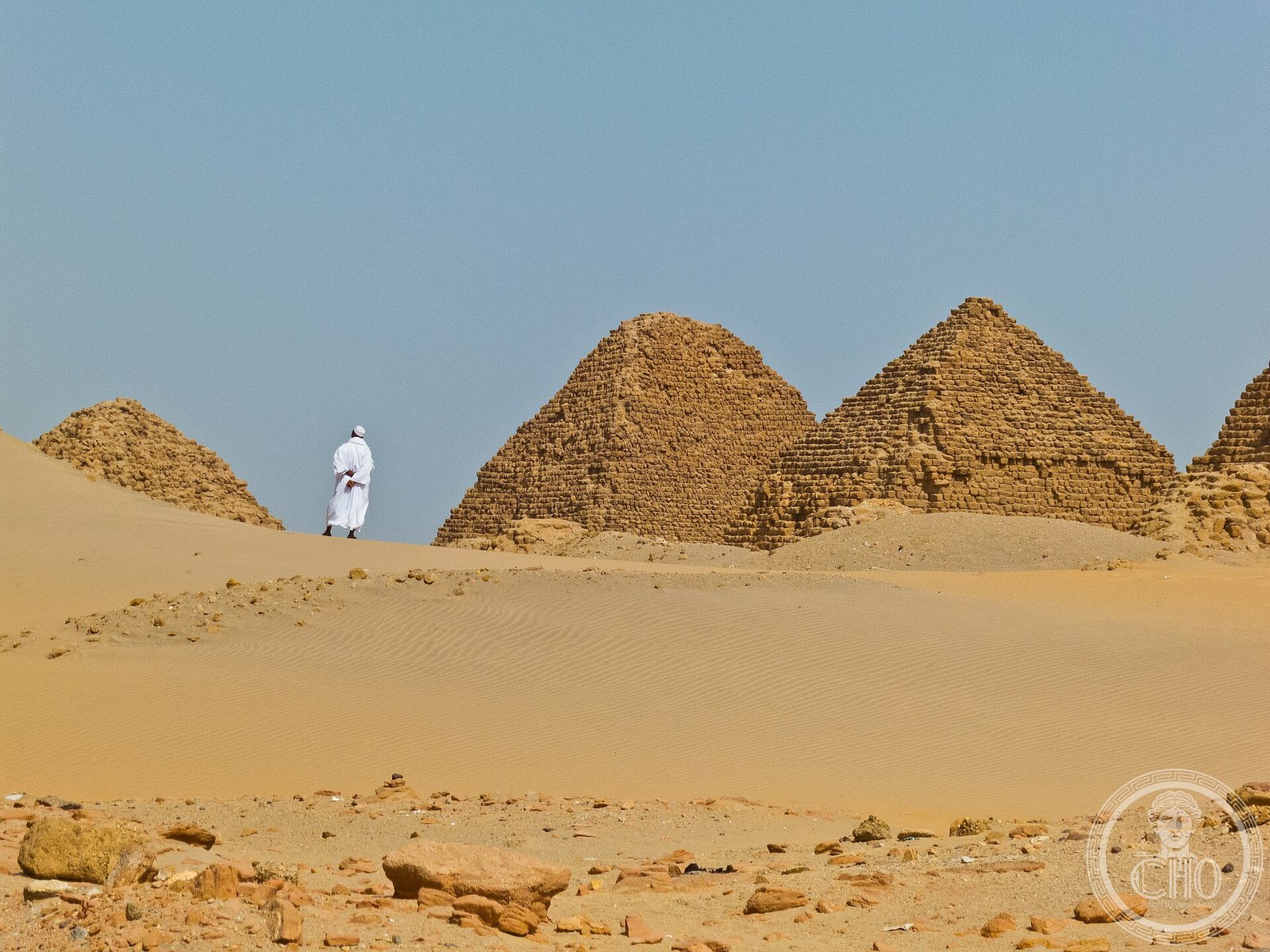
On the west bank of the Nile in northern Sudan, a field of 21 royal pyramids marks the principal burial ground of the Napatan kingdom — the Nubian dynasty that conquered and ruled all of Egypt, and whose greatest king, Taharqa, built the largest pyramid in the world after the Egyptian Old Kingdom.
At a glance
Nuri lies approximately 15 km upstream from Gebel Barkal in northern Sudan, on the west bank of the Nile. The site contains 21 royal pyramids and 53 subsidiary pyramid tombs marking the principal royal necropolis of the Napatan kingdom — the Nubian state descended from the 25th Dynasty pharaohs who ruled all of Egypt from 744 to 656 BC. Excavated by George Reisner of Harvard and the Museum of Fine Arts Boston between 1916 and 1923, the site remains one of the most significant and least-visited royal burial grounds in the ancient world. In 2019 an underwater archaeology team led by Pearce Paul Creasman documented the completely flooded burial chamber of Taharqa — the rising water table having inundated the subterranean chambers of most Nuri pyramids — revealing a carved ceiling of stone stars intact beneath the water.
Key facts
- Location: West bank of the Nile, approximately 15 km upstream from Gebel Barkal, Northern State, Sudan
- Period: c. 690–310 BC; Nubian 25th Dynasty and successor Napatan period
- Scale: 21 royal pyramids plus 53 subsidiary tombs
- Largest pyramid: Tomb of Taharqa — approx. 50 m tall on a 51 × 51 m base; largest pyramid by base area built after the Egyptian Old Kingdom
- Taharqa: Nubian pharaoh who held Egypt against the Assyrian invasion of 674 BC; mentioned in the Bible as Tirhakah; built a colonnade at Karnak comparable to the greatest Egyptian pharaohs
- 2019 discovery: Taharqa burial chamber documented completely underwater — rising water table has flooded the subterranean chambers of most Nuri pyramids
- UNESCO status: Part of the Archaeological Sites of the Island of Meroe, inscribed 2011; Nuri itself is in the broader Napatan cultural landscape under consideration
History
The Napatan kingdom arose from the Nubian state of Kush, centred on the sacred mountain of Gebel Barkal near the Fourth Nile Cataract. From this base, the Kushite king Piye (Piankhy) launched a military campaign in 744 BC that swept through all of Egypt, establishing the 25th Dynasty — the Nubian pharaohs who ruled the entire Nile Valley from Khartoum to the Mediterranean. Taharqa, the most celebrated of these pharaohs, built extensively throughout Egypt and Egypt Sudan: his colonnade at Karnak rivals anything built by native Egyptian dynasties, and his pyramid at Nuri dwarfs all other post-Old-Kingdom pyramids in sheer volume and base area. After the Assyrian invasions of 671 and 663 BC drove the Nubian pharaohs back into Sudan, their descendants continued to rule the Napatan kingdom, building pyramids at Nuri for a further four centuries. The tradition of royal pyramid burial — which Egypt itself had largely abandoned by this period — was preserved and adapted by Nubian kings who saw themselves as the legitimate heirs of Egyptian civilisation. The subsidiary tombs at Nuri include queens, princes, and court officials buried in smaller pyramids surrounding the royal tombs.
The pyramids were robbed in antiquity, their burial chambers stripped of their contents before the modern era. George Reisner excavation in 1916–1923 documented the site in meticulous detail, identifying each pyramid and its probable occupant through inscribed objects and architectural parallels. The rising water table — a consequence of modern irrigation schemes and the Merowe Dam completed in 2009 — has since flooded most of the subterranean burial chambers, creating a unique and alarming archaeological challenge. The 2019 Creasman expedition demonstrated that although the chambers have been filled with water for years, the carved stonework remains structurally intact beneath the surface, awaiting proper underwater excavation.
What you see
The pyramids of Nuri are steeper than their Egyptian counterparts — typically between 65 and 70 degrees — giving them a needle-like profile against the desert sky. They are built of rubble fill faced with dressed sandstone blocks, now largely stripped by stone robbers and erosion, giving most structures a stepped or ragged appearance. Taharqa pyramid dominates the site from a distance, its sheer mass distinguishing it from the surrounding field of smaller royal and subsidiary tombs. The entrance corridors and subterranean burial chambers, where accessible, show sophisticated stonecutting and in several cases carved relief decoration; Taharqa chamber retains a carved stone ceiling of stars that remains intact despite being completely underwater.
The site is open desert, unfenced, and essentially unmanaged by current Sudanese antiquities standards — visitors walk freely among the pyramids with no barriers or entrance fees. The surrounding landscape is flat agricultural land beside the Nile, with palms and the distant profile of Gebel Barkal visible to the south. The remoteness, silence, and sheer historical weight of the site — a royal burial ground of kings who ruled the ancient world at its peak — make Nuri one of the most profoundly affecting archaeological landscapes in Africa.
Practical information
- Access: No entrance fee; open desert site; no on-site infrastructure
- Getting there: The nearest town is Karima (approximately 15 km); most visitors travel from Khartoum by bus (8–10 hours north) or via the Nile ferry network
- Guided access: Strongly recommended; local guides in Karima can arrange transport to Nuri and the nearby sites of Gebel Barkal and Meroe
- Travel context: Sudan travel requirements change frequently; check current Foreign Ministry advisories and visa requirements before travel
- Best season: October–March; summer temperatures in northern Sudan routinely exceed 45°C
- Photography: Unrestricted at the open-air site; no tripod permits required
Getting there
Nuri is reached from Karima, the nearest town, approximately 15 km to the southeast. Karima is connected to Khartoum by bus (approximately 8–10 hours via the Nile Valley highway) and to Atbara by road. From Karima, the crossing to the west bank of the Nile requires a ferry or motorboat; local guides can arrange the full excursion combining Nuri with Gebel Barkal and the nearby Meroe island pyramid fields. There is no commercial airport at Karima; the nearest is at Khartoum, with domestic connections from major Sudanese cities.
Nearby
- Gebel Barkal — The sacred mountain of the Nubian pharaohs, approximately 15 km southeast of Nuri; temples of Amun and Mut cut into and built around the rock pinnacle
- Meroe Pyramids — The later royal pyramid field of the Meroitic kingdom, approximately 300 km southeast; a UNESCO World Heritage site with the largest surviving collection of Nubian pyramids
- Kerma — The ancient capital of the earlier Nubian kingdom of Kerma, approximately 200 km upstream; site of the massive mudbrick Deffufa temples
- Karima — The nearest town, with basic accommodation and access to the Nile ferry network
Sources
- Reisner, George A. Excavations at Kerma. Harvard African Studies 5–6. Cambridge: Peabody Museum, 1923.
- Kendall, Timothy. Gebel Barkal and the Egyptian Empire in Sudan. Boston: Museum of Fine Arts, 1997.
- Creasman, Pearce Paul et al. Flooded Royal Burial Chambers at Nuri, Sudan. Journal of Egyptian Archaeology, 2020.
- Wikipedia contributors. Nuri, Sudan. Wikipedia, The Free Encyclopedia. Retrieved June 2026.
- Wikipedia contributors. Taharqa. Wikipedia, The Free Encyclopedia. Retrieved June 2026.
Find it on the map
See this place and what’s around it →📷 Become a Cultural Heritage Online photographer
Share your photos of places: they stay published under your name as the author. The more they're seen, the more you get noticed — and soon a contest will reward the most appreciated photos.
Log in or sign up free to add a photo