
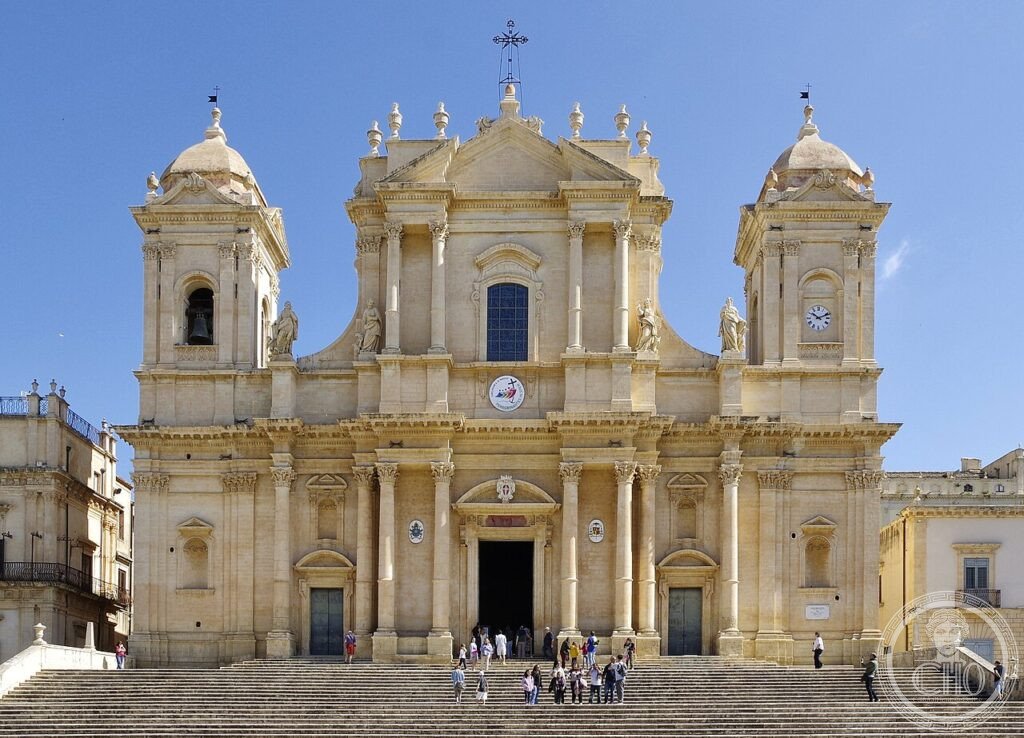
Noto was not rebuilt after the earthquake of 1693 — it was designed, from a blank meadow, as a complete Baroque city, the first and most coherent example of urban Baroque planning in Europe: a single main street (the Corso Vittorio Emanuele) lined with palaces and churches of uniform cornice height, punctuated by three piazzas that open from the street like theatrical stage sets, all built in local honey-gold limestone (pietra di Billiemi) that turns amber in the afternoon light, an effect so specific that Noto is referred to by Sicilians as “the capital of the Baroque.”
At a glance
Noto is the most complete example of planned Baroque urban design in the world, inscribed on the UNESCO World Heritage List in 2002 (ref. 1024) as part of the serial site “Late Baroque Towns of the Val di Noto” (8 cities in southeastern Sicily: Caltagirone, Militello Val di Catania, Catania, Modica, Noto, Palazzolo Acreide, Ragusa, Scicli). The city of Noto was entirely destroyed by the catastrophic earthquake of 11 January 1693 (estimated M 7.4, killing approximately 60,000 people across Sicily) and rebuilt on a new site (4 km from the original medieval Noto, known as Noto Antica) following a unified Baroque plan designed by engineers, architects, and the Sicilian Baroque master Rosario Gagliardi (1698-1762).
Key facts
- Terremoto del Val di Noto, 1693: The earthquake of 11 January 1693, estimated at magnitude 7.4-7.5, is the most destructive natural disaster in Italian history; it killed approximately 60,000-90,000 people in southeastern Sicily; it destroyed 50 towns and cities, including the medieval Noto; the decision to rebuild on the new site (4 km south, on a limestone ridge) rather than on the ruins was taken within days of the disaster and was unusually rapid for the period
- Corso Vittorio Emanuele: The main east-west street of Noto (width 10 m, length approximately 600 m); the entire street is lined with palaces and churches of uniform cornice height (the “law of the cornice” — all buildings must not exceed 4 floors, with the roofline maintaining a consistent visual horizon along the street); three piazzas open from the Corso at regular intervals (Piazza del Municipio, Piazza dell’Immacolata, and Piazza XVI Maggio), each framed by a major church on a raised platform with a monumental staircase
- Cattedrale di San Nicolò di Mira: The principal church of Noto (1703-1776, architect Giovanni Battista Landolina; facade Rosario Gagliardi); the dome collapsed in 1996 and was restored and reopened in 2007; the current facade (two bell towers flanking the central three-bay facade with columns, pilasters, and entablature) is the most reproduced image of Sicilian Baroque architecture
- Palazzo Villadorata (Palazzo Nicolaci): Via Corrado Nicolaci; 1737; the most spectacular noble palace in Noto; the facade is decorated with 6 ranks of balconies supported by corbels carved as mythological creatures, monsters, lions, horses, and cherubs — a catalogue of Baroque sculptural invention; the Infiorata (flower-petal carpet on the via Nicolaci) takes place annually in May on this street
- UNESCO: 2002, ref. 1024 — “Late Baroque Towns of the Val di Noto” (8 cities)
- GPS: 36.8926, 15.0720 — Google Maps
History
The earthquake of 1693 gave the administrators, architects, and aristocratic patrons of southeastern Sicily an extraordinary and unprecedented opportunity: the ability to design an entire city from scratch, without the constraints of existing streets, property lines, or medieval fortifications. The choice of site for the new Noto was made by the viceroy’s engineer, Carlos de Grunenbergh, within three weeks of the earthquake; the plan was a rational Baroque grid, with a main axis (the future Corso Vittorio Emanuele) aligned east-west on the limestone ridge to take advantage of the views and the prevailing breeze, with secondary streets running perpendicular to the main axis, with convents and churches positioned on elevated sites above the street level to create visual terminations for the cross-streets.
The construction of the new city proceeded over approximately 80 years (1693-1776) under the direction of a succession of local architects, most importantly Rosario Gagliardi (1698-1762), who designed or influenced the design of the most important public buildings (the three main churches on the Corso, the Convento di San Francesco d’Assisi, the Convento di Santa Maria dell’Arco). The building material throughout is the local pietra di Billiemi (a soft limestone quarried from the ridge on which the city stands), which is easy to carve in detail when freshly quarried but hardens on exposure to air; the warm honey-yellow colour of the stone is the defining visual quality of Noto at any time of day, but most dramatically in the late afternoon when the low sun strikes the carved facades directly.
What you see
Noto is experienced as a walk along the Corso Vittorio Emanuele from the Porta Reale (the triumphal arch at the west end, 1838) to the Piazza XVI Maggio (the east end, with the church of San Domenico). The sequence of three piazzas along the Corso — each with a major church on a raised platform reached by a monumental staircase — is the defining spatial experience: the piazzas open suddenly from the relatively narrow Corso (the visual compression of the street followed by the sudden expansion of the piazza is a calculated Baroque theatrical effect).
The most important building in Noto is the Palazzo Nicolaci di Villadorata (Via Nicolaci 18, parallel to the Corso one block north): the 6-story facade with its extraordinarily carved balcony corbels — each corbel a different mythological creature (centaurs, horses, lions, sphinxes, cherubs, mermaids) carved in the warm pietra di Billiemi — is the finest piece of decorative sculpture in the Sicilian Baroque. The via Nicolaci itself hosts the annual Infiorata di Noto in May (a petal carpet covering the entire street in a floral design, one of the most photographed street festivals in Sicily).
Gallery
Practical information
- Access: The historic centre of Noto is a ZTL (Limited Traffic Zone) for private vehicles; park outside the Porta Reale (large free car park on Via Napoli) and walk the Corso. The Corso Vittorio Emanuele and the main piazzas are always accessible (outdoor public spaces; no ticket required). The Cathedral interior (open 9:00-18:00; free) and the Palazzo Nicolaci (guided tours; ~€5; reduced hours in winter) require separate entry.
- Best time: May for the Infiorata (petal carpet on via Nicolaci, typically the third Sunday of May); September-October for the best light and least crowded conditions; July-August is very hot (35-40°C in the narrow streets).
- Duration: 2 hours for the Corso + main piazzas + Cathedral + Palazzo Nicolaci exterior. 3-4 hours with the Palazzo Nicolaci interior, the Convento del Santissimo Salvatore, and the Noto Antica ruins (4 km north).
Getting there
Corso Vittorio Emanuele, Noto (SR), Sicilia. By train: Trenitalia from Siracusa (28 km north; 35 min by train); from Catania (90 km north-west; 1h30 via Siracusa). The station is 500 m south of the Porta Reale. By car: from Siracusa, SS115 south (28 km, 30 min); from Palermo, A19 east to Catania then SS114 south (230 km, 2h45); from Catania, A18 south then SS115 (65 km, 1h).
Nearby
- Siracusa (Ortigia) — 28 km north; the island of Ortigia (the ancient Greek city-centre) with the Cathedral of Siracusa (built inside the Temple of Athena, 5th century BCE — the earliest Christian adaptation of a Greek temple in Sicily), the Fonte Aretusa (freshwater spring at the waterfront, mythological spring of the nymph Arethusa), and the Museo Archeologico Paolo Orsi (the most important Greek-Sicilian collection in the world; the Landolina Venus, the Ephebe of Adrano, the gold tiaras from Pantalica)
- Modica — 30 km west; another of the 8 Late Baroque cities of the Val di Noto (UNESCO 2002); the two main churches (San Giorgio and San Pietro) are on terraces above the valley — both Gagliardi-attributed; famous for the cioccolato di Modica (Aztec-process chocolate without added fats, made since the 17th century)
- Riserva Naturale di Vendicari — 20 km south; the most important bird sanctuary in southeastern Sicily (flamingos, herons, spoonbills, black storks in migration); archaeological site of Eloro (Greek, 7th century BCE) at the north end of the reserve; Torre Sveva (Norman-Hohenstaufen watchtower, 13th century CE) on the beach
Sources
- UNESCO: whc.unesco.org/en/list/1024
- Wikipedia EN: Noto
- Tobriner, Stephen: The Genesis of Noto: An Eighteenth-Century Sicilian City, A. Zwemmer, London, 1982
- Comune di Noto: comunenoto.it
Find it on the map
See this place and what’s around it →📷 Become a Cultural Heritage Online photographer
Share your photos of places: they stay published under your name as the author. The more they're seen, the more you get noticed — and soon a contest will reward the most appreciated photos.
Log in or sign up free to add a photo