

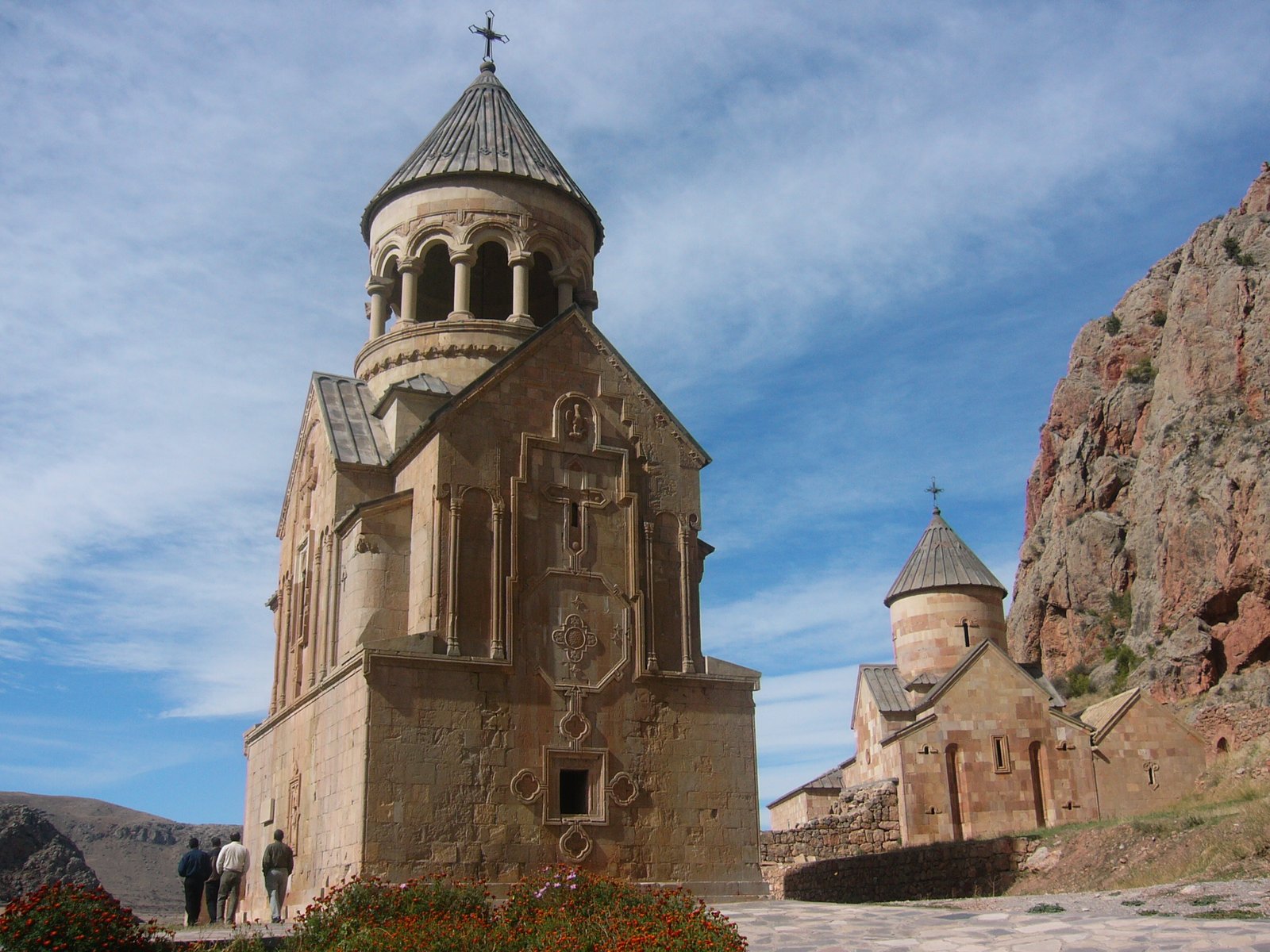
A medieval Armenian monastic complex clinging to a cliff ledge in a narrow crimson limestone gorge — among the most dramatically sited sacred buildings in the world and a masterwork of 13th-14th century Armenian sculptural architecture.
At a glance
Noravank (meaning “new monastery” in Armenian) occupies a ledge cut by the Amaghu River through the volcanic highlands of Vayots Dzor province in southern Armenia, approximately 122 km south of Yerevan. Founded in 1205 by Bishop Hovhannes Orbelian and expanded under Orbelian princes through the 13th and early 14th centuries, the complex served as the dynastic mausoleum and spiritual centre of the lords of Syunik. Its two principal churches — Surb Karapet (1216–1227) and Surb Astvatsatsin (1339) — are among the finest surviving examples of Armenian high medieval sacred architecture, combining structural ambition with exceptional relief carving. The surrounding canyon walls of deep red and ochre limestone frame the complex in a setting that has made it one of the most photographed monuments in the South Caucasus.
Key facts
- Founded: 1205 AD by Bishop Hovhannes Orbelian; expanded to 1339 AD
- Patrons: The Orbelian princes, rulers of Syunik under Mongol suzerainty
- Principal churches: Surb Karapet (St. John the Baptist, 1216–1227) and Surb Astvatsatsin (Holy Mother of God, 1339)
- Master sculptor: Momik, active at Noravank c. 1300–1339; also designed illuminated manuscripts
- Notable first: The 1308 relief above Surb Karapet portal is the earliest known dated image of God the Father in Armenian art
- UNESCO status: On Armenia’s Tentative List for World Heritage designation
- Canyon geology: Eocene-age volcanic limestone with iron-oxide colouration producing the red-ochre canyon walls
History
Noravank was founded in 1205 when Bishop Hovhannes Orbelian established a monastery on the Amaghu River gorge as a seat of the Bishop of Syunik. The Orbelian family, who ruled Syunik as semi-autonomous princes first under the Ilkhanate (Mongol) and later under the Kingdom of Georgia, developed the complex as their dynastic mausoleum and cultural centre. The 13th century was a period of intense intellectual and artistic activity in Armenian Syunik despite Mongol overlordship: Noravank became a centre of manuscript illumination, stone carving, and theological education, attracting craftsmen of the highest calibre.
The architectural development spans the entire 13th and early 14th centuries. Surb Karapet was built 1216–1227; its gavit (narthex), added 1261, was decorated with relief carvings including a full-face image of God the Father executed in 1308 by the master Momik — a theological and artistic innovation in Armenian Christian iconography. The second church, Surb Astvatsatsin, was completed in 1339, the last major construction at Noravank, representing the culmination of the Orbelian building programme. After the decline of the Orbelian princes in the late 14th century, Noravank continued as an active monastery but received no further major architectural patronage.
The Mongol period (1236–1345) was paradoxically favourable for Armenian ecclesiastical art: Mongol khans generally tolerated and sometimes patronised Christian institutions, and the Orbelians leveraged their position as intermediaries between the Mongol court and the Armenian population to accumulate resources for monastic construction. Noravank’s flourishing under Mongol suzerainty exemplifies how Armenian architectural patronage adapted under political subordination, producing some of the finest medieval buildings in the entire Caucasus region.
What you see
The most photographed structure of the complex is the Church of Surb Astvatsatsin (1339): a two-storey building whose upper chapel is reached by a narrow external staircase climbing the facade. The staircase projects from the first-storey portal so narrowly that it must be climbed facing the wall, using hand-holds carved into the stone — a design that reads simultaneously as an engineering solution to limited terrace space and as architectural theatre. The relief carvings on the Surb Astvatsatsin facade are by the master Momik and include representations of the Evangelists, eagles, and interlaced geometric ornament typical of high medieval Armenian stone-cutting.
The older Surb Karapet church (1216–1227) is the larger of the two principal buildings. Its attached gavit (assembly hall, 1261) is a high-ceilinged vaulted chamber whose keystones bear carved reliefs. The 1308 relief above the central portal — showing God the Father as a bearded figure flanked by angels, the earliest known dated image of this iconographic type in Armenian art — is the most theologically significant carving in the complex. The canyon walls behind rise nearly vertically to heights of 80–100 metres in deep shades of red, rust, and amber limestone, dramatically framing the pale-grey masonry of the churches.
Practical information
- Open: Daily, generally sunrise to sunset; small admission fee supports conservation
- Distance from Yerevan: 122 km south via the M2 highway; approximately 1.5–2 hours by car
- Canyon road: A 10 km single-lane road runs through the Amaghu gorge from Areni village to the monastery; the drive is itself a highlight
- Facilities: Small visitor car park, souvenir stalls; Areni village has a winery and the Areni-1 cave nearby
- Best seasons: Late April–June and September–October; canyon walls catch dramatic morning and afternoon light
- Dress code: Active Orthodox church — shoulders and knees covered for entry into the churches
Getting there
Noravank is most conveniently reached by private car or taxi from Yerevan (approximately 122 km, 1.5–2 hours). Shared minibuses (marshrutkas) run from Yerevan’s Kilikia bus station to Yeghegnadzor; from there, local taxis cover the remaining distance to the monastery. Tour operators in Yerevan offer day trips combining Noravank with the Areni-1 wine cave and Khor Virap monastery. The gorge road from Areni village is not served by public transport.
Nearby
- Areni-1 Cave — 10 km west; site of the world’s oldest known winery (c. 4100 BC) and the earliest leather shoe; active archaeological excavation
- Khor Virap Monastery — 90 km north; 4th-century site where Gregory the Illuminator was imprisoned; iconic views of Mount Ararat
- Selim Caravanserai — 40 km northeast; 14th-century Silk Road caravanserai, one of the best-preserved in Armenia
- Tatev Monastery — 75 km southeast; 9th-century monastic complex reached by the world’s longest reversible aerial tramway
Sources
- Thierry, Jean-Michel. Armenian Art. New York: Abrams, 1989.
- Cuneo, Paolo. Architettura armena. Rome: De Luca, 1988.
- UNESCO Tentative List: Noravank Monastery Complex (Armenia), nomination dossier.
- Mnatsakanian, Stepan. Noravank. Yerevan: Hayastan Publishing, 1975.
- Wikipedia contributors. “Noravank.” Wikipedia, The Free Encyclopedia. Wikimedia Foundation.
Find it on the map
See this place and what’s around it →📷 Become a Cultural Heritage Online photographer
Share your photos of places: they stay published under your name as the author. The more they're seen, the more you get noticed — and soon a contest will reward the most appreciated photos.
Log in or sign up free to add a photo