

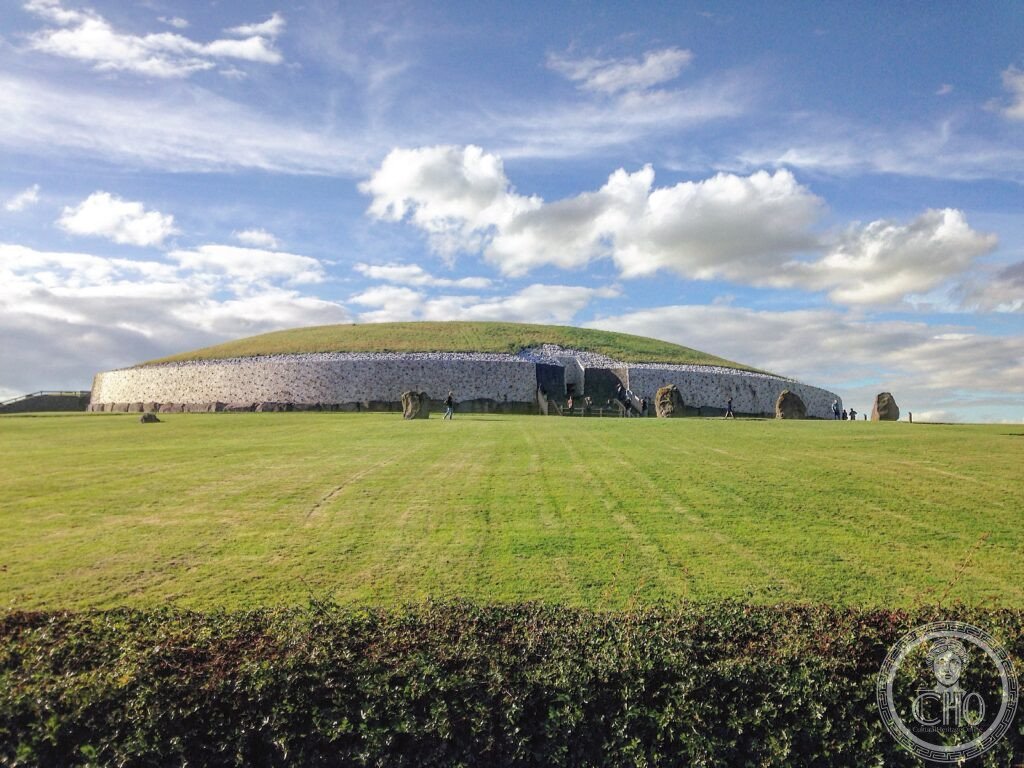
Newgrange
The most precisely astronomical monument in the Neolithic world and the oldest intact building on earth — Newgrange (Brú na Bóinne; County Meath, Ireland; UNESCO WHS 1993) is a passage tomb built around 3200-3100 BCE, approximately 600 years before the Egyptian pyramids and 1,000 years before Stonehenge, aligned with absolute precision on the winter solstice sunrise.
At a glance
Newgrange (the most precisely NewgrangeIreland single Brú na Bóinne Bend in the Boyne Boyne River valley County Meath Ireland County Meath 50 km north Dublin 3200 3100 BCE passage tomb megalithic construction 97 kerbstones encircling base 200000 tonnes stone 200 tonnes white quartz facing front facade imported from Wicklow Mountains 80 km south 450 tonnes granite orthostats uprights 30m south River Boyne 43 additional satellite tombs Brú na Bóinne area Knowth Dowth two other major passage tombs same UNESCO site Newgrange passage tomb 19m passage leading to cruciform cross-shaped central chamber 6.1m high corbelled vault passage tomb use 500 years 2700 2500 BCE abandoned sealed winter solstice December 21 alignment most precisely aligned ancient monument in the world 17 minute window sunrise December 19 23 light enters roof-box (a deliberately constructed aperture above the entrance) travels entire 19m passage and illuminates the triple spiral carved stone at the back of the central chamber UNESCO heritage: the rediscovery of the winter solstice alignment (the most precise astronomical discovery in archaeology): when the passage tomb of Newgrange was first excavated in 1962-1975 CE by M.J. O’Kelly (Professor of Archaeology at University College Cork), local farmers reported a “roof-box” above the entrance — a deliberate aperture constructed by the Neolithic builders above the entrance lintel; in 1967 CE, on the morning of the winter solstice (December 21), O’Kelly lay alone in the central chamber at sunrise and watched the light enter the roof-box, travel the 19m passage, and illuminate the chamber floor — the first person to observe this phenomenon in approximately 4,500 years; the precision of the alignment was subsequently verified by surveying instruments: the solar event occurs only in a 17-minute window on approximately five days around the solstice (December 19-23); the alignment was deliberate and was designed into the monument 5,200 years ago)) — the most precisely NewgrangeIreland single 3200 3100 BCE 97 kerbstones 200000 tonnes 200 tonnes white quartz Wicklow 80 km 450 tonnes granite 19m passage cruciform chamber 6.1m high corbelled vault Knowth Dowth same UNESCO WHS 1967 CE O’Kelly discovered solstice alignment alone chamber December 21 first person 4500 years verification 17 minute window December 19 23 deliberate 5200 years ago UNESCO heritage in any UNESCO world heritage site)).
Key facts
- The triple spiral (the first known use of the triple spiral in art): the most precisely NewgrangeIreland single triple spiral triskelion carved stone C10 back wall central chamber Newgrange 3200 BCE the most famous megalithic art motif in Ireland triple spiral 3200 BCE oldest known triple spiral in world predates Celtic triple spiral culture triskelion by 2500 years Celtic peoples arrived Ireland 500 BCE or later meaning of triple spiral unknown modern interpretations: three seasons (spring summer autumn winter = 4 but three-fold annual cycle), three states of the sun (rising mid-height setting), three lives or reincarnations in Irish mythology In Irish mythology Brú na Bóinne residence of Dagda Irish god father creator Aengus Óg son of Dagda river and sun goddess Boann Boyne river named after Boann Irish mythology rich associations with site UNESCO heritage — the most reproduced prehistoric symbol in the world: the triple spiral (triskelion) carved on the back stone (C10) of the central chamber at Newgrange (ca. 3200 BCE) predates the Celtic triple spiral motif (ca. 700-500 BCE) by approximately 2,500 years; the Newgrange triple spiral is the oldest known three-dimensional expression of the triple spiral; the spiral at Newgrange is carved in low relief on a stone approximately 0.5m × 0.5m, placed at the exact point where the winter solstice sunrise illuminates the chamber; this may be coincidental (the stone is also a structural upright supporting the corbelled vault) or may be the most concentrated point of intentional symbolism in the entire monument; the triple spiral has been reproduced worldwide as a symbol of Ireland, as the emblem of the Irish Presidency, and as a symbol of Celtic spirituality — a 5,200-year-old trademark
- GPS: 53.6947° N, -6.4759° E
History
From Neolithic construction to Irish mythology to Williamite land grant to modern UNESCO site (the most precisely NewgrangeIreland single 3200 3100 BCE Neolithic farmers built Newgrange passage tomb Irish Neolithic farming culture 4000 3000 BCE cattle wheat barley pigs farming culture Boyne Valley fertile river valley 500 year use period 3200 2700 BCE passage tomb used unknown purpose burial ritual symbolic astronomical 2700 2500 BCE deliberate sealing blocking entrance stone placed blocking access sealed for use 5000 years 1142 CE Cistercian monks Mellifont Abbey granted Newgrange lands to farm 13th 17th century CE Newgrange estate part New Grange farm Anglo-Norman land grants 1699 CE Charles Campbell landowner digging to remove limestone building material workers broke through entrance accidentally discovered chamber first modern European discovery 18th 19th century CE various antiquarian visits limited excavation Sir William Wilde Oscar Wilde’s father 1849 CE wrote first accurate description 1962 1975 CE Michael J O’Kelly University College Cork systematic excavation first scientific excavation Newgrange 1967 CE O’Kelly solstice alignment discovery 1993 CE UNESCO Brú na Bóinne UNESCO heritage: the winter solstice lottery (the most extraordinary modern use of an ancient monument): the 17-minute winter solstice sunrise light event can only be experienced by approximately 50-100 people per year (the inner chamber holds approximately 7-10 people; the light event occurs for approximately 17 minutes on the 5 days around the solstice); the Office of Public Works (OPW) Ireland runs an annual lottery for the solstice places; applications are open to anyone (Irish citizens and international visitors alike); approximately 30,000-40,000 people apply annually for approximately 50 places in the inner chamber; the waiting list (until recently) extended for approximately 10-15 years if every applicant entered only once; to observe the solstice light from inside the chamber of Newgrange is the most coveted single archaeological experience in Ireland)) — the most precisely NewgrangeIreland single 3200 3100 BCE Neolithic farming cattle wheat barley Boyne Valley fertile 500 year use 2700 2500 BCE sealed blocked 5000 years 1142 CE Cistercian Mellifont Abbey 1699 CE Charles Campbell workers limestone broke through entrance discovered 18th 19th century CE William Wilde Oscar Wilde father 1849 CE 1962 1975 CE O’Kelly systematic excavation 1967 CE O’Kelly alone chamber solstice December 21 first person 4500 years 1993 CE UNESCO 30000 40000 lottery applications 50 places annual winter solstice UNESCO heritage in any UNESCO world heritage site)).
What you see
The kerbstone art, the passage, and the corbelled chamber (the most precisely NewgrangeIreland single 97 kerbstones encircling base 200000 tonnes mound most famous Kerbstone K1 entrance stone 3m long spirals lozenges chevrons concentric rectangles curvilinear megalithic art most complex decorated kerbstone Neolithic world passage 19m long 90cm wide 1.8m high at entrance narrowing at end you must crouch toward end central chamber 6.1m high corbelled vault corbelling technique no mortar each ring of stones slightly inset from ring below creating upward narrowing dome 5000 years structurally intact without repair water-tight roof-box deliberately constructed aperture above entrance 25cm × 25cm allows solstice sunlight to enter passage deliberately different from modern reconstruction O’Kelly 1962 1975 original position not exact triple spiral C10 back stone of chamber left recess right recess back recess three recesses three stone basins 1000 kg granite Wicklow basins used cremated remains originally three satellite tombs Site A Site B Site C small passage tombs nearby mound white quartz facade partially restored UNESCO heritage: the engineering of the corbelled vault (the most intact Neolithic roofing technique): the corbelled vault of Newgrange’s central chamber (6.1m internal height; 5,200 years old) is the oldest intact corbelled roof in the world; the construction technique: 7 rings of large flat stones, each ring corbelled (cantilevered slightly inward over the previous ring), gradually narrowing toward the capstone at the top; the entire structure weighs several hundred tonnes and has remained completely waterproof without any restoration or maintenance for 5,200 years — a longer engineering record than any other roofed structure; the mortar-free construction uses only the weight, fit, and compression of the stones; the drainage channels cut into the top surfaces of the stones direct rainwater outward, not inward)) — the most precisely NewgrangeIreland single 97 kerbstones Kerbstone K1 3m spirals lozenges concentric rectangles most complex decorated Neolithic world 19m passage 90cm wide crouch narrow end 6.1m corbelled vault 5000 years structurally intact waterproof no repair roof-box 25cm × 25cm solstice light triple spiral C10 back chamber 3 recesses left right back 3 stone basins granite cremated remains 1000 kg UNESCO heritage in any UNESCO world heritage site)).
Practical information
- Getting there: the Brú na Bóinne Visitor Centre (all visits to Newgrange and Knowth are managed from here; there is no direct public access to Newgrange except by tour from the visitor centre; visitors must book in advance (especially in summer)); from Dublin: bus Éireann service 100 from Busáras Central Bus Station to Drogheda (1h10m; €12 return) then local bus to the Brú na Bóinne Visitor Centre (approximately 9 km west of Drogheda; limited local bus service; taxi approximately €15); or drive from Dublin (50 km; N2 to N51; 1h); the Brú na Bóinne Visitor Centre entry and Newgrange tour (€9 for the Visitor Centre + Newgrange tour; €14 for Visitor Centre + Newgrange + Knowth; book in advance online (bruna-boinne.ie); the most popular tourist site in Ireland — fully booked days or weeks in advance in summer); the winter solstice lottery (open September-October each year; applications online at heritageireland.ie; approximately 30,000 applicants for 50 places; the most coveted archaeological experience in Ireland)); the visiting time (2h minimum for the Visitor Centre + Newgrange tour; 3h for the complete Brú na Bóinne UNESCO site including Knowth; the tours are guided and have fixed departure times — allow extra time if visiting Knowth separately); the best time (any time of year; the solstice experience in December is accessible only via the lottery; the monument is equally impressive in any season; June-August is the busiest period and advance booking is essential))
Getting there
From Dublin: drive 50 km (N2/N51, 1h) or bus to Drogheda then taxi. Brú na Bóinne Visitor Centre: all tours depart from here, book in advance (bruna-boinne.ie). Entry + Newgrange tour €9; add Knowth €14. Winter solstice: annual lottery (September-October; heritageireland.ie). GPS: 53.6947, -6.4759.
Nearby
- Knowth — 1.5 km west (the largest passage tomb in the Brú na Bóinne complex; more decorated kerbstones than Newgrange (127 vs 97); the two passage tombs aligned on the equinox (not the solstice); the most concentrated megalithic art in Europe; guided tours depart from the Brú na Bóinne Visitor Centre; included in the combined ticket)
- Hill of Tara — 20 km south (the ceremonial and political centre of ancient Ireland; the seat of the High Kings of Ireland (5th-10th century CE); the Mound of the Hostages (a small passage tomb ca. 2500 BCE; pre-dating Tara’s political role); the Stone of Destiny (Lia Fáil; a standing stone reputed to cry out when the rightful High King of Ireland stood on it); no admission charge; freely accessible; one of the most atmospheric sites in Ireland))
Sources
- Wikipedia, Newgrange; Brú na Bóinne; Michael J. O’Kelly, accessed June 2026
- UNESCO, Brú na Bóinne – Archaeological Ensemble of the Bend of the Boyne, WHS reference 659, inscribed 1993
Find it on the map
See this place and what’s around it →📷 Diventa un fotografo di Cultural Heritage Online
Condividi le tue foto dei luoghi: restano pubblicate con la tua firma come autore. Più vengono viste, più ti fai conoscere — e presto un concorso premierà le foto più apprezzate.
Accedi o registrati gratis per aggiungere una foto