

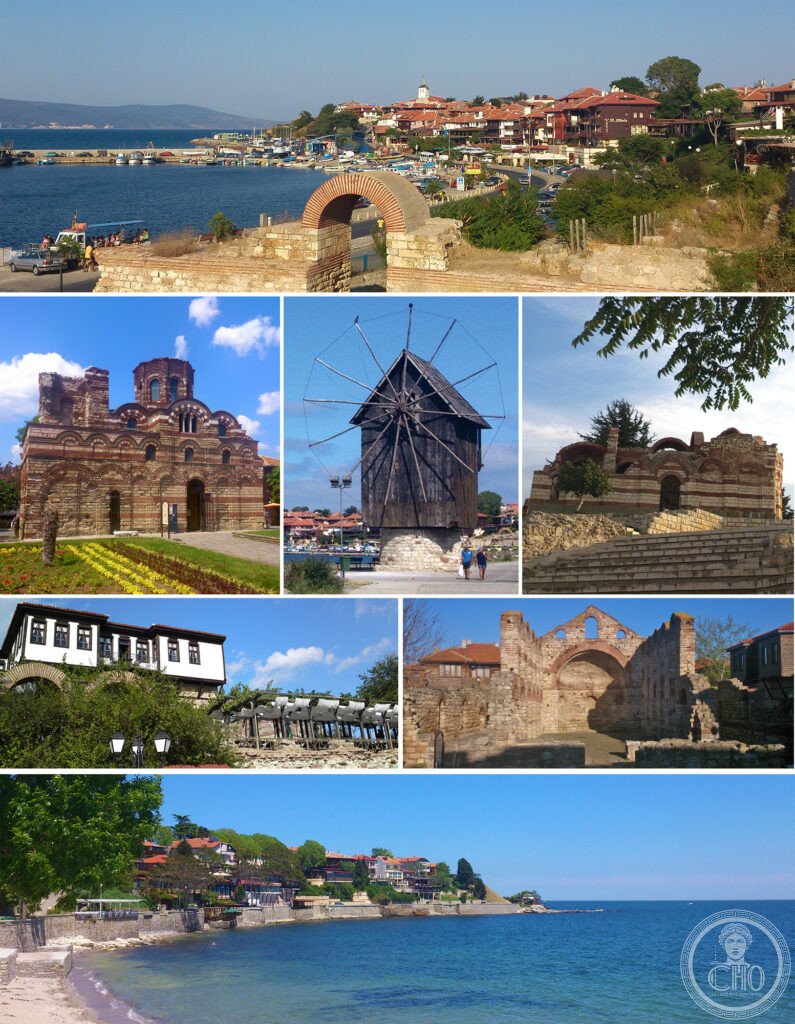
A rocky headland on Bulgaria’s Black Sea coast holds three thousand years of building on top of building: Thracian foundations under Greek and Roman remains, Byzantine churches raised one after another, and timber-framed houses of the Bulgarian National Revival set directly on the older stone. The whole sequence survives within a peninsula barely 400 metres across.
At a glance
Nessebar occupies a narrow rocky peninsula on Bulgaria’s southern Black Sea coast, joined to the mainland by a short isthmus. Known in antiquity as Mesembria, it was settled by Thracians, colonised by Dorian Greeks, absorbed by Rome, and rebuilt repeatedly under Byzantine and Bulgarian rule. Nine Byzantine churches survive on the peninsula in varying states of repair, alongside timber-framed houses from the Bulgarian National Revival period built directly over Roman and Byzantine foundations. The old town was inscribed as a UNESCO World Heritage Site in 1983.
Key facts
- Location: Burgas Province, southern Bulgarian Black Sea coast.
- Ancient name: Mesembria.
- Surviving Byzantine churches: nine, dating from the 5th to the 14th century CE.
- Old town size: a peninsula roughly 400 metres by 400 metres, linked to the mainland by a narrow isthmus.
- Timber-framed houses: around eighty examples from the Bulgarian National Revival, 18th–19th century.
- UNESCO status: inscribed as a World Heritage Site in 1983.
History
Nessebar began as the Thracian settlement of Mesembria before Dorian Greek colonists from Megara established a polis there in the 6th century BCE; the town is mentioned by Thucydides and was later taken by the Macedonian general Lysimachus. Rome absorbed it during the conquest of Thrace in the 1st century BCE, and by the 4th century CE it had become a Byzantine port of some importance, with major church building under way from the 5th and 6th centuries.
Bulgarian rule reached Mesembria with the First Bulgarian Empire from the 7th century, and the Bulgarian khan Krum sacked the Byzantine town in the early 9th century; Christianity became the official religion of Bulgaria later that century. Control of the town alternated between Byzantines and Bulgarians through the Second Bulgarian Empire, a period in which the town is said to have had as many as forty churches at its height. The Ottomans took Nessebar in 1396 and held it for roughly four and a half centuries, until Bulgaria’s liberation followed the Russo-Ottoman War and the Treaty of Berlin in 1878. The characteristic timber-framed houses of the old town date largely from the 1800s, the era of the Bulgarian National Revival, and were built directly over the Roman and Byzantine remains beneath them. UNESCO inscribed the old town in 1983.
What you see
The Old Metropolitan Church, the largest early Christian basilica on Bulgaria’s Black Sea coast, survives as excavated open-air ruins some seventy metres long, with its three aisles and apse still traceable and fragments of mosaic floor visible. The Church of Saint John the Baptist, also from the 5th century, is similarly ruined but retains sections of its original mosaic floor. The Church of Saint Stephen, known as the New Metropolitan Church, is still a functioning place of worship and holds the best-preserved interior frescoes in Nessebar, including a cycle painted in the 16th century. The Church of Christ Pantocrator, from the 14th century, has the best-preserved exterior in the old town, its façade banded in red brick and white limestone with decorative ceramic ornament; it now houses a gallery. The ruined Church of the Holy Mother of God Eleusa and the sunken-floored Church of Saint Spas complete the principal surviving monuments.
Away from the churches, the old town’s streets are lined with timber-framed houses whose stone ground floors carry projecting wooden upper storeys, often overhanging the narrow lanes. A row of traditional windmills on the causeway forms one of the more recognisable approach views to the peninsula, and the Archaeological Museum in Nessebar holds a collection of Greek, Byzantine and Thracian finds from the site. The old town itself is compact enough to be walked in an hour or so.
Nessebar’s fame has brought it close to Sunny Beach, one of Bulgaria’s largest coastal resort developments, only a couple of kilometres to the north. The proximity has put real pressure on the historic peninsula: UNESCO discussed placing the site on its list of heritage in danger in 2007, though it stopped short of doing so, and the resident population of the old town has fallen sharply since the 1980s as housing has been converted to tourism use.
Practical information
- Entry: the old town itself is open to walk through freely; individual churches charge a small entry fee, details available from local tourist information.
- Priorities: the Church of Saint Stephen for its frescoes and the Church of Christ Pantocrator for its exterior are generally considered the highlights.
- Best time to visit: May, June, September and October, avoiding the height of summer when the old town becomes very crowded with day-trippers.
- Time needed: around one and a half to two hours to see the old town, its churches and the sea views, ideally in the morning before tour groups arrive.
Getting there
Nessebar sits close to Burgas, from where regular bus services run to the old town, and it is within easy reach of Sunny Beach on foot or by shuttle. Varna is also connected by bus via Burgas. The causeway road forms the single entrance to the old town, which becomes heavily congested with visitors during the summer peak.
Nearby
- Burgas — around 40 km south, Bulgaria’s fourth-largest city and a modern port town.
- Sunny Beach — about 2 km north, one of Bulgaria’s largest beach resort developments.
Sources
- UNESCO.
Find it on the map
See this place and what’s around it →📷 Become a Cultural Heritage Online photographer
Share your photos of places: they stay published under your name as the author. The more they're seen, the more you get noticed — and soon a contest will reward the most appreciated photos.
Log in or sign up free to add a photo