
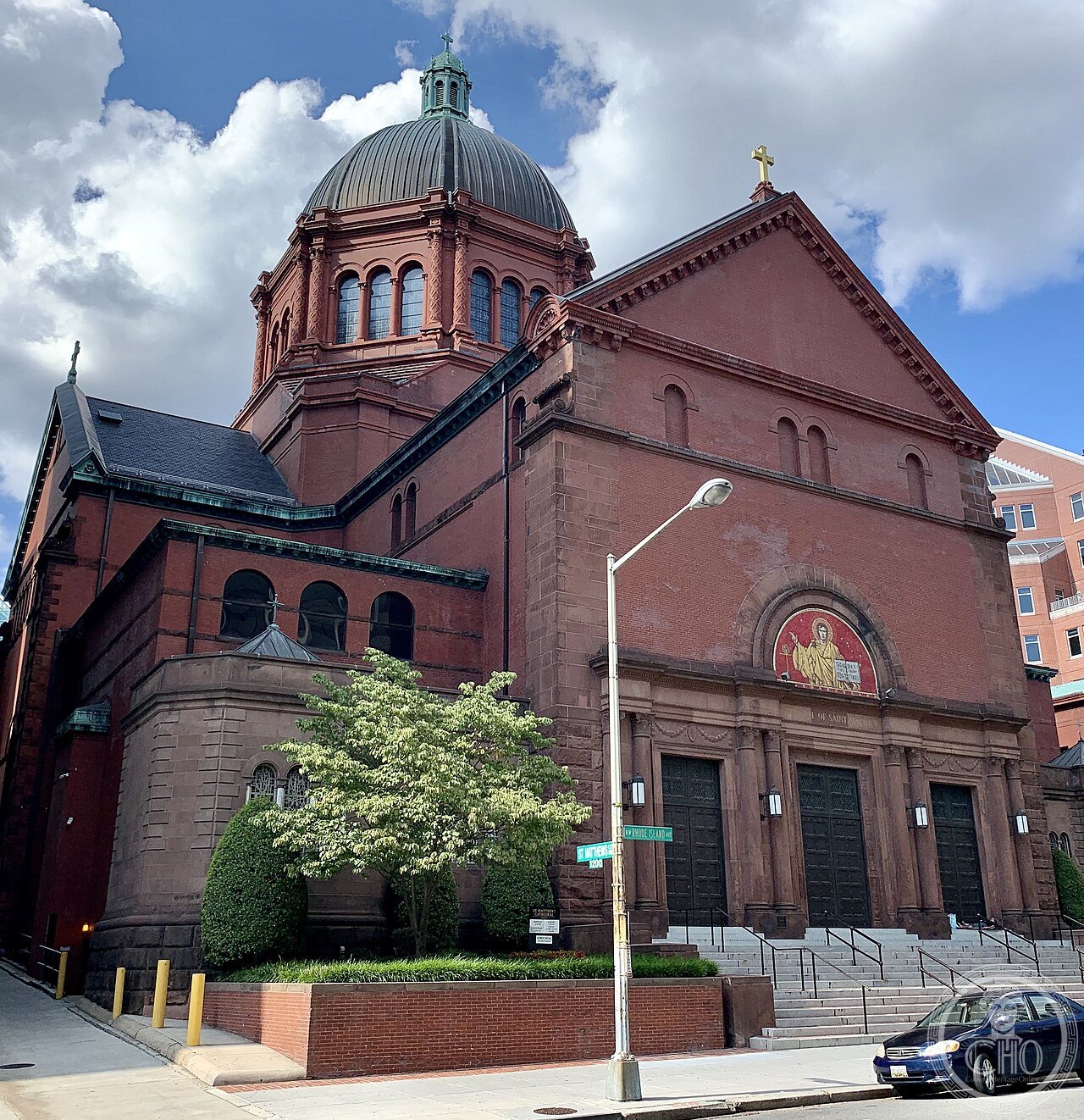
In Washington, D.C., Monsignor Thomas Sim Lee bought the site on Rhode Island Avenue in 1892 for a new parish church to replace the earlier St. Matthew’s. The architect Christopher Grant La Farge, already involved in the Cathedral of St. John the Divine in New York, drew the design, which was accepted in 1893, the year the foundation stone was also laid. The first mass was celebrated on 2 June 1895, but the work went on for years more, until the installation of the dome and the formal dedication of the building in 1913. The church is in Romanesque Revival style with Byzantine elements, not Renaissance as is sometimes read, built in red brick with sandstone and terracotta trim. In 1939 Pope Pius XII suppressed the Archdiocese of Baltimore and established the Archdiocese of Baltimore-Washington, which made St. Matthew’s a co-cathedral, of equal rank with the Cathedral Basilica of the Assumption in Baltimore. Only in 1947, with the separation of the new Archdiocese of Washington, did the church become the sole cathedral of the new jurisdiction. The cathedral is known above all for hosting, on 25 November 1963, three days after the assassination, the requiem mass for President John F. Kennedy, presided over by Cardinal Richard Cushing of Boston, with many heads of state and dignitaries present, followed by the funeral procession to Arlington National Cemetery. An inscription on the floor still marks the point where the coffin rested. Inside, behind the high altar, is a 10.7-metre mosaic of St. Matthew, by the American muralist Edwin Howland Blashfield, who also made the mosaics of the chancel, of the pendentives and of the Blessed Sacrament Chapel. The Chapel of Our Lady holds instead three mosaics by Thomas S. La Farge. The octagonal dome rises 58 metres above the nave. Every year, on the Sunday before the first Monday in October, the day the Supreme Court opens its term, the cathedral hosts the traditional «Red Mass», celebrated since 1953 under the auspices of the John Carroll Society, attended from 1954 onwards by sitting presidents, Supreme Court justices and members of the government. No other United States president has had his funeral ceremony here, although the cathedral did host that of the Philippine president Manuel L. Quezon in 1944.
About the Cathedral of St. Matthew the Apostle
In Washington, D.C., Monsignor Thomas Sim Lee purchased the Rhode Island Avenue site in 1892 for a new parish church to replace the earlier St. Matthew’s; architect Christopher Grant La Farge, already involved in New York’s Cathedral of St. John the Divine, designed the building, his plan accepted in 1893, the year the cornerstone was laid; the first Mass was celebrated on 2 June 1895, but work continued for years afterward, culminating in the dome’s installation and the church’s formal dedication in 1913. The church is built in Romanesque Revival style with Byzantine elements, not Renaissance style as sometimes reported, in red brick with sandstone and terra-cotta trim. In 1939 Pope Pius XII suppressed the Archdiocese of Baltimore and established the Archdiocese of Baltimore-Washington, making St. Matthew’s a co-cathedral, of equal rank to Baltimore’s Cathedral Basilica of the Assumption; only in 1947, with the separation of the new Archdiocese of Washington, did the church become the sole cathedral of the new jurisdiction. The cathedral is best known for hosting, on 25 November 1963, three days after his assassination, the Requiem Mass for President John F. Kennedy, presided over by Cardinal Richard Cushing of Boston, attended by numerous heads of state and dignitaries, followed by the funeral procession to Arlington National Cemetery; a floor inscription still marks where the casket rested. Inside, behind the high altar, stands a 35-foot mosaic of St. Matthew by American muralist Edwin Howland Blashfield, who also created the mosaics of the chancel, pendentives and Blessed Sacrament Chapel; the Chapel of Our Lady holds three mosaics by Thomas S. La Farge. The octagonal dome rises 190 feet above the nave. Each year, on the Sunday before the first Monday in October, the day the Supreme Court opens its term, the cathedral hosts the traditional “Red Mass,” celebrated since 1953 under the auspices of the John Carroll Society, attended from 1954 onward by sitting presidents, Supreme Court justices and government officials. No other U.S. president has had a funeral ceremony here, though the cathedral did host that of Philippine President Manuel L. Quezon in 1944.
Key facts
- 1893-1913: built and dedicated, designed by architect Christopher Grant La Farge.
- Romanesque Revival style with Byzantine elements, in red brick and sandstone.
- 1939/1947: becomes co-cathedral, then sole cathedral of the new Archdiocese of Washington.
- 25 November 1963: site of President John F. Kennedy’s Requiem Mass.
- 35-foot mosaic of St. Matthew by Edwin Howland Blashfield behind the high altar.
- Annual “Red Mass” for the legal community, held since 1953.
History
The cathedral’s two-decade construction and its gradual elevation from parish church to co-cathedral in 1939 and finally sole cathedral in 1947 reflect the broader reorganization of American Catholic dioceses in the early 20th century. Its single afternoon in November 1963, when the eyes of the world turned to a Requiem Mass inside its walls, gave the building a place in American civic memory that outweighs even its long institutional history.
What you see
A red-brick Romanesque Revival facade with Byzantine touches rises to a 190-foot octagonal dome, its interior anchored by Edwin Howland Blashfield’s 35-foot mosaic of St. Matthew above the high altar. A floor inscription near the sanctuary marks the exact spot where President Kennedy’s casket rested during his 1963 funeral Mass.
Practical information
- Opening hours: generally open daily outside services; check current hours before visiting.
- Address: 1725 Rhode Island Avenue NW, Washington, D.C., United States.
Getting there
The cathedral stands near Dupont Circle in northwest Washington, D.C., easily reached by metro or on foot. GPS: 38°54′22″N, 77°02′24″W.
Nearby
- Dupont Circle — the historic neighborhood surrounding the cathedral.
- Basilica of the National Shrine of the Immaculate Conception — the larger national shrine elsewhere in Washington.
Sources
- Wikipedia — “Cathedral of St. Matthew the Apostle” (en.wikipedia.org).
- Official cathedral site — History pages (stmatthewscathedral.org).
- SAH Archipedia — “Saint Matthew’s Cathedral” (sah-archipedia.org).
Find it on the map
See this place and what’s around it →📷 Become a Cultural Heritage Online photographer
Share your photos of places: they stay published under your name as the author. The more they're seen, the more you get noticed — and soon a contest will reward the most appreciated photos.
Log in or sign up free to add a photo