
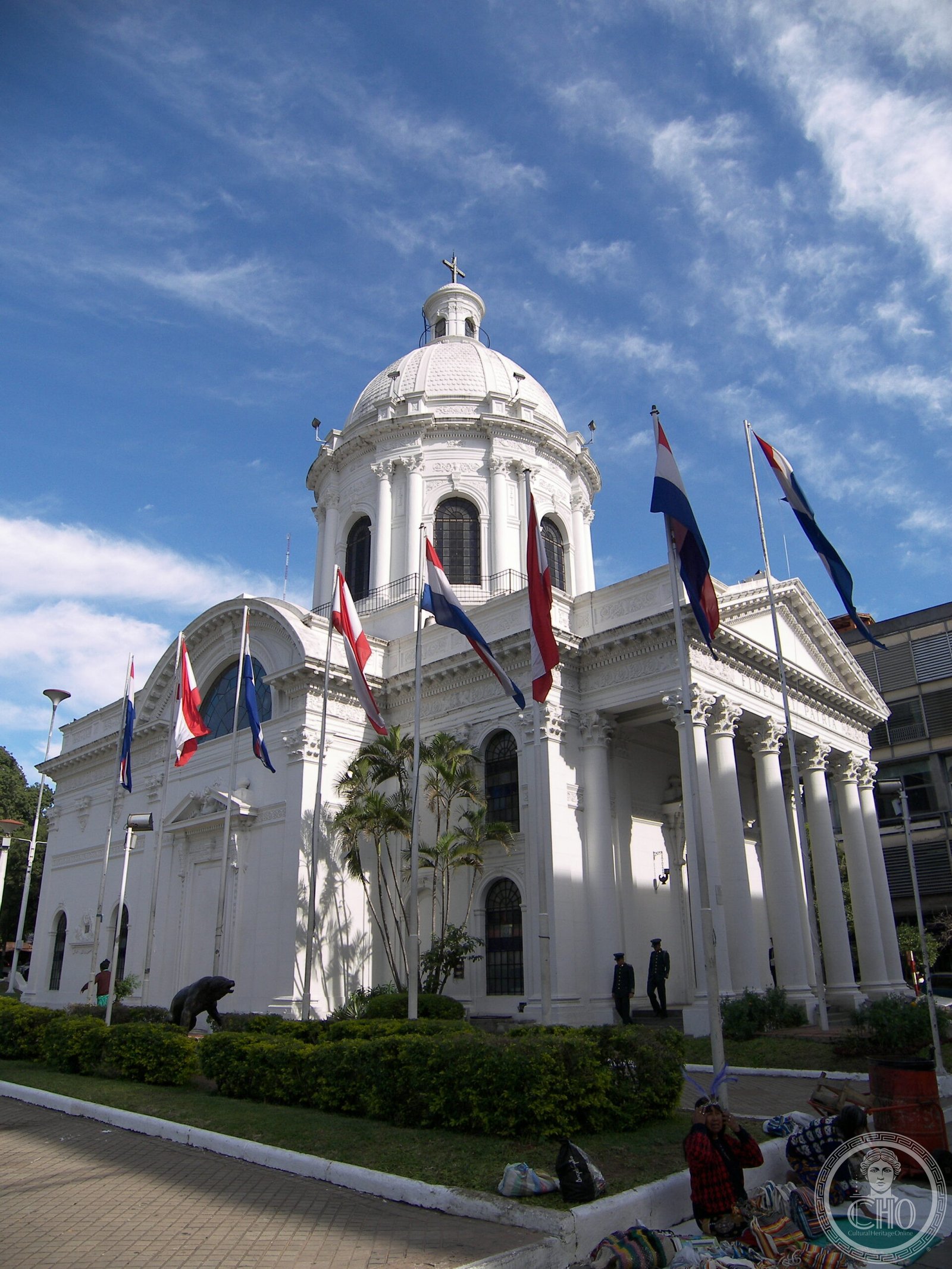
One of the most extraordinary buildings in South America, the National Pantheon of the Heroes in Asuncion stands as a monument to survival as much as to the dead it commemorates. Construction began in 1863 under President Francisco Solano Lopez, who ordered a marble chapel built using stone imported from Europe. Within a year the War of the Triple Alliance had begun, the most destructive war in Latin American history: between 1864 and 1870 Paraguay fought Brazil, Argentina, and Uruguay simultaneously, losing an estimated 60 to 70 percent of its total population and half its national territory. The unfinished chapel stood as a roofless ruin for decades, a physical scar in the capital's landscape. Completed in neo-Baroque style between 1926 and 1936, it was redesignated as the national pantheon to hold the remains of Paraguay's heroes — Mariscal Francisco Solano Lopez, his Irish companion Elisa Lynch, President Carlos Antonio Lopez, and successive presidents and generals. Its golden dome and ceremonial guard of honor make it the most visited historic monument in Asuncion.
At a glance
- Type
- National pantheon and oratory
- Period
- Begun 1863; completed 1936
- Style
- Neo-Baroque / Neoclassical
- Location
- Asuncion, Paraguay
- Coordinates
- -25.2865, -57.6436
- Architect(s)
- Alejandro Ravizza (original design); completed by later architects
Overview
The Panteon Nacional de los Heroes y Oratorio de la Virgen de la Asuncion stands on the Plaza de los Heroes in the historic centre of Asuncion, the oldest continuously inhabited city in the Rio de la Plata basin. The building occupies a site that was once the centre of the city's colonial street grid. Its circular plan, Baroque drum, and gilded dome were modelled on the Pantheon in Paris and the chapel of the Invalides, filtered through the aesthetic of mid-nineteenth century Latin American civic architecture. The interior holds the sarcophagi of the nation's most important figures, flanked by national flags and military honors. A flame burns permanently at the entrance. The building is maintained by the Paraguayan armed forces, and a guard of honor in historical dress is posted at the entrance around the clock.
History
The foundation stone was laid on 24 September 1863, the feast of Our Lady of Mercy. The project was intended as a chapel dedicated to the Virgin of the Assumption — patron of the city — and as a symbol of the Lopez government's ambitions for Paraguay as a modern South American state. The imported marble arrived from Europe before the war broke out; the unfinished walls were built to window-sill height when the Triple Alliance coalition formed in 1864. The war devastated Paraguay so completely that reconstruction took generations. Work on the building resumed in 1926 under the government of Eligio Ayala. It was completed and consecrated in 1936, the same year as the Chaco War with Bolivia ended. The remains of Mariscal Lopez were interred here in 1936 after decades of controversy about his legacy.
Architecture and Design
The building follows a centralized Greek-cross plan with a circular drum rising above the crossing and a hemispherical dome finished in gilded copper tiles. The exterior is faced in white-painted stucco over masonry, with Corinthian pilasters marking the bays of the drum. The main portal on the north facade is framed by a classical pediment with sculptural relief panels. The interior dome is painted with allegorical scenes representing the nation and its heroes, executed in a late-nineteenth century academic style. Four shallow niches around the rotunda each contain a sarcophagus set on a raised plinth, flanked by tall gilded candelabra. The floor is in polished black and white marble. Natural light enters through the drum windows in the clerestory, falling in controlled shafts onto the sarcophagi below.
Cultural significance
The Pantheon is one of the most contested commemorative spaces in South American history. The figure of Mariscal Francisco Solano Lopez was for generations either vilified as a tyrant who led Paraguay to catastrophe or venerated as the defender of national sovereignty against imperialist neighbours — a debate that has never been fully resolved. His companion Elisa Lynch, an Irish woman who arrived in Asuncion in 1855 and became the most powerful woman in Paraguay, is buried in a separate but adjacent location and remains a figure of intense historical controversy. The building itself represents a remarkable act of national will: completing a project begun during the most destructive period in Paraguayan history, and using its completion as a statement that the nation had survived and endured.
Visiting today
The Pantheon is open to visitors daily; entry is free. The guard of honor changes at regular intervals and the ceremony is one of the more atmospheric public rituals in Asuncion. Photography is generally permitted in the exterior and in the entrance hall; interior photography policies may vary. The building faces the Plaza de los Heroes, which is surrounded by shaded benches, street vendors, and several cafes. Visitors combining the Pantheon with the nearby Palacio de Lopez (government palace) and the Metropolitan Cathedral can cover all three on foot in an afternoon. The area is busiest on weekday mornings; weekend afternoons tend to be quieter.
Getting there
The Pantheon stands on the corner of Chile and Palma streets in central Asuncion, a short walk from the waterfront Costanera and the city's main commercial axis. Most central hotels are within walking distance. Taxis and ride-hailing apps (Uber operates in Asuncion) provide convenient access from further districts. From Silvio Pettirossi International Airport the journey by taxi takes approximately 20 to 30 minutes. City buses serve the historic centre from multiple routes. The Plaza de los Heroes is best reached on foot from the Palma pedestrian street, Asuncion's main shopping and promenade axis.
Sources and resources
Find it on the map
See this place and what’s around it →Record researched and written by Luigi De Marchi for Cultural Heritage Online, 2026.
📷 Become a Cultural Heritage Online photographer
Share your photos of places: they stay published under your name as the author. The more they're seen, the more you get noticed — and soon a contest will reward the most appreciated photos.
Log in or sign up free to add a photoIs this page about you?
This page is read by travellers and heritage enthusiasts who find it on Google. Tell us how you are connected to this place and we will take it from there.