
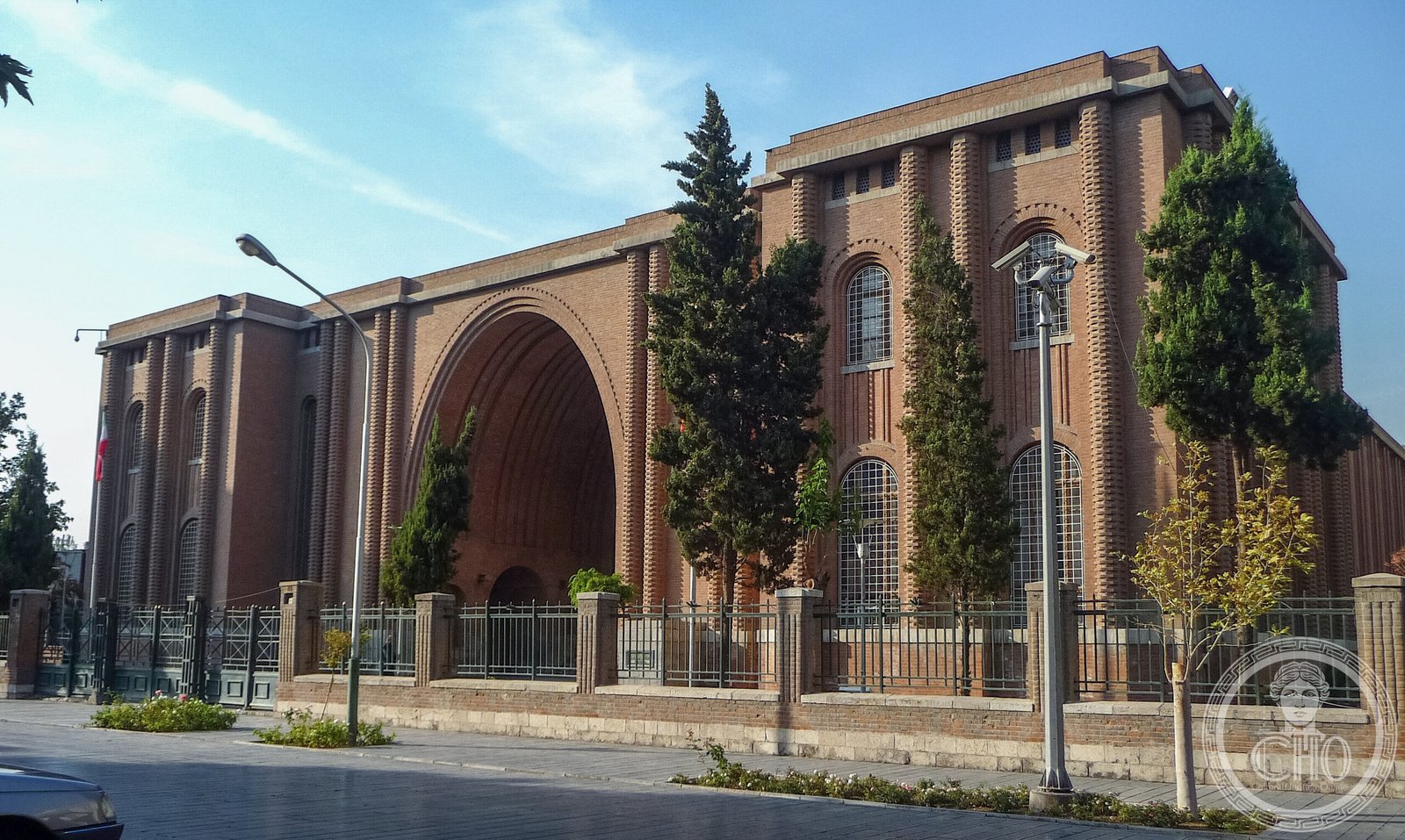
The National Museum of Iran — known in Persian as Muzeh-ye Iran-e Bastan, the Museum of Ancient Iran — is the principal repository of the country’s pre-Islamic archaeological heritage, housing more than 300,000 objects spanning 7,000 years of human civilization on the Iranian plateau. Built in 1937 and designed by the French archaeologist-architect André Godard, the building is itself a landmark of 20th-century architectural synthesis: its monumental entrance iwan, modeled on the great arch of Ctesiphon, announces that this is not a generic European institution transplanted to Persian soil, but a building that belongs to its own cultural tradition. Godard — who spent decades excavating at Susa, Persepolis, and other sites across Iran — understood the material he was housing better than almost any other architect could, and the building reflects that intimacy. Inside, the collections range from Paleolithic stone tools to Achaemenid gold, from Elamite cuneiform tablets to Parthian bronzes and Sasanian silver. Highlights include the Salt Man (five naturally mummified Iron Age figures preserved in a salt mine), a replica of the Cyrus Cylinder, and one of the world’s great assemblages of ancient Iranian pottery. The museum was the first purpose-built modern museum in Iran and remains the country’s most important cultural institution.
At a glance
- Type
- National Archaeological Museum
- Period
- Opened 1937
- Style
- Persian Revival / Art Deco
- Location
- 15th of Khordad Avenue, Tehran, Iran
- Coordinates
- 35.6909° N, 51.4207° E
- Architect(s)
- André Godard (French archaeologist-architect)
Overview
The museum occupies a prominent position in central Tehran, near the Grand Bazaar and the Golestan Palace complex. It comprises two main wings: the original 1937 building (Museum of Ancient Iran), which houses pre-Islamic collections from the Paleolithic through the Sasanian period, and the adjacent Museum of the Islamic Era, completed in 1972, which covers the Islamic period from the 7th century onward. The two buildings together give Iran the most comprehensive national survey of its own history available under one roof. Godard’s original building, with its brick-faced facade, its giant iwan entrance, and its high vaulted halls, is the architectural centerpiece — still the most photographed museum building in Iran.
History
The museum was founded under Reza Shah Pahlavi as part of a broader program of national modernization and cultural affirmation. The decision to commission Godard — who had been appointed director of the Iranian Archaeological Service in 1928 — ensured that the building would emerge from deep knowledge of what it would contain. Construction ran from 1935 to 1937. For the first decades the museum grew steadily as French and later Iranian excavations yielded new finds; the Salt Man discovery at Zanjan in 1993 added a globally significant attraction. After the 1979 Islamic Revolution the museum continued to operate under the Ministry of Cultural Heritage, and major acquisitions and reorganizations have continued into the 21st century. The institution also manages research, conservation, and outreach programs across the country.
Architecture & Design
Godard’s design draws its central motif from the Taq Kasra — the great brick iwan of the Sasanian palace at Ctesiphon, near Baghdad — transposing its proportions into a monumental entrance arch that frames the museum’s main door. The facade is clad in a warm orange brick that echoes Achaemenid and Sasanian construction, while the plan’s symmetry and the interior’s high vaulted gallery spaces are organized according to modern museum principles. The synthesis is precise rather than romantic: Godard was an archaeologist who had measured these precedents firsthand, and the building reads as a scholarly argument about Persian architectural continuity rather than a decorative pastiche. The adjoining 1972 wing, in a more neutral modernist idiom, deliberately defers to the original structure.
Cultural significance
For Iran, the National Museum is the institutional embodiment of a civilization that predates Islam by millennia — a politically and culturally sensitive position that the museum has navigated across radically different political regimes. The building itself, with its Sasanian architectural references commissioned by a secular nationalist shah, has outlasted the ideological world that produced it and found new relevance as Iranian society debates the meaning of its pre-Islamic heritage. Internationally, the collections — particularly the Achaemenid and Elamite holdings — are of irreplaceable scholarly importance, and the museum collaborates with institutions worldwide on excavation, conservation, and loan agreements.
Visiting today
The National Museum of Iran is open to visitors Tuesday through Sunday; hours and admission fees should be confirmed on arrival as they are subject to change. The museum is located in central Tehran, within walking distance of the Grand Bazaar and the Golestan Palace UNESCO World Heritage Site, making it a natural anchor for a day of cultural visits in the city center. Photography is permitted in most galleries; flash and tripods may be restricted. Guided tours in Persian are available; English-language guided visits can be arranged in advance through the museum administration.
Getting there
The museum is located on 15th of Khordad Avenue in central Tehran, approximately 500 metres south of Tehran Grand Bazaar Metro Station (Line 7) and roughly 1.2 kilometres from Imam Khomeini Square, the city’s main hub. Tehran Metro Line 7 stops at Grand Bazaar station, a short walk away. Taxis and ride-hailing apps (Snapp, Tap30) serve the area readily. The dense central location makes most major Tehran landmarks accessible within 20–30 minutes.
Sources & resources
Find it on the map
See this place and what’s around it →Record researched and written by Luigi De Marchi for Cultural Heritage Online, 2026.
📷 Become a Cultural Heritage Online photographer
Share your photos of places: they stay published under your name as the author. The more they're seen, the more you get noticed — and soon a contest will reward the most appreciated photos.
Log in or sign up free to add a photoIs this page about you?
This page is read by travellers and heritage enthusiasts who find it on Google. Tell us how you are connected to this place and we will take it from there.