
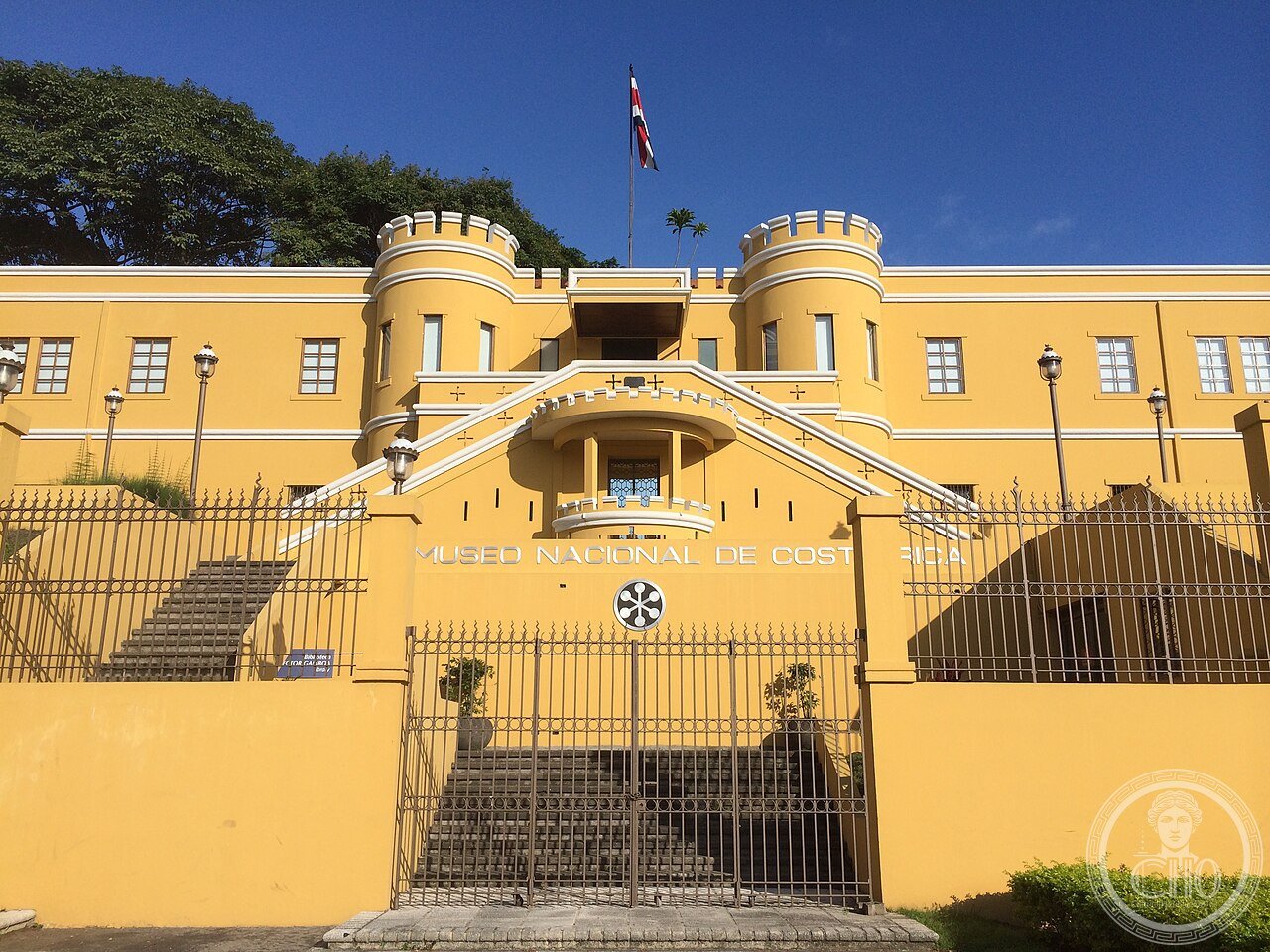
Housed in the Bellavista Fortress, this is where Costa Rica abolished its army in 1948 — a hammer blow to a rampart wall that became one of the most remarkable acts of peaceful nation-building in the Americas.
At a glance
- Type
- National Museum / Former Military Fortress
- Period
- 1917 (fortress); museum since 1950
- Style
- Victorian / Colonial Military
- Location
- Calle 17, San Jose, Costa Rica
- Coordinates
- 9.9332, -84.0706
- Architect
- Unknown (military construction)
Overview
The National Museum of Costa Rica occupies the Bellavista Fortress, a stone military barracks built in 1917 on a hillside overlooking the center of San Jose. The yellow-painted building with its distinctive corner turrets and visible bullet holes is one of the most historically charged sites in Central America. More than a collection of artifacts, the museum is a monument to a defining national choice: the voluntary abolition of the military, made here on March 19, 1948. Today it traces the full arc of Costa Rican civilization from Pre-Columbian cultures to the present, and includes one of the most visited butterfly gardens in the country.
History
The Bellavista Fortress was constructed in 1917 to house the Costa Rican army garrison in the capital. Its moment of greatest historical consequence came thirty-one years later. On March 19, 1948, following a brief but bloody civil war, the victorious leader Jose Figueres Ferrer ascended the ramparts of the fortress and, in a ceremony witnessed by diplomats and journalists, smashed a section of wall with a hammer. His declaration was unambiguous: Costa Rica would abolish its armed forces. The 1949 Constitution of Costa Rica made this permanent in Article 12, prohibiting the establishment of a standing army as a permanent institution. The fortress was converted into the National Museum the following year, 1950. Bullet holes from the 1948 battle of San Jose remain visible in the exterior stonework — a deliberate preservation of memory.
Architecture and Design
The Bellavista Fortress is built in a pragmatic Victorian military style common to Central American institutional construction of the early 20th century. Two stories of load-bearing stone masonry are arranged around a central courtyard, with corner turrets that provided observation and defensive angles over the approaches to central San Jose. The exterior is painted in a warm ochre-yellow. The main facade faces west toward the city, with a symmetrical arrangement of arched windows and a central entrance gate. The courtyard, now landscaped with native plants and housing a butterfly vivarium, was originally a parade and exercise ground. The architectural interest lies less in decorative sophistication than in the physical evidence of the 1948 battle: impact craters in the stone walls were intentionally left unrepaired when the building became a museum.
Cultural significance
Costa Rica is one of fewer than twenty countries worldwide that have constitutionally abolished their armed forces, and among the largest and most prosperous of them. The decision made at Bellavista Fortress in 1948 redirected military budget to education and healthcare. Today Costa Rica has a literacy rate above 98 percent and a life expectancy that exceeds the United States average, outcomes that economists and sociologists frequently attribute in part to sustained investment in social services made possible by the absence of defense spending. The stone spheres of the Diquis culture (300-800 CE), displayed in the museum, received UNESCO World Heritage inscription in 2014 as part of the Pre-Columbian chiefdom settlements of the Caribbean lowlands. The museum thus holds in one building both a symbol of ancient Costa Rican civilization and the most consequential modern act of its political history.
Visiting today
The National Museum is open Tuesday to Saturday, 8:30am to 4:30pm, and Sunday 9am to 4:30pm; closed Mondays. Admission is approximately USD 9 for foreign adults, with reductions for children and students. The Butterfly Garden within the courtyard is included in the admission price and is one of the most popular features for families. Audio guides in Spanish and English are available. Photography is permitted in most gallery areas. The museum shop sells high-quality reproductions of Pre-Columbian ceramics and jade artifacts. The surrounding Barrio Metalico and Plaza de la Democracia are within easy walking distance.
Getting there
The museum sits on Calle 17 between Avenida Central and Avenida 2, on the eastern edge of downtown San Jose, a ten-minute walk from the central market and the main bus terminal at Coca-Cola. Taxis and Uber are readily available from anywhere in the metropolitan area. There is no dedicated parking on site; street parking is limited. The closest airport is Juan Santamaria International (SJO), approximately 20 km northwest of the city center, served by regular bus, taxi, and shuttle services.
Sources and resources
Find it on the map
See this place and what’s around it →Record researched and written by Luigi De Marchi for Cultural Heritage Online, 2026.
📷 Become a Cultural Heritage Online photographer
Share your photos of places: they stay published under your name as the author. The more they're seen, the more you get noticed — and soon a contest will reward the most appreciated photos.
Log in or sign up free to add a photoIs this page about you?
This page is read by travellers and heritage enthusiasts who find it on Google. Tell us how you are connected to this place and we will take it from there.