

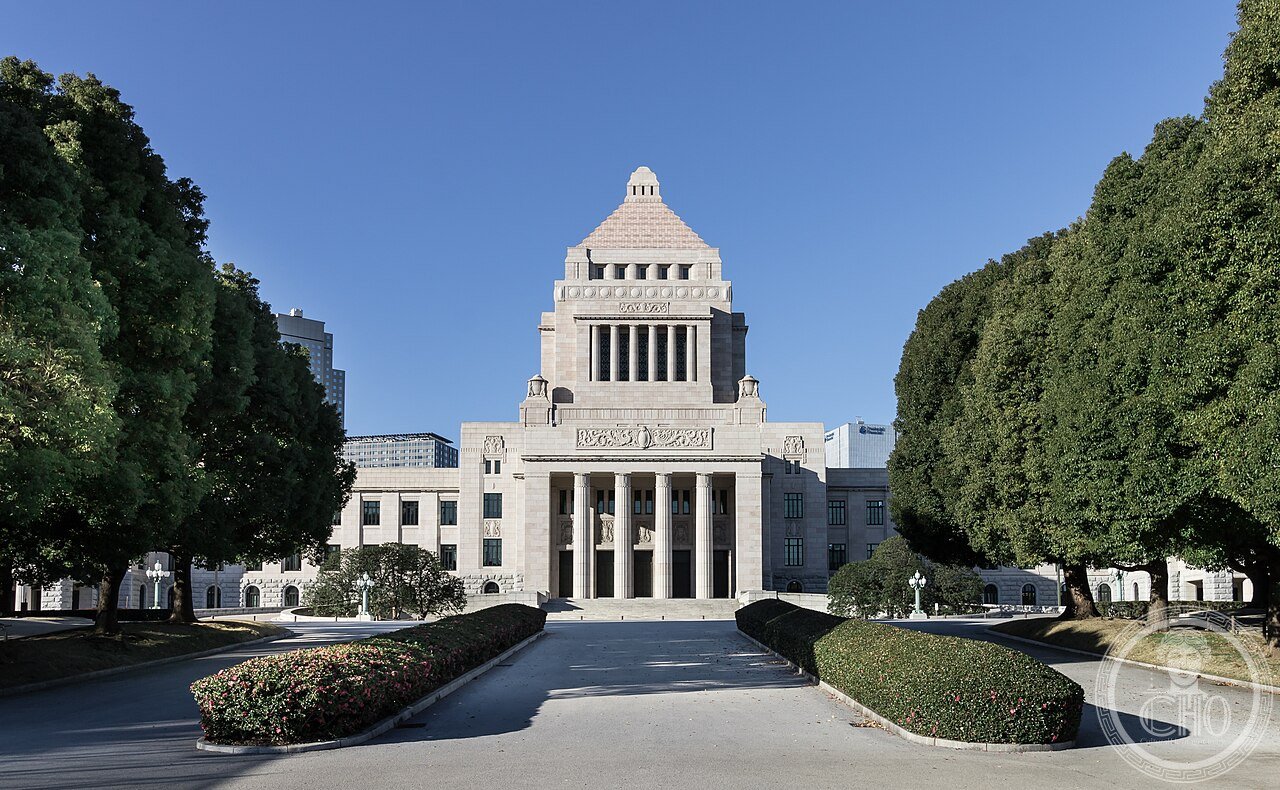
Japan’s parliament building stands as one of the most distinctive government structures of the twentieth century — a massive granite edifice that took seventeen years to complete and emerged from a committee process that tried simultaneously to look Western and unmistakably Japanese. Clad in pale stone quarried from Hiroshima Prefecture, the symmetrical main block rises to a truncated octagonal pyramid crowned by a glazed lantern, a silhouette that appears on every banknote and textbook illustration of Japanese democracy. The building opened in 1936, in the final years of imperial parliamentary government, and has hosted every session of the National Diet since. The approach avenue, formal gates, and ceremonial forecourt remain reserved for state arrivals; on ordinary days the Diet operates behind closed doors, though tours of the interior reveal tatami-influenced chamber seating, marble corridors, and bronze statues of three former prime ministers. The National Diet Building is not simply a seat of government — it is the frozen image of the moment Japan tried to reconcile Meiji modernization with constitutional tradition.
At a glance
- Type
- Parliamentary building
- Period
- 1920–1936 (construction); opened November 1936
- Style
- Eclectic Neo-Classical with Art Deco elements
- Location
- Nagatacho, Chiyoda, Tokyo, Japan
- Coordinates
- 35.6757° N, 139.7447° E
- Architect(s)
- Government committee; supervised by Yoshiyuki Hara
Overview
The National Diet Building is the seat of Japan’s bicameral legislature, housing both the House of Representatives and the House of Councillors. Its granite mass dominates the Nagatacho political district of central Tokyo. The building is approached by a long ceremonial avenue flanked by ginkgo trees; the main gate opens only for the Emperor and visiting heads of state. A secondary entrance admits members, officials, and, on scheduled days, members of the public on guided tours. The interior is lavishly finished in marble, hardwood, and bronze — a deliberate statement that Japan’s constitutional government had arrived on the world stage.
History
Planning for a permanent parliament building began as early as 1882, when Meiji leaders recognized that the provisional assembly hall was inadequate for a constitutional monarchy. A design competition in 1918 drew hundreds of entries; the winning scheme was then revised multiple times by a government committee. Construction began in 1920 using exclusively Japanese materials — a nationalist insistence that all stone, timber, and fittings come from domestic sources. Hiroshima granite and Okinawan marble were quarried and shipped at considerable expense. The seventeen-year build reflected both the ambition of the design and the disruptions of economic depression. The building opened in November 1936, just months after the February 26 Incident — a failed military coup — had shaken the parliamentary system it was built to house. It survived the Allied bombing campaigns of 1944–45 without significant damage.
Architecture & Design
The plan is strictly symmetrical: two identical wings for the two chambers flank a central block topped by the landmark pyramid-and-lantern tower. The tower’s stepped profile borrows from both Western Renaissance domes and the tiered roofs of Japanese castle architecture, arriving at something that belongs to neither tradition and unmistakably to both. The exterior stonework is austere, with shallow relief ornament at the cornices and window surrounds. Inside, the House of Representatives chamber is finished in dark wood with a semicircular bench arrangement; the House of Councillors chamber is larger and more ceremonial, with a throne dais for imperial addresses. The central hall contains bronze statues of the founders of Japanese parliamentary politics: Itagaki Taisuke, Okuma Shigenobu, and Ito Hirobumi.
Cultural significance
The National Diet Building appears on the reverse of the old 10,000-yen note and is instantly recognizable to every Japanese citizen. Its image has been used in films, protests, and political cartoons as the symbol of Japanese democracy and its perceived shortcomings. The building witnessed the postwar constitutional rewriting of 1946–47 that transformed Japan from an imperial state to a parliamentary democracy. That continuity — the same building, a different constitution — makes it a uniquely layered monument. The Diet is not a museum; it remains fully operational, giving it a gravity that preserved but emptied parliament buildings elsewhere lack.
Visiting today
Free guided tours of the interior are available to visitors on weekdays (Monday–Friday, approximately 09:00–17:00) when the Diet is not in session. Tours begin at the visitor entrance on the south side and cover the Central Hall, the House of Representatives chamber, and the upper observation corridor. Booking is recommended. The exterior and gardens can be viewed year-round; the ginkgo avenue turns gold in late November. Photography is restricted in some interior areas. No admission charge.
Getting there
Metro: Nagatacho Station (Tokyo Metro Yurakucho, Namboku, and Hanzomon Lines) or Kokkai-Gijido-mae Station (Chiyoda and Marunouchi Lines) — both a 5-minute walk. By bus: numerous Toei and metropolitan bus routes stop along Kokkai-doori. The building is a 25-minute metro ride from Tokyo Station. No dedicated car parking; taxis drop off at the visitor gate.
Sources & resources
Find it on the map
See this place and what’s around it →Record researched and written by Luigi De Marchi for Cultural Heritage Online, 2026.
📷 Become a Cultural Heritage Online photographer
Share your photos of places: they stay published under your name as the author. The more they're seen, the more you get noticed — and soon a contest will reward the most appreciated photos.
Log in or sign up free to add a photoIs this page about you?
This page is read by travellers and heritage enthusiasts who find it on Google. Tell us how you are connected to this place and we will take it from there.