
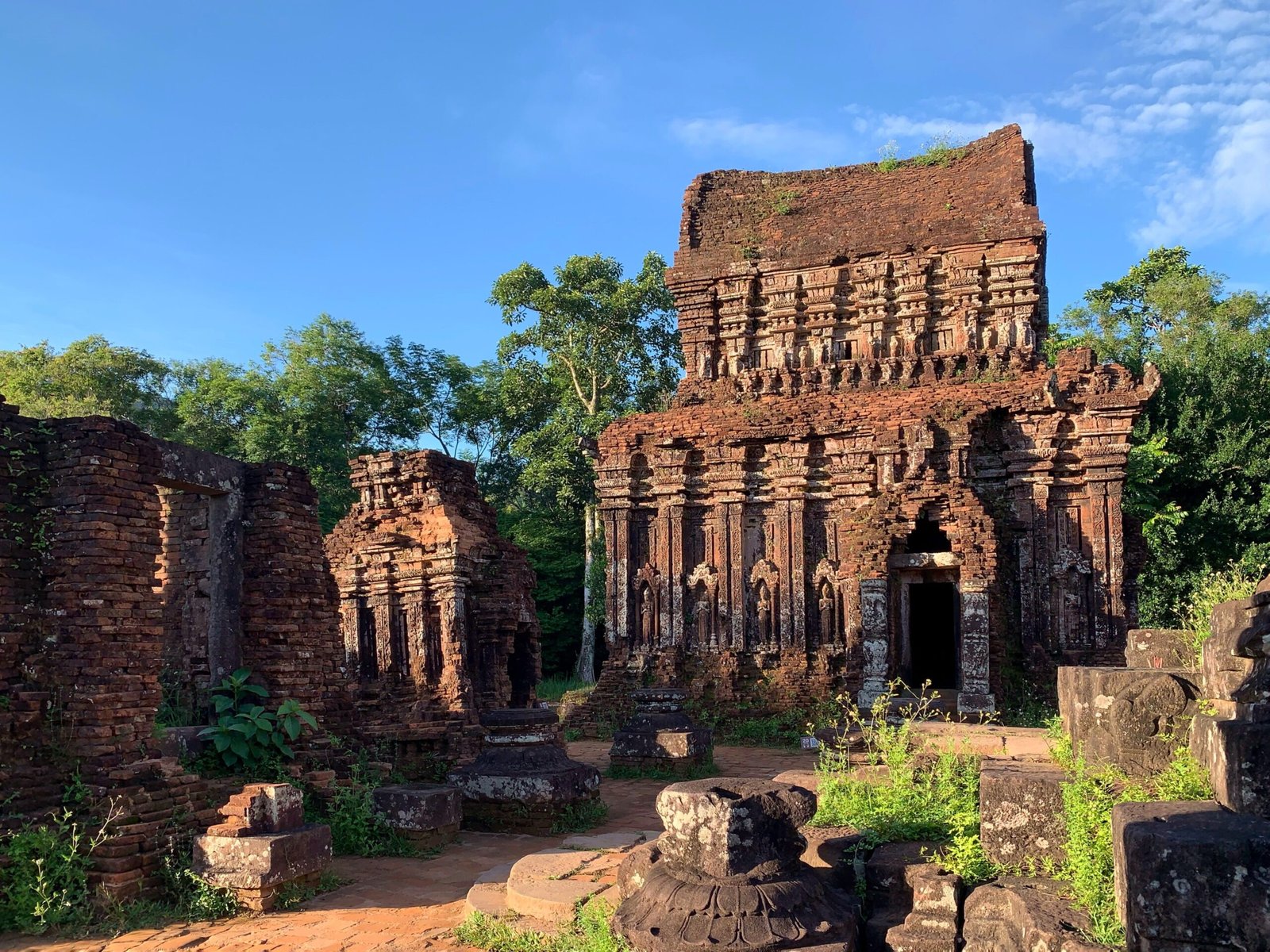
The most important Hindu temple complex in Southeast Asia outside of Indonesia: brick tower-sanctuaries built without mortar by the kings of Champa over a thousand years, deep in a mountain valley of central Vietnam, dedicated to Shiva and testifying to a civilization contemporary with Angkor but wholly distinct.
At a glance
My Son Sanctuary (Vietnamese: Thánh Ðía Mý Sơn) was inscribed on the UNESCO World Heritage List in 1999 as the outstanding example of the cultural and architectural exchange between the Indianized Champa civilization and the indigenous cultures of mainland Southeast Asia. Located in a narrow jungle valley surrounded by hills in Quang Nam Province, approximately 69 km southwest of Hoi An, the sanctuary was the spiritual and political capital of the Champa kingdom from the 4th to the 13th century CE. At its peak the valley contained over 70 temples; approximately 20 groups of towers survive. The brick construction technique — bricks fused by a vegetable resin rather than mortar — is unique in the world of ancient architecture and gives the structures an unusually monolithic quality.
Key facts
- UNESCO designation: 1999 (World Heritage Site)
- Champa kingdom: c. 192-1832 CE (central and southern Vietnam)
- Construction period: 4th-14th century CE
- Dedication: Primarily to Shiva (as Bhadresvara/Uroja); also Vishnu and other Hindu deities
- Construction technique: Fired brick, fused with vegetable resin (no mortar); carved sandstone reliefs
- Original extent: 70+ temples; ~20 groups survive
- War damage: Serious damage by US bombing 1969 (the valley was used as a Viet Cong base)
- Distance from Hoi An: 69 km southwest; half-day excursion
History
The Champa kingdom (c. 192-1832 CE) was a maritime Hindu civilization that controlled the central and southern coastal regions of what is now Vietnam for nearly two millennia. Champa was a contemporary, neighbor, and frequent rival of the Khmer empire of Cambodia; the two civilizations traded, fought, and influenced each other across centuries, but they followed very different artistic and architectural traditions. While the Khmer built in stone at Angkor, the Cham built in brick — and their brickwork, fired locally and laid with an organic resin of extraordinary adhesive strength, is technically one of the most remarkable achievements of pre-modern construction in Asia.
The valley of My Son was dedicated to the principal Cham deity Bhadresvara — a form of Shiva identified with the founding king of the dynasty — by King Bhadravarman I in the late 4th century CE. Every subsequent Cham king built or restored temples here: the site functioned simultaneously as a royal mausoleum, a place of ritual power, and a treasury. The French colonial scholar Henri Parmentier documented the site systematically in the early 20th century, identifying and cataloguing all surviving structures. UNESCO and Polish conservation teams began restoration work after 1981.
During the Vietnam War the valley was used as a staging base by the National Liberation Front (Viet Cong). US bombing in August 1969 destroyed a significant portion of the surviving temples, including what archaeologists had designated Group A, considered the finest ensemble of Cham architecture. The damage is irreversible and represents one of the major cultural heritage losses of the 20th century.
What you see
The My Son towers are kalan: sanctuary towers tapering upward in multiple curved tiers decorated with carved sandstone reliefs. The ground plan is square or slightly rectangular; the walls are covered with shallow carved pilasters, niches, and panels depicting apsaras (celestial dancers), devatas (female divinities), mythological animals, and scenes from Hindu epic literature. Sanskrit and Cham-script inscriptions on stelae at the site record the names of kings and their dedications to specific deities.
The reddish-orange fired brick used throughout My Son is of exceptional quality: it was heated to very high temperatures and is still harder than modern brick after 1,000 years of exposure. The bonding resin — probably from a tree related to the Dipterocarpaceae family — fuses the bricks without visible joint material, giving the walls their characteristic monolithic appearance. The carved sandstone elements — lintels, pediments, medallions — were added after construction and are in a more perishable material; many have eroded or been removed.
The surviving tower groups are labeled A through N by the French classification. Group B-C-D is among the best preserved; the mandapa (antechamber) of Group B preserves original friezes. Group G has been partially restored with UNESCO funding.
Practical information
- Opening hours: Daily, approximately 6:00-17:00
- Entrance fee: Paid; tickets at the gate
- Best time to visit: Dry season (February-August); the valley floor can flood in the October-December rainy season
- Guided tours: Available at the site; audio guides also available
- Dance performances: Traditional Cham dance performed near Group B-C-D at certain hours; check at entrance
- Distance from Hoi An: 69 km; organized tours available from Hoi An, Da Nang, and Hue
- Currency: Vietnamese Dong (VND)
Getting there
My Son is most easily reached from Hoi An (69 km, approximately 1.5 hours by road) or Da Nang (80 km). Organized day tours from both cities are the most common option; private car hire is also practical. A popular combination is the My Son sunrise tour (departing Hoi An at 05:00-06:00 to arrive at dawn before other visitors) followed by a boat return along the Thu Bon River to Hoi An. There is no direct public bus service to the site itself; the nearest bus stop is at Duy Xuyen town, 10 km away.
Nearby
- Hoi An Ancient Town — UNESCO World Heritage trading port, 69 km east; one of Southeast Asia’s best-preserved historic towns
- Da Nang — Modern coastal city with the Cham Museum (largest collection of Cham sculpture in the world), 80 km northeast
- Hue Imperial City — UNESCO World Heritage Vietnamese imperial capital, 120 km north
- Thu Bon River — Scenic river connecting My Son to Hoi An; boat tours possible
Sources
- UNESCO World Heritage List: My Son Sanctuary, no. 949
- Wikipedia: My Son
- Wikipedia: Champa kingdom
Find it on the map
See this place and what’s around it →📷 Become a Cultural Heritage Online photographer
Share your photos of places: they stay published under your name as the author. The more they're seen, the more you get noticed — and soon a contest will reward the most appreciated photos.
Log in or sign up free to add a photo