
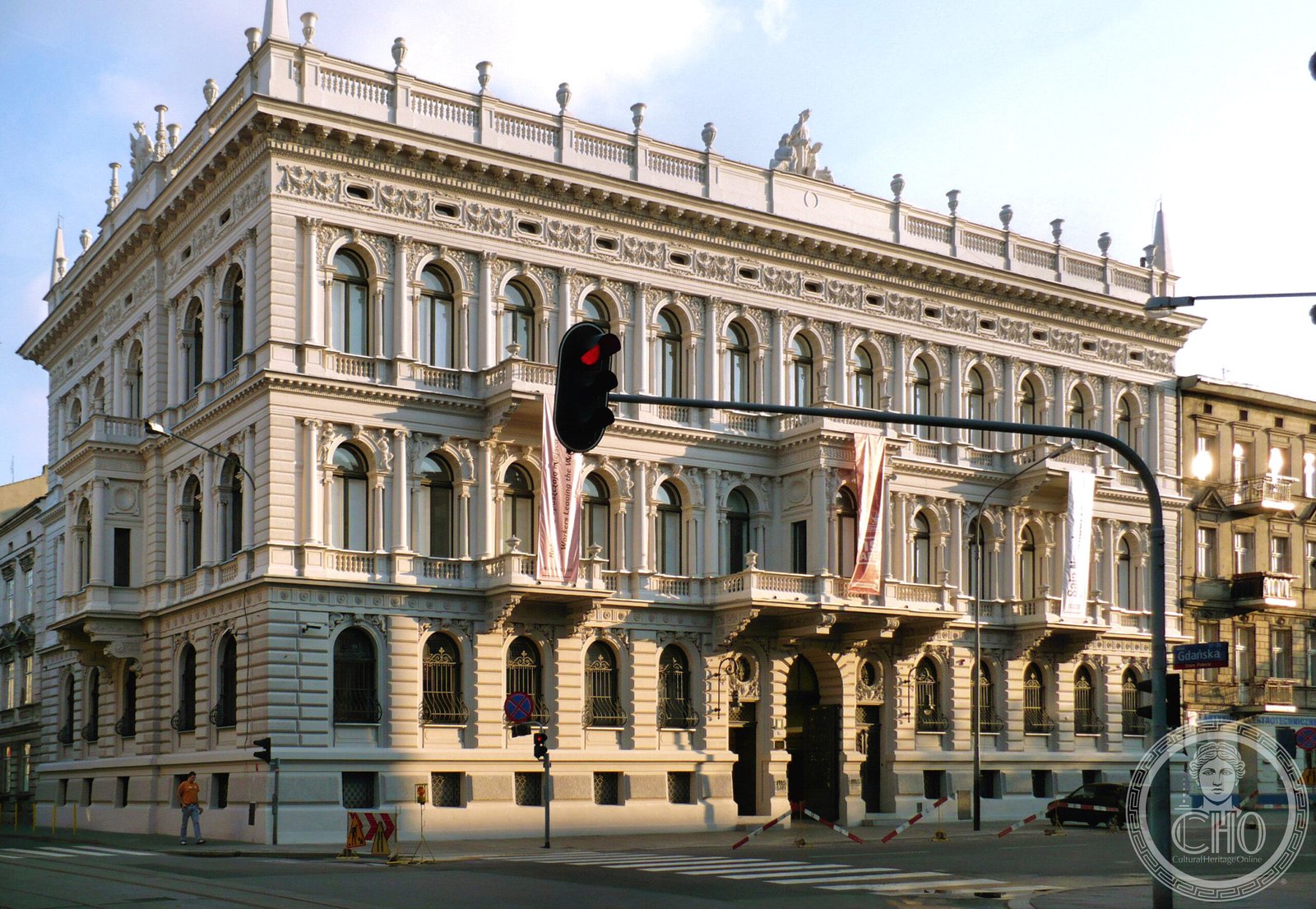
The world’s first museum dedicated exclusively to modern and avant-garde art, founded in 1929 by Polish Constructivist Wladyslaw Strzeminski and a constellation of international artists including El Lissitzky, Theo van Doesburg, and Hans Arp.
At a glance
- Type
- Art museum
- Period
- 1929 (founding); building 1903
- Style
- Art Nouveau / Neoclassical (Maurycy Poznanski Palace)
- Location
- ul. Wieckowskiego 36, Lodz, Poland
- Coordinates
- 51.7717 N, 19.4484 E
- Architect
- Adolf Zeligson (palace, 1903); museum founded by Wladyslaw Strzeminski
Overview
Muzeum Sztuki in Lodz holds a singular place in world art history: it was the first museum anywhere dedicated solely to modern and avant-garde art. Founded in 1929, it predates MoMA in New York (opened later the same year) and operated on a revolutionary model in which the founding artists themselves donated works from their personal collections. Today the permanent collection spans approximately 23,000 works, from early 20th-century Constructivism and Polish Avant-Garde through Bauhaus and its aftermath to contemporary Polish and international art. The museum occupies the former Maurycy Poznanski Palace, a magnificent Art Nouveau and Neoclassical confection built in 1903 for the son of Lodz’s most powerful textile magnate — a monument in its own right to the city’s extraordinary industrial past as the “Manchester of Poland.”
History
Lodz in the early 20th century was one of Europe’s most dynamic industrial cities, its wealth built on the textile trade. The Poznanski family were among its greatest industrialists, and their palace — completed in 1903 — expressed that prosperity in lavish architectural terms. By the 1920s the city had developed a significant artistic avant-garde. Wladyslaw Strzeminski, who had studied under Kazimir Malevich in Russia, returned to Lodz and in 1929 co-founded the museum with colleagues including Katarzyna Kobro, his wife and fellow sculptor. The founding group solicited donations from international artists sympathetic to the Constructivist and De Stijl movements: El Lissitzky, Theo van Doesburg, and Hans Arp all contributed works. This gift-based model of collection-building was unprecedented. Under German occupation from 1939, the collection was largely hidden or dispersed; recovery and reconstruction occupied the postwar decades. The institution today operates across two main buildings in Lodz.
Architecture and Design
The Maurycy Poznanski Palace that houses the museum’s main collection (ms1) is an opulent late 19th-century structure combining Art Nouveau ornament with Neoclassical proportions. Designed by Adolf Zeligson and completed in 1903, it was built as a private residence for Maurycy Poznanski, son of the textile baron Izrael Poznanski whose factory complex nearby is now the Manufaktura cultural center. The palace exterior features elaborately carved stonework, large arched windows, and a steeply pitched mansard roof. Interior spaces retain much of their original decorative plasterwork and parquet flooring, creating a productive tension between the historic domestic setting and the radical abstract works displayed within. A second museum building (ms2) at ul. Ogrodowa 19 was added later to accommodate contemporary and experimental programming.
Cultural significance
The Muzeum Sztuki holds an exceptional position in the history of modern institutions. By founding the museum in 1929 — the same year as MoMA New York — Strzeminski and his collaborators established that the avant-garde deserved dedicated institutional space. The gift model they pioneered, in which living artists donated their own works, has influenced collection-building worldwide. The collection documents the full arc of Central European modernism: Polish Constructivism, the international Constructivist network, Bauhaus connections, and the postwar avant-garde. Lodz as a city was devastated by WWII; the survival and recovery of the museum’s collection is a story of cultural resilience. The institution remains one of the most important repositories of interwar modernism outside Germany and Russia.
Visiting today
The museum’s main building (ms1) at ul. Wieckowskiego 36 is open Tuesday through Sunday; check the official website for current hours and admission prices. The permanent collection is displayed across multiple floors of the Poznanski Palace and is organized thematically rather than strictly chronologically, which rewards unhurried exploration. Temporary exhibitions occupy dedicated galleries and change regularly. The museum shop stocks a well-curated selection of publications on Polish and international modernism. Lodz is accessible from Warsaw by express train in under 90 minutes, making a day trip feasible, though the city’s industrial heritage — including the Manufaktura complex adjacent to the Poznanski factory — warrants a longer stay.
Getting there
Lodz Fabryczna station (the main intercity rail terminus) is served by PKP Intercity express trains from Warsaw Centralna (approximately 75-90 minutes). From the station, tram lines run through the city center; the museum is a short walk from ul. Piotrkowska, Lodz’s celebrated pedestrian high street. By car from Warsaw, take the A1 or A2 motorway; journey time is approximately 90-120 minutes depending on traffic. Lodz Wladyslaw Reymont Airport offers connections to selected European cities.
Sources and resources
Find it on the map
See this place and what’s around it →Record researched and written by Luigi De Marchi for Cultural Heritage Online, 2026.
📷 Become a Cultural Heritage Online photographer
Share your photos of places: they stay published under your name as the author. The more they're seen, the more you get noticed — and soon a contest will reward the most appreciated photos.
Log in or sign up free to add a photoIs this page about you?
This page is read by travellers and heritage enthusiasts who find it on Google. Tell us how you are connected to this place and we will take it from there.