
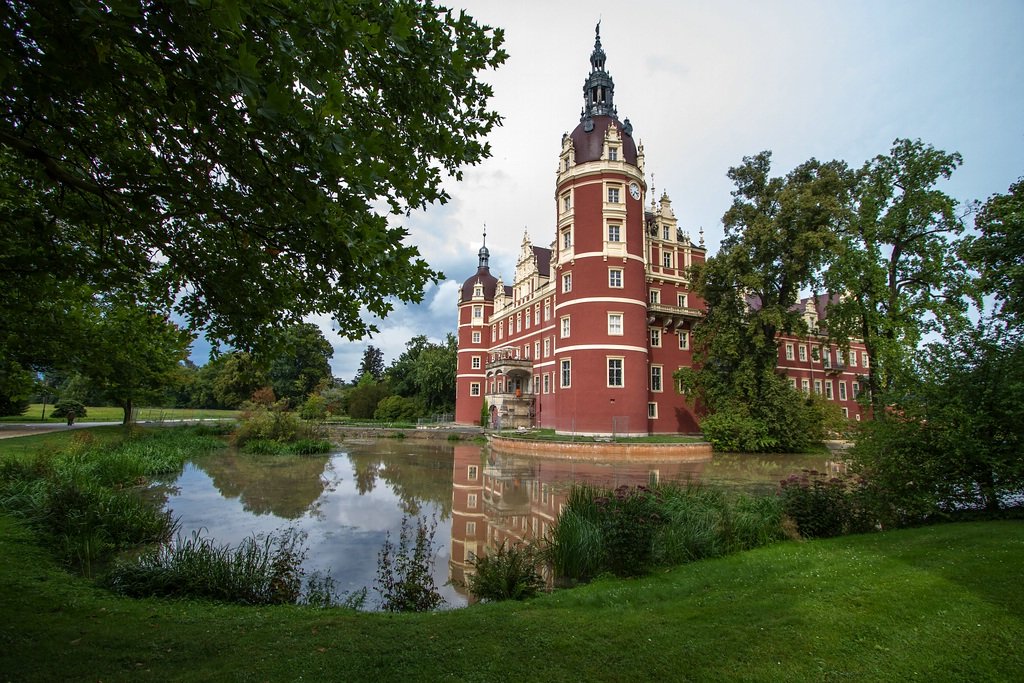
A vast transboundary landscape park straddling the German–Polish border along the Neisse River, designed by Prince Hermann von Pückler-Muskau between 1815 and 1844. Inscribed as a UNESCO World Heritage Site in 2004, it is the most ambitious example of naturalistic English-style landscape design in Central Europe and a living monument to one of history’s great landscape architects.
At a glance
Muskauer Park covers 559 hectares of designed landscape that dissolves into the surrounding Lusatian countryside — no walls, no hard boundaries, just a gradual transition from formal gardens near the New Castle to wild woodland along the Neisse. Prince Hermann von Pückler-Muskau created it over nearly three decades, bankrupting himself in the process, guided by a vision he articulated in his influential 1834 treatise Hints on Landscape Gardening. The park was divided between Germany and Poland when the Oder-Neisse line became the international border after World War II; both halves were restored and reunited conceptually as a joint UNESCO serial site, with the German section centred on Bad Muskau and the Polish section on Łęknica.
Key facts
- UNESCO inscription: 2004, Cultural Landscape
- Created: 1815–1844 by Prince Hermann von Pückler-Muskau
- Area: 559 hectares spanning Germany and Poland
- Location: Bad Muskau (Germany) / Łęknica (Poland), along the Neisse River
- Style: Naturalistic English landscape park with German Romantic inflection
- Key structures: New Castle (neo-Renaissance, rebuilt 1866), English Bridge, Bath House, Herrschaftliches Gestüt (stud farm)
- Pückler’s treatise: Andeutungen über Landschaftsgärtnerei (1834), translated into English and widely read; influenced Frederick Law Olmsted
History
Hermann von Pückler-Muskau (1785–1871) inherited the Muskau estate in 1811 and immediately set about transforming it into the grandest landscape park in the German-speaking world. His inspiration was the English tradition of Capability Brown and Humphry Repton — a naturalistic aesthetic that replaced the geometric formality of Baroque gardens with flowing meadows, serpentine paths, and carefully composed views.
Pückler worked without professional training but with extraordinary instinct: he moved streams, sculpted hills, planted thousands of trees for seasonal colour effects, and constructed a series of bridges and decorative farm buildings that read as natural elements of the landscape. He described his philosophy in Hints on Landscape Gardening (1834), a book that circulated widely in Europe and America. Frederick Law Olmsted, designer of New York’s Central Park, acknowledged Pückler’s influence.
The cost was ruinous. To fund the park, Pückler famously placed newspaper advertisements seeking a wealthy wife for himself while he was still married — with his existing wife’s blessing, in a remarkable arrangement. He sold Muskau in 1845, unable to continue, and moved on to create another major landscape park at Branitz near Cottbus. The subsequent owners maintained the park; it survived both World Wars largely intact.
The postwar border settlement in 1945 split the estate along the Neisse River, placing the western part (with the New Castle) in East Germany and the eastern portion in Poland (renamed Łęknica). The park fell into partial neglect on both sides during the communist era. After German reunification and Polish EU accession, joint restoration began with EU funding; the park was inscribed as a UNESCO World Heritage Site in 2004, spanning both countries.
What you see
The New Castle dominates the German side: a neo-Renaissance pile rebuilt in 1866 after a fire, carefully restored after wartime damage and today used for cultural events. It sits above a formal terrace garden that melts into the park’s wilder reaches. The English Bridge, a graceful stone arch over the Neisse, once connected the two halves before the Iron Curtain; it was restored and reopened to pedestrians in 2000, years before the UNESCO designation.
The landscape design works through contrast and sequence: a visitor moving from the castle through the park encounters managed meadows with specimen trees, then denser woodland, then glimpses of the Neisse and the Polish bank. Pückler planted for chromatic effect — spring bulbs, summer shade, autumn colour — so the park reads differently in each season. Approximately 100 km of paths criss-cross the estate; the full circuit takes several hours on foot or by bicycle.
On the Polish side, the landscape opens into more natural woodland with the remnants of the former Muskau estate’s agricultural structures. The Łęknica entrance now has its own visitor centre explaining the binational history of the site.
Practical information
- Open: Park open year-round, dawn to dusk; free entry to the landscape. New Castle has separate admission.
- Best season: May–June (spring blossom) and October (autumn colour) for peak landscape effect; summer is lush but crowded on weekends
- Time needed: Half-day minimum; full day recommended for both German and Polish sections
- Visitor centre: Bad Muskau, adjacent to the New Castle; Polish centre at Łęknica entrance
- Cycling: Bicycles highly recommended; rental available in Bad Muskau
- Cross-border access: EU/Schengen border; pedestrians and cyclists cross freely via the English Bridge
Getting there
- By car: Bad Muskau is on the B115 road, approximately 110 km east of Dresden. From Warsaw, take the A18/A15 motorways to Forst, then B115 north.
- By rail: Nearest station is Weißwasser (17 km west); regional buses connect to Bad Muskau. From Dresden, change at Cottbus or Zittau depending on route.
- From Berlin: Approximately 200 km; about 2.5 hours by car via A15 motorway
- From Wrocław: Approximately 130 km; about 1.5 hours by car via A4 and local roads through Łęknica (Polish side entry)
- GPS (Bad Muskau castle entrance): 51.5456, 14.7202
Nearby
- Branitz Park, Cottbus (50 km west): Pückler’s second great landscape park, where he is buried in a pyramid mausoleum of his own design — essential companion visit
- Görlitz/Zgorzelec (70 km south): Another binational German–Polish border city with outstanding medieval and Renaissance heritage
- Zittau Mountains (80 km south): Forested border region shared by Germany, Poland, and Czech Republic; medieval textile industry heritage
- Wrocław (130 km east): Major city with the Centennial Hall UNESCO site and rich architectural heritage
Sources
- UNESCO World Heritage List: Muskauer Park / Park Mużakowski (No. 1127)
- Wikipedia: Muskauer Park
- Stiftung Fürst-Pückler-Park Bad Muskau: muskauer-park.de
- Pückler-Muskau, H. (1834). Andeutungen über Landschaftsgärtnerei (Hints on Landscape Gardening). Stuttgart: Cotta.
Find it on the map
See this place and what’s around it →📷 Become a Cultural Heritage Online photographer
Share your photos of places: they stay published under your name as the author. The more they're seen, the more you get noticed — and soon a contest will reward the most appreciated photos.
Log in or sign up free to add a photo