
Museum Van Loon, Amsterdam
A Golden Age canal house designed by Adriaan Dortsman, first rented to the painter Ferdinand Bol, and held by one family long enough to become its own museum.
At a glance
Museum Van Loon occupies the double canal house at Keizersgracht 672, on the southern stretch of Amsterdam’s Canal Ring. Adriaan Dortsman — the architect of the city’s Ronde Lutherse Kerk — designed it in 1668, and it was completed in 1671 for the merchant Jeremias van Raey, together with its twin at number 674. Its first tenant, from 1672, was Ferdinand Bol, one of Rembrandt’s most successful pupils. In 1884 the banker Hendrik van Loon bought the house for his son, and the Van Loon family’s name has been attached to it ever since. Since 1973 the Van Loon Foundation has run it as a museum of Amsterdam canal-house life, complete with its garden and coach house.
Key facts
- Address: Keizersgracht 672, Amsterdam
- Architect: Adriaan Dortsman, design 1668, built 1671
- Commissioned by: Jeremias van Raey, merchant, as one of a pair with no. 674
- First tenant: the painter Ferdinand Bol, from 1672
- Van Loon ownership: from 1884, when Hendrik van Loon bought the house for his son
- Museum: since 1973, run by the Van Loon Foundation
- Protection: Rijksmonument no. 2695, registered 17 June 1970
History
When Jeremias van Raey commissioned the pair of houses at Keizersgracht 672–674, the fourth expansion of Amsterdam’s canal ring was still filling in, and Adriaan Dortsman’s restrained classicism was the fashionable answer to the ornamented gables of the earlier Golden Age. Dortsman drew the design in 1668; the houses stood complete by 1671. Van Raey lived in one and let the other, and his first tenant at number 672, from 1672, was Ferdinand Bol — by then a celebrated portraitist who had trained in Rembrandt’s studio. The date of Bol’s arrival is sometimes misread as the date of the design itself; the building is three to four years older than its most famous early resident’s lease.
The house passed through a succession of owners over the next two centuries. In 1884 Hendrik van Loon bought it for his son, bringing it into a family whose name had been woven into Amsterdam’s mercantile history since the founding era of the Dutch East India Company. The Van Loons kept the house, its portraits, and its furnishings together as a single ensemble — the quality that makes the museum unusual among canal houses. The state registered it as Rijksmonument no. 2695 on 17 June 1970, and in 1973 the Van Loon Foundation opened it to the public as a museum.
What you see
From the canal, the house reads as Dortsman intended: a sober sandstone front, flat and symmetrical, with none of the scrolled gables of the previous generation — the same disciplined manner he brought to the Ronde Lutherse Kerk. Inside, the rooms are furnished as they were lived in, with Van Loon family portraits spanning several centuries, period furniture, silver, and porcelain arranged through the salons of the ground and first floors rather than in display cases.
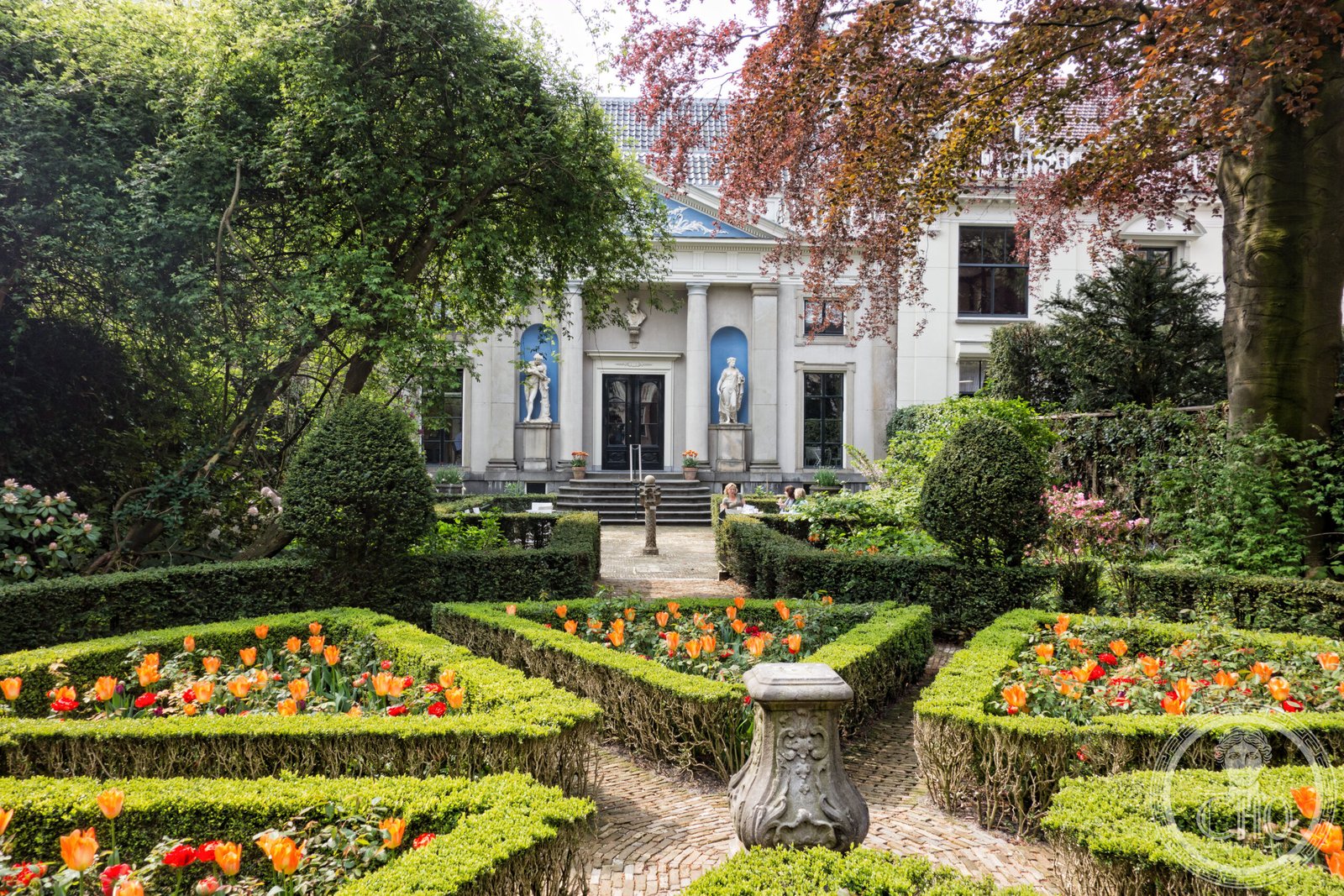
Behind the house lies one of the least-known pleasures of the Canal Ring: a formal garden closed at its far end by the coach house on Kerkstraat, whose facade is dressed like a small classical building. The sequence of house, garden, and coach house survives here as a complete unit — the full depth of a seventeenth-century canal parcel, legible from front door to stable door.
Practical information
- Address: Keizersgracht 672, Amsterdam
- Opening times: daily, 10:00–17:00
- Admission: paid entry; tickets available online at museumvanloon.nl
- On site: museum café; the garden is included in the visit
Getting there
The museum stands between Vijzelstraat and Reguliersgracht on the even-numbered side of the Keizersgracht. Vijzelgracht station on Metro 52 is a few minutes’ walk, and trams along Vijzelstraat stop close by; from Rembrandtplein the walk along the canals takes about ten minutes.
Nearby
- Foam photography museum — on the opposite bank of the Keizersgracht, at no. 609
- Museum Willet-Holthuysen — another furnished canal house, on the Herengracht
- Rembrandtplein and the Amstel river — about ten minutes on foot
Sources
- Rijksmonumentenregister, monument no. 2695 — monumentenregister.cultureelerfgoed.nl
- Amsterdam Monumentenstad, Grachtenboek, Keizersgracht 672 — amsterdam-monumentenstad.nl
- Amsterdamse Grachtenhuizen, Keizersgracht 672 — amsterdamsegrachtenhuizen.info
- Museum Van Loon, official website — museumvanloon.nl
Find it on the map
See this place and what’s around it →📷 Diventa un fotografo di Cultural Heritage Online
Condividi le tue foto dei luoghi: restano pubblicate con la tua firma come autore. Più vengono viste, più ti fai conoscere — e presto un concorso premierà le foto più apprezzate.
Accedi o registrati gratis per aggiungere una fotoDo you manage this place?
This page is read by travellers and heritage enthusiasts who find it on Google. Keep it accurate — and make it work for you. Free for non-profit heritage institutions.