
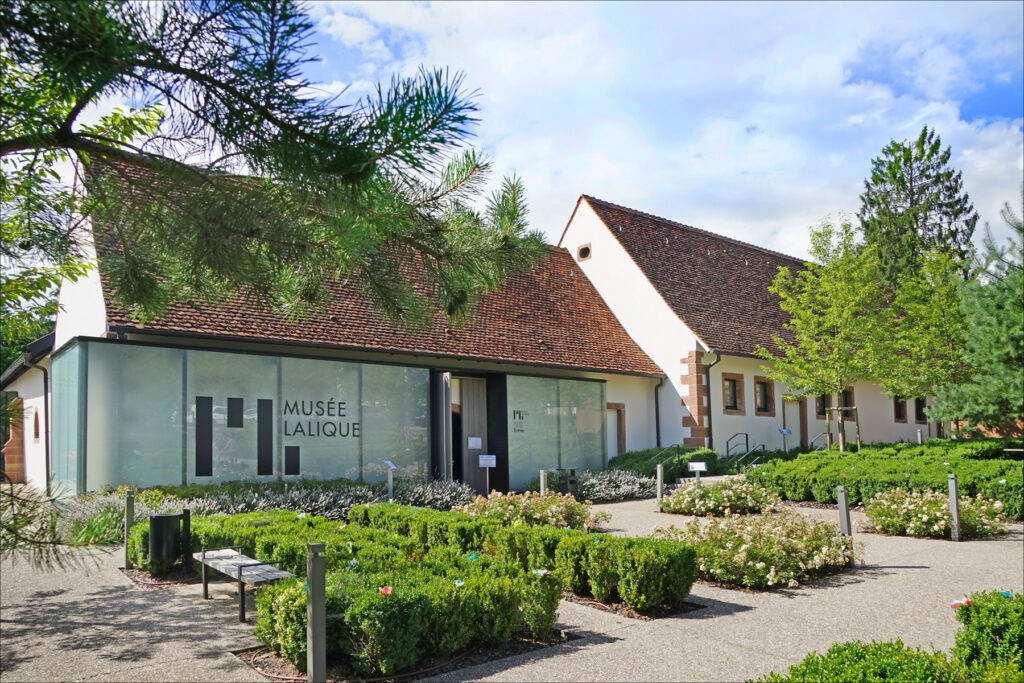
The Musée Lalique in Wingen-sur-Moder holds 650 works spanning René Lalique’s full creative arc — from Art Nouveau jewellery that redefined the Belle Époque to the Art Deco crystal that made his glassworks in Alsace the most admired in Europe. The museum sits immediately beside the still-operating Lalique factory, founded here in 1922.
At a glance
The Musée Lalique opened in 2011 in a purpose-built pavilion designed by architect Jean-Michel Wilmotte, adjacent to the Lalique crystal factory in Wingen-sur-Moder, a village in the Northern Vosges of Alsace. The museum traces the complete work of René Lalique (1860–1945), from the jewellery pieces he exhibited at the Paris Exposition Universelle of 1900 to the large-scale crystal commissions of the 1930s. The building’s understated glass and steel architecture keeps focus on the collection rather than the container, and the proximity to the active factory means visitors experience both historical legacy and living craft in a single visit.
History
René Lalique trained as a goldsmith in Paris in the 1880s and began exhibiting jewellery in the early 1890s. By 1900 he was the defining figure of Art Nouveau jewellery design, celebrated for pieces that combined enamel, glass, horn, ivory, and semi-precious stones in compositions drawn from nature — dragonflies, orchids, snakes, and female figures rendered in unprecedented technical detail. Around 1905 Lalique pivoted decisively toward glass, attracted by its possibilities for mass production without sacrificing artistry. He established his first glassworks at Combs-la-Ville near Paris in 1909. After World War One, seeking space to expand and proximity to Alsatian craftsmen, he founded a second and ultimately primary factory at Wingen-sur-Moder in 1922. The Alsatian factory became the creative centre of his late career, producing the monumental decorative glass — car mascots, chandeliers, church windows, ship interior fittings — that defined the Art Deco aesthetic globally. Lalique died in 1945; his son Marc and later granddaughter Marie-Claude continued the business. The factory still operates today as Lalique SA, producing crystal under the Lalique name.
What you see
The Wilmotte building (2011) uses a neutral palette of pale stone and glass to frame the collection without visual competition. Inside, the permanent display follows a clear chronological and thematic sequence: the first rooms focus on the jewellery years, with cases holding brooches, tiaras, and pendants that demonstrate Lalique’s mastery of enamel and glass inlay. Central galleries move through the transitional period — early perfume flacons for Coty and other clients — into the full Art Deco output of the Alsace factory years: car mascots in frosted crystal, illuminated chandeliers, pressed-glass table services, and the architectural panels made for ocean liners including the Normandie. A dedicated section covers work made for sacred spaces: baptistery windows and altarpieces. The final rooms display post-war and contemporary Lalique crystal, showing how the vocabulary established by René has been extended into current production. Temporary exhibitions occupy a separate wing.
Cultural significance
René Lalique occupies a position in the decorative arts comparable to that of Rodin in sculpture: an artist who both defined an era and transcended it. His jewellery work of 1895–1905 set the visual grammar of Art Nouveau at its most refined; his glass work of 1910–1940 became synonymous with Art Deco luxury on an international scale. The Wingen-sur-Moder museum is the only site where the full breadth of both phases can be experienced in the location where much of the later work was made. For Alsace, the museum is a significant cultural anchor — the region’s industrial and artistic heritage in a single institution — and draws visitors from across Europe to a village that would otherwise remain off the cultural tourism map.
Key facts
- René Lalique (1860–1945): pioneer of Art Nouveau jewellery and Art Deco glass
- Lalique factory in Wingen-sur-Moder founded 1922; still operating as Lalique SA
- Museum opened 2011; building designed by Jean-Michel Wilmotte
- Collection: 650+ pieces across jewellery, glass, and crystal
- Location: 40 Rue Bellis, 67290 Wingen-sur-Moder, Alsace
- One of the finest glass heritage museums in France
Practical information
The museum is open daily (except Monday in low season) from 10:00 to 18:00 in summer and 10:00 to 17:00 in winter. Admission is charged; reduced rates for students and under-18s. Audio guides are available in French, English, and German. The museum shop carries current Lalique crystal pieces alongside exhibition catalogues and reproductions. Guided visits can be arranged for groups with advance booking. Refreshments are available in the museum café, which overlooks the factory grounds. The museum is fully accessible.
Getting there
Wingen-sur-Moder is in the Northern Vosges, approximately 55 kilometres northwest of Strasbourg. By car: take the A4 motorway toward Paris, exit at Saverne, then follow D919 north through Ingwiller toward Wingen-sur-Moder (45 minutes from Strasbourg). By rail: take a regional train from Strasbourg to Saverne, then a connecting bus or taxi (journey approximately 1 hour 15 minutes total). The museum is signposted from the village centre. Limited free parking is available adjacent to the museum entrance.
Sources & resources
- Musée Lalique official site: musee-lalique.com
- Bayer, Patricia, The Art of René Lalique (Bloomsbury, 1988)
- Lalique SA company history: lalique.com/history
- Strasbourg museum network regional heritage documentation
Find it on the map
See this place and what’s around it →📷 Become a Cultural Heritage Online photographer
Share your photos of places: they stay published under your name as the author. The more they're seen, the more you get noticed — and soon a contest will reward the most appreciated photos.
Log in or sign up free to add a photo