

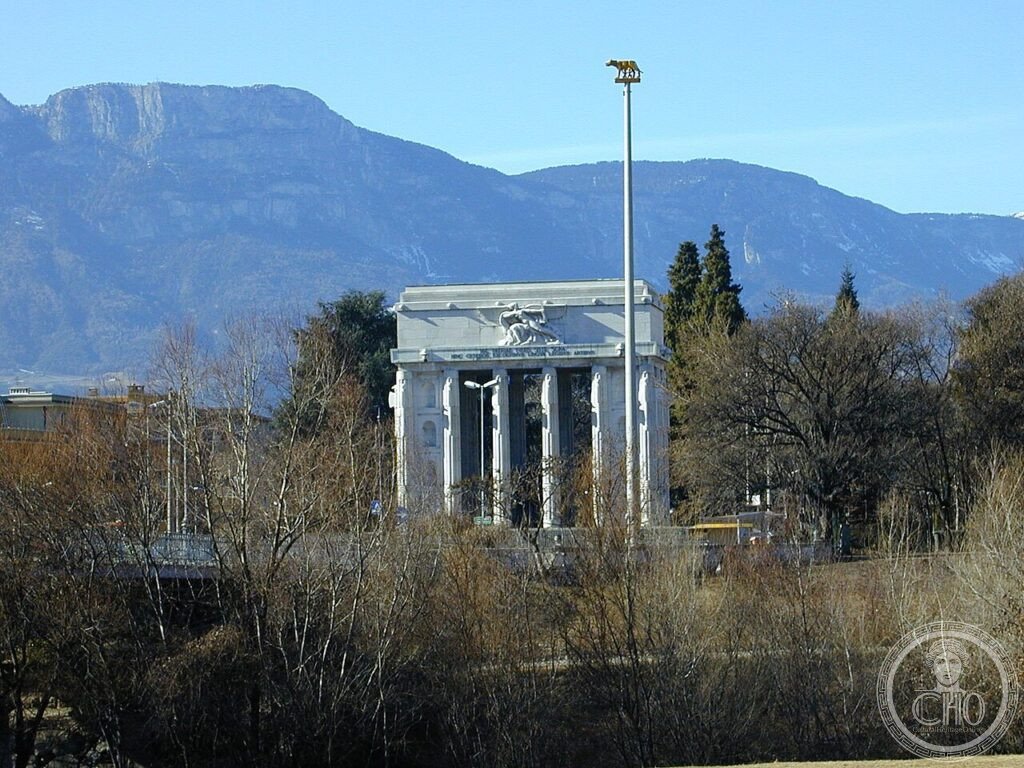
Italy’s most contested piece of fascist architecture: a triumphal arch in Carrara marble that one half of the city built and the other half never asked for.
At a glance
The monument dominates Piazza della Vittoria, on the west bank of the Talvera in Bolzano. Since 2014 its crypt has housed the permanent exhibition «BZ ’18–’45: one monument, one city, two dictatorships», run by the city with a joint Italian and German-speaking historical commission — which makes this both a fascist-era monument and one of Italy’s most serious attempts to face one.
Key facts
- Architect: Marcello Piacentini (1881–1960)
- Built: 1926–1928; inaugurated 12 July 1928
- Form: triumphal arch, about 29 metres, clad in Carrara marble, with crypt below
- Inscription: Latin text by Gabriele D’Annunzio — never removed, contested for a century
- Since 2014: permanent documentation exhibition BZ ’18–’45 in the crypt (entrance at the rear)
- Status: heritage-listed; at the centre of an unresolved public debate
- Location: Piazza della Vittoria, Bolzano — 46.5005 N, 11.3450 E
History
The Monumento alla Vittoria in Bolzano — the Victory Monument — is the most contested piece of fascist architecture in Italy. Built between 1926 and 1928 from a design by Marcello Piacentini, the leading architect of the Mussolini regime, it was inaugurated on July 12, 1928, in a city that had been Austrian until a decade earlier. The monument celebrates the Italian victory in the First World War and the annexation of South Tyrol, a region whose majority population was — and remains — German-speaking. For the German-speaking Südtiroler, the monument was never a celebration: it was an occupation in stone.
What you see
Piacentini’s design takes the form of a triumphal arch, 29 metres tall, clad in Carrara marble, with flanking colonnades and a crypt below. The architectural language is that of imperial Rome — arches, columns, vertical marble surfaces — stripped of ornament and compressed into the compressed vocabulary of early fascist architecture. The form is commanding without being decorative, authoritarian without being baroque. It was meant to be legible from across the city and to assert Italian sovereignty in a landscape that spoke a different language.
The Inscription
The inscription on the monument became the most inflammatory element: “Hic patriae fines siste signa / Hinc ceteros excoluimus lingua legibus artibus” — “Here at the boundary of the fatherland, plant your banners / From this point we educated others in language, laws, and arts.” The text was written by the poet Gabriele D’Annunzio, and it claimed that Italy had been the civilising force in the region — a claim the German-speaking population read as a declaration of cultural war. The inscription has been the focus of political controversy for nearly a century and has never been removed.
Forced Italianisation
The Monumento alla Vittoria was built during the period of forced Italianisation (Italianizzazione) that the fascist regime imposed on South Tyrol after 1923. The use of German language in schools, newspapers, and public life was banned. German and Ladin place names were replaced with Italian versions. The German-speaking population was pressured to emigrate or assimilate. Bolzano — Germanised as Bozen — received a large influx of Italian workers and civil servants, and the urban fabric of the city was substantially altered to reflect the new political reality. The monument was both a symbol and an instrument of this process.
The BZ ’18–’45 Museum
In 2011, an exhibition was installed in the crypt of the monument, and in 2014 it became a permanent museum: “BZ ’18–’45: One Monument, One City, Two Dictatorships.” The museum contextualises the monument’s history and the period of Italian and German fascism in South Tyrol, including the annexation of the region by Nazi Germany in 1943 and the subsequent Allied liberation. The museum is operated by a commission of Italian and German-speaking historians and is one of the more honest institutional confrontations with fascist heritage in Italy. Entry is from the rear of the monument, on Via del Brennero.
Current Status and Debate
The monument remains one of the most active political flashpoints in Italian public life. Proposals to demolish it, contextualise it, cover it, or transform it have been raised repeatedly since 1945. The museum installation was the most recent attempt at a permanent solution. The monument is classified as a cultural heritage site under Italian law, which prevents demolition without state approval. The political parties of the German-speaking South Tyrol (SVP) have called for its removal or substantial modification; Italian nationalist parties have defended it as an integral part of the city’s heritage. No resolution has been reached. The monument stands, the museum operates, and the debate continues.
Cultural significance
For the architectural historian, the Monumento alla Vittoria is a significant and well-preserved example of early fascist architecture by the regime’s most important architect, in a more restrained mode than his later work on the Sapienza campus or the EUR. For the cultural historian, it is one of the best-documented case studies of how a political regime deploys architecture as an instrument of territorial assertion. For the city of Bolzano, it is both of those things and also simply an unresolved inheritance.
Practical information
- The monument stands on a public square: the exterior is visible at any time (the fenced area immediately around it may be closed).
- The BZ ’18–’45 exhibition in the crypt is free; entrance from the rear of the monument. Opening days and hours are published on the official site.
Sources
Find it on the map
See this place and what’s around it →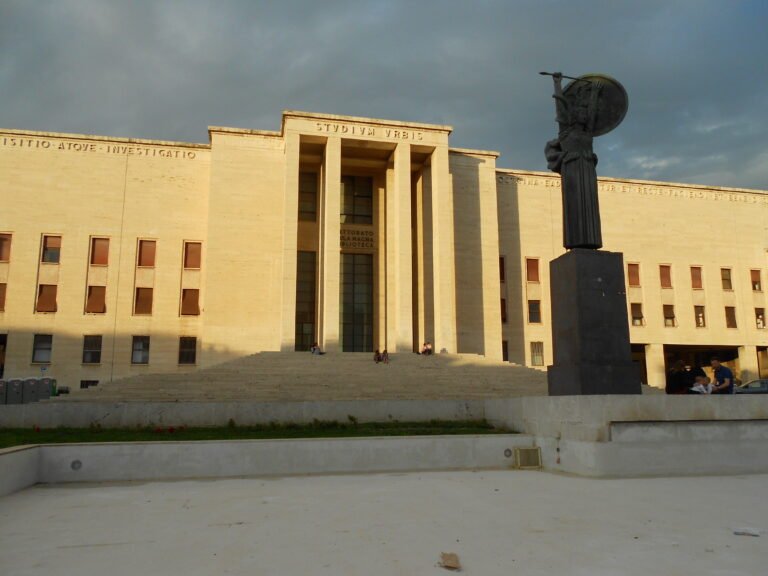

📷 Become a Cultural Heritage Online photographer
Share your photos of places: they stay published under your name as the author. The more they're seen, the more you get noticed — and soon a contest will reward the most appreciated photos.
Log in or sign up free to add a photoIs this page about you?
This page is read by travellers and heritage enthusiasts who find it on Google. Tell us how you are connected to this place and we will take it from there.