
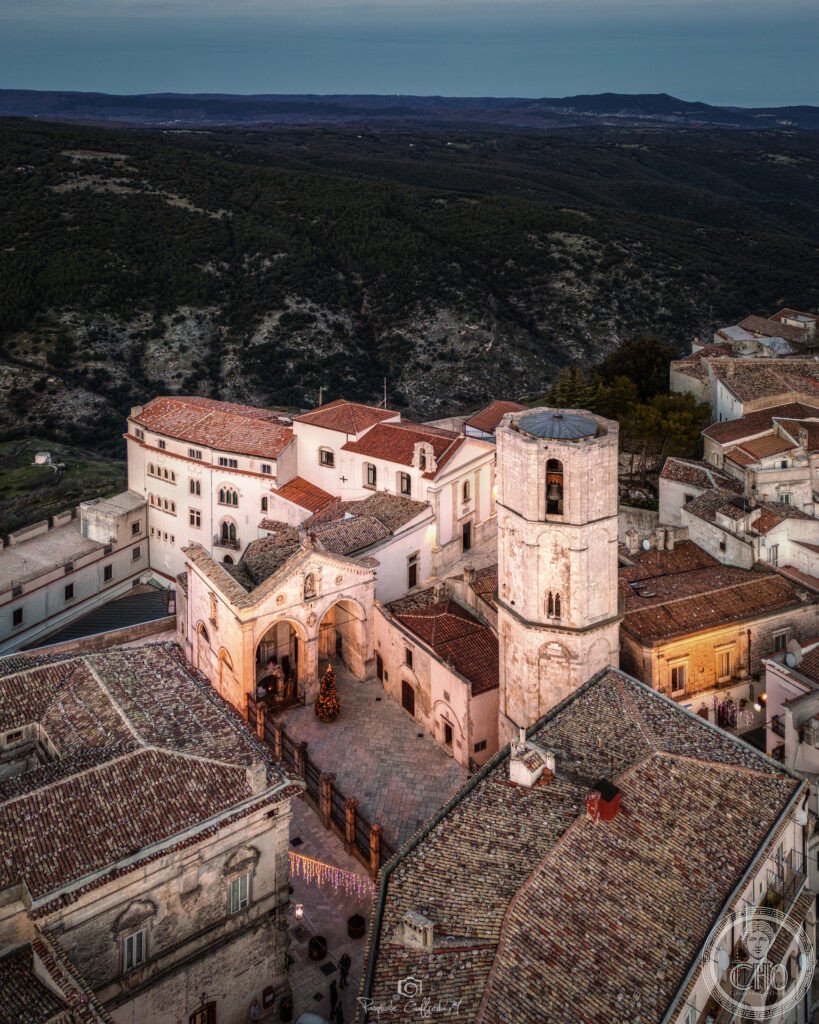
Cut into the rock of the Gargano promontory, this cave sanctuary marks the spot where the Archangel Michael is said to have appeared around 490. Its Byzantine bronze doors, Norman and Angevin additions, and long history as a Lombard dynastic shrine make it one of the most layered pilgrimage sites in southern Italy.
At a glance
The Santuario di San Michele Arcangelo occupies a natural limestone cave on the Gargano promontory, reached through an octagonal campanile built in 1274 for Charles I of Anjou and a set of bronze doors cast in Constantinople in 1076. The site was not founded by the Lombards, but from around 580 the Duchy of Benevento adopted it as its principal shrine, and it later drew Norman knights bound for the Crusades.
In 2011 UNESCO inscribed the sanctuary as one of seven sites in the serial listing Longobards in Italy, recognising the Lombard role in turning a pre-Christian cave shrine into a Christian sanctuary that became a model for cave sanctuaries elsewhere in Europe.
Key facts
- Location: Via Reale Basilica 87, Monte Sant’Angelo, Province of Foggia, Puglia.
- Coordinates: 41.7077° N, 15.9551° E.
- Bronze doors: 24 panels, cast and silver-inlaid, made in Constantinople in 1076 for the Amalfitan merchant Pantaleone.
- Campanile: octagonal tower, 1274, commissioned by Charles I of Anjou, roughly 30.5 metres high, standing on an 11th-century Norman crypt.
- UNESCO status: inscribed 2011 as part of the serial property Longobards in Italy, reference 1318.
History
Tradition holds that the Archangel Michael appeared to Bishop Lorenzo Maiorano around 490, with further apparitions recorded in 492 and 493, when the bishop found the cave already furnished with an altar and a red silk vestment. A later apparition, to Archbishop Alfonso Puccinelli in 1656 during a plague epidemic in Foggia, led to the establishment of a feast day.
Although the cave predates the Lombard arrival in Italy by some eighty years, the Duchy of Benevento, founded in 571, made the sanctuary its principal religious centre from around 580. Duke Grimoaldo formally dedicated it to the Lombard nation, and a sword attributed to him, the spatha di Grimoaldo, is kept in the crypt. The sanctuary lay on the Via Sacra Langobardorum, the pilgrim road linking the northern Lombard duchies to the Gargano, travelled among others by William I of England in 1016.
In 1059 Robert Guiscard visited the shrine before launching his campaign to retake Sicily, and the sanctuary became a customary stop for Norman knights heading to the Crusades, receiving gifts from figures such as Bohemond I of Antioch and Tancred. The octagonal campanile was added in 1274 under Charles I of Anjou, its eight-sided form referring to the theological idea of the Eighth Day and the Resurrection that Michael was believed to announce. UNESCO’s 2011 inscription recognised this long process of Lombard patronage transforming a pre-Christian cave into a Christian shrine that influenced cave sanctuaries elsewhere in Europe.
What you see
Visitors descend the Via del Santuario to an outer atrium holding the bronze doors of 1076, twenty-four panels showing the four Archangels and Old Testament scenes in silver-inlaid relief, with Pantaleone’s dedication inscribed in Greek along the lower edge. From here stairs lead down below street level to the cave itself, a natural limestone chamber roughly 30 by 10 metres.
Inside, the marble altar carries a Byzantine-style icon of the Archangel Michael dated to the 12th century, its angular wings and geometric feather pattern typical of Byzantine rather than later Western imagery. Adjoining the sanctuary is the Tomba di Rotari, a 12th-century cylindrical tower built over the mausoleum of the Lombard Duke Rotari, standing above a 4th-century baptistery whose carved cross-shaped immersion font is said to be the oldest surviving in Apulia. The surrounding medieval quarter includes the Casa Caporale, an 11th-century Lombard tower house now used as a small museum.
Practical information
Opening hours and ticket prices change through the year, so we do not republish them here: the current ones are on santuariosanmichele.it. What does not change is where it is: Via Reale Basilica, 127, 71037, at 41.70770, 15.95510.
Getting there
Monte Sant’Angelo sits on the Gargano promontory in the Province of Foggia, with Foggia itself the nearest larger town. Road access into the town centre leads to the sanctuary on foot along Via Reale Basilica; travellers without a car are best advised to check current bus links from Foggia or Manfredonia before setting out.
Nearby
- Tomba di Rotari — adjoining the sanctuary, the mausoleum of the Lombard Duke Rotari with a 4th-century baptistery beneath.
- Casa Caporale — in the medieval quarter around the sanctuary, an 11th-century Lombard tower house now a small museum.
Sources
- UNESCO World Heritage Centre
Find it on the map
See this place and what’s around it →📷 Become a Cultural Heritage Online photographer
Share your photos of places: they stay published under your name as the author. The more they're seen, the more you get noticed — and soon a contest will reward the most appreciated photos.
Log in or sign up free to add a photoIs this page about you?
This page is read by travellers and heritage enthusiasts who find it on Google. Tell us how you are connected to this place and we will take it from there.