
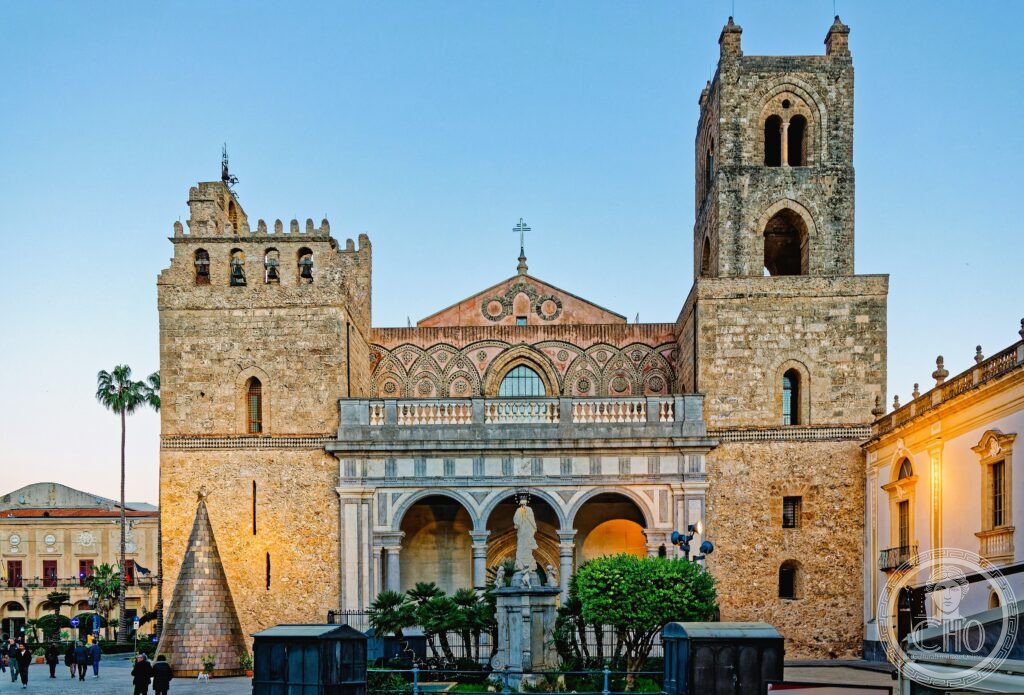
The Duomo di Monreale holds the most complete surviving Byzantine mosaic cycle outside Constantinople, over six thousand square metres of gold-ground scenes commissioned in a single campaign by William II of Sicily. Beside it stands a Benedictine cloister whose two hundred and twenty-eight paired columns are each carved differently.
At a glance
The cathedral of Santa Maria Nuova at Monreale was built for William II of Sicily between 1174 and 1189. Its interior is covered almost entirely in Byzantine gold-ground mosaic, some 6,340 square metres in total, telling the Old Testament story on one side of the nave, the New Testament and the life of Christ on the other, and the lives of the saints and the Norman kings around the lower registers. Compared with the Palatine Chapel in Palermo or the apse mosaics of Cefalù Cathedral, both smaller Norman-era schemes, Monreale is the largest surviving mosaic programme in the Western Christian world.
Attached to the south side of the church is the Benedictine cloister, built at the same time as the cathedral. Its four arcaded galleries are carried on 228 paired columns, no two pairs alike in their capitals or shaft decoration, with a fountain enclosure forming a small cloister within the cloister in the southwest corner.
Key facts
- Dedication: Santa Maria Nuova
- Commissioned by: William II of Sicily, from 1174
- Building campaign: completed by 1189
- Mosaic surface: approximately 6,340 m², covering nave, transepts and apses
- Cloister: 228 twin columns around four galleries, each roughly 47 metres long
- UNESCO status: inscribed 2015 as part of the serial site Arab-Norman Palermo and the Cathedral Churches of Cefalù and Monreale (reference 1487)
History
William II ordered the building of the cathedral from 1174. Two accounts survive of his motives. One is a pious legend in which the Virgin appeared to him in a dream on the hill of Monreale and directed him to a hidden treasure left by his father, which he then used to found the church. The other, more political, explanation is that William wanted a royal monastery and a new archbishopric at Monreale to counterbalance the power of Walter of the Mill, the Archbishop of Palermo, so splitting ecclesiastical authority in Sicily between two sees; Monreale duly became an archbishopric in 1183.
The building campaign lasted only fifteen years, a remarkably short time for the scale of decoration achieved. The mosaic programme follows Byzantine models closely, in both the Old Testament and New Testament cycles, and is thought to have been executed by Greek mosaicists brought from Constantinople or from Byzantine communities in southern Italy. The geometric interlace of the cloister capitals and the fountain enclosure, by contrast, show construction traditions associated with Islamic craftsmanship, probably introduced by artisans working in Sicily from North Africa or from the earlier Fatimid period.
The cathedral and cloister were inscribed by UNESCO in 2015 as part of the serial nomination covering Arab-Norman Palermo together with the cathedrals of Cefalù and Monreale.
What you see
Entering by the west door, the nave leads the eye directly to the apse, where a monumental figure of Christ Pantocrator dominates the gold ground; the composition follows the earlier model at Cefalù but on a larger scale. Along the nave walls, the Old Testament narrative unfolds on one side, beginning with the Creation, and the New Testament narrative on the other, culminating in a large Crucifixion in the south transept. The lower registers and columns carry figures of individual saints and portraits of the Norman kings, including Roger II being crowned by Christ and William II presenting a model of the church to the Virgin.
The Benedictine cloister on the south side of the cathedral is reached separately. Its four galleries surround a garden, and every pair of columns differs in its carved capital, showing vine leaves, animals, geometric interlace, human figures and biblical scenes; some shafts carry inlaid marble mosaic, others twisted fluting. In the southwest corner a small fountain enclosure, itself framed by four columns and pointed arches, forms a miniature cloister of its own.
A staircase gives access to the roof of the nave, from which the Conca d’Oro, the fertile coastal plain below Palermo, spreads out towards the sea, much of it now built over.
Practical information
- Access: the nave, the treasury, the cloister and the roof terrace are visited under separate arrangements with their own entrances and timings; current details are best confirmed through the cathedral’s own visitor information before travelling.
- Best viewpoint: stand at the west entrance of the nave to take in the full alignment of the mosaic programme towards the apse.
- Cloister visit: begin at the fountain enclosure in the southwest corner and walk the four galleries in sequence.
Getting there
Monreale stands above Palermo on the edge of the Conca d’Ord plain, and is reached from the city as a short onward trip; visitors typically travel up from central Palermo before continuing on foot to Piazza Guglielmo II, where the cathedral faces the square.
Nearby
- Palermo Cathedral and the Palatine Chapel — in Palermo, the earlier Norman mosaic programme commissioned in 1132, smaller in scale than Monreale.
- Cefalù Cathedral — on the northern Sicilian coast, its apse mosaic of 1148 is an earlier model for the Monreale Pantocrator.
- La Martorana, Palermo — shares the same iconographic type used at Monreale for the coronation of Roger II.
Sources
- UNESCO
Find it on the map
See this place and what’s around it →📷 Become a Cultural Heritage Online photographer
Share your photos of places: they stay published under your name as the author. The more they're seen, the more you get noticed — and soon a contest will reward the most appreciated photos.
Log in or sign up free to add a photoDo you manage this place?
This page is read by travellers and heritage enthusiasts who find it on Google. Keep it accurate — and make it work for you. Free for non-profit heritage institutions.