
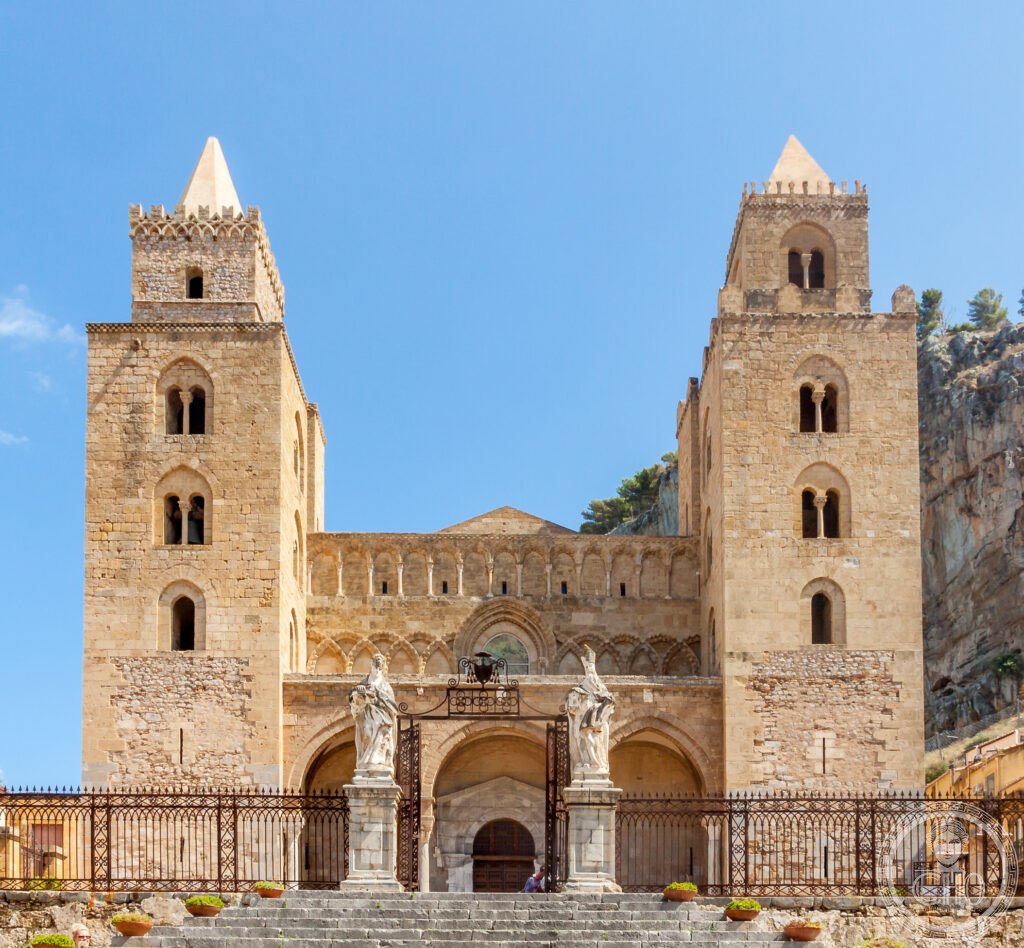
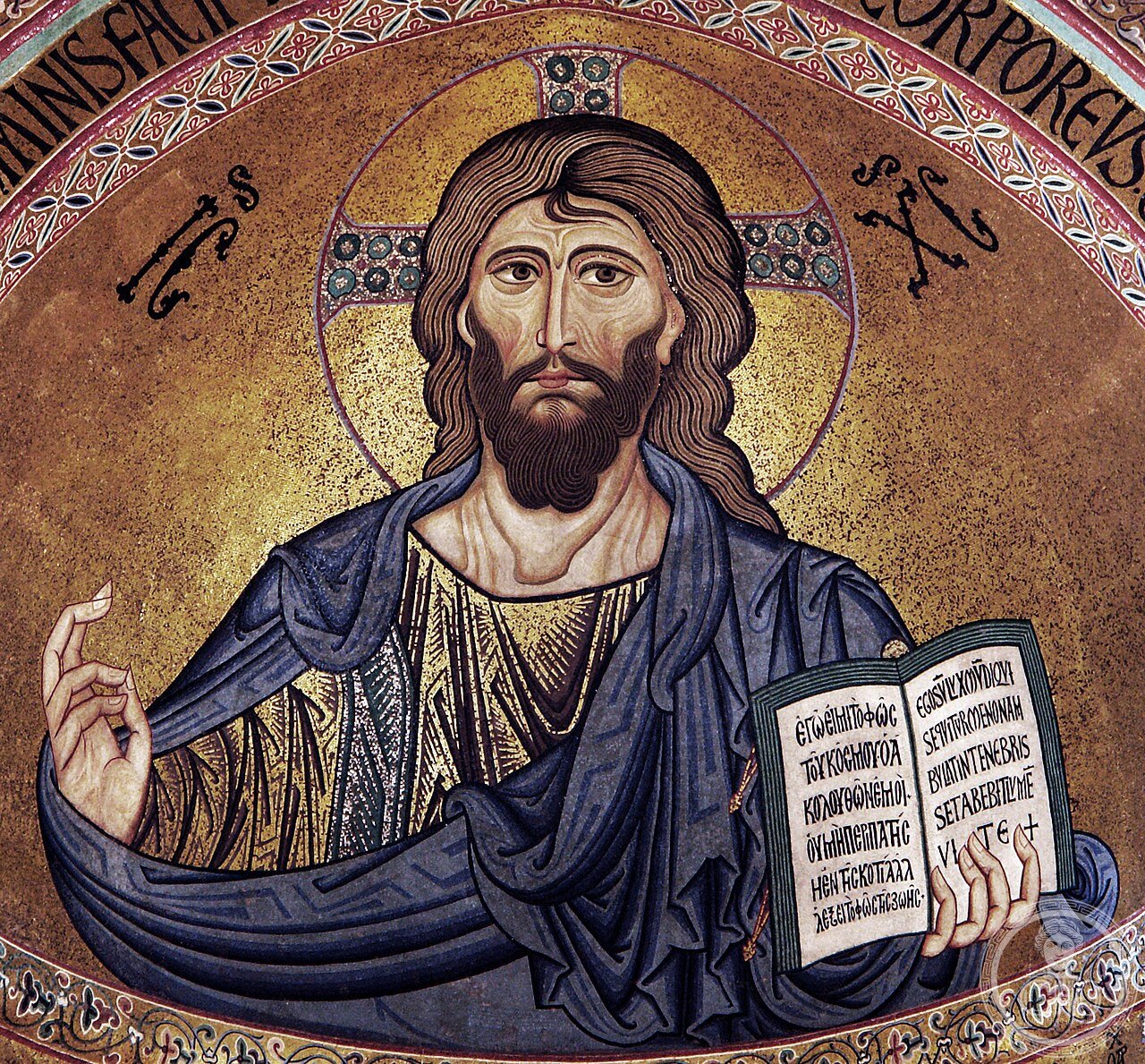
Cefalù’s Norman cathedral, begun in 1131 on the order of Roger II of Sicily, stands against the limestone cliff of the Rocca. Its apse holds one of the oldest and largest surviving Byzantine-Norman mosaics of Christ Pantocrator, a seven-metre figure blessing in both Greek and Latin, a direct image of Roger’s mixed Greek, Latin and Arab court.
At a glance
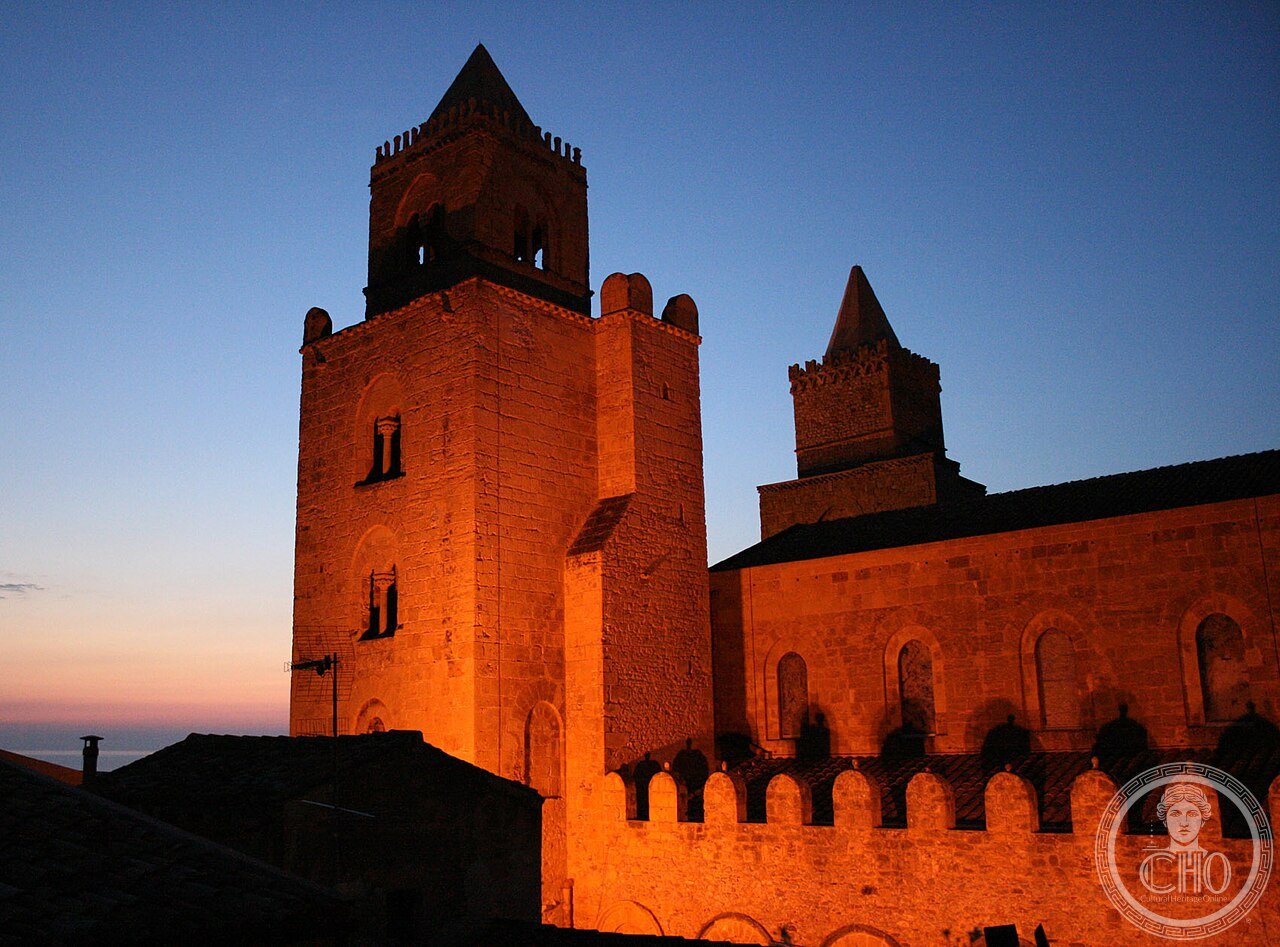
The cathedral of Cefalù presents a twin-towered Norman facade begun in 1131. The north tower was finished around 1150 and the south tower, slightly taller, around 1180; the two differ in their upper storeys because different Norman masons, from different regions, worked on each. A large rose window from the 14th century replaces the earlier Romanesque opening of the original design. Behind the building rises the Rocca di Cefalù, a limestone cliff that served as the construction platform for the east end of the church.
The cathedral is one of the nine components of the serial UNESCO World Heritage inscription Arab-Norman Palermo and the Cathedral Churches of Cefalù and Monreale, listed in 2015 under reference 1487, together with monuments in Palermo and Monreale.
Key facts
- Commissioned by: Roger II of Sicily, work begun in 1131
- Towers: north tower completed around 1150, south tower around 1180, built by masons from different Norman regions
- Apse mosaic: Christ Pantocrator, around 1148, the oldest and largest surviving example of the subject in the Byzantine-Norman tradition
- Rose window: 14th century, replacing the original Romanesque window
- UNESCO status: inscribed 2015 as part of the nine-component serial site Arab-Norman Palermo and the Cathedral Churches of Cefalù and Monreale, reference 1487
- Location: Piazza del Duomo, Cefalù, Province of Palermo
History
Roger II is said to have vowed to build a cathedral at Cefalù after surviving a storm at sea near the cape in 1128. Construction began soon after his coronation as King of Sicily on 25 December 1130. The plan called for a five-aisled basilica with two western towers, the most ambitious church programme in the Norman kingdom, but Roger died in 1154 with only the apse and the first two bays of the nave finished. Work continued under his successors William I and William II, though the original design was never realised in full and the nave was reduced to three aisles.
When the Hohenstaufen succeeded the Normans in 1194, the royal porphyry sarcophagi that Roger had intended for Cefalù were moved to Palermo Cathedral, where two of them now hold the remains of Frederick II and Henry VI instead of resting at Cefalù as planned.
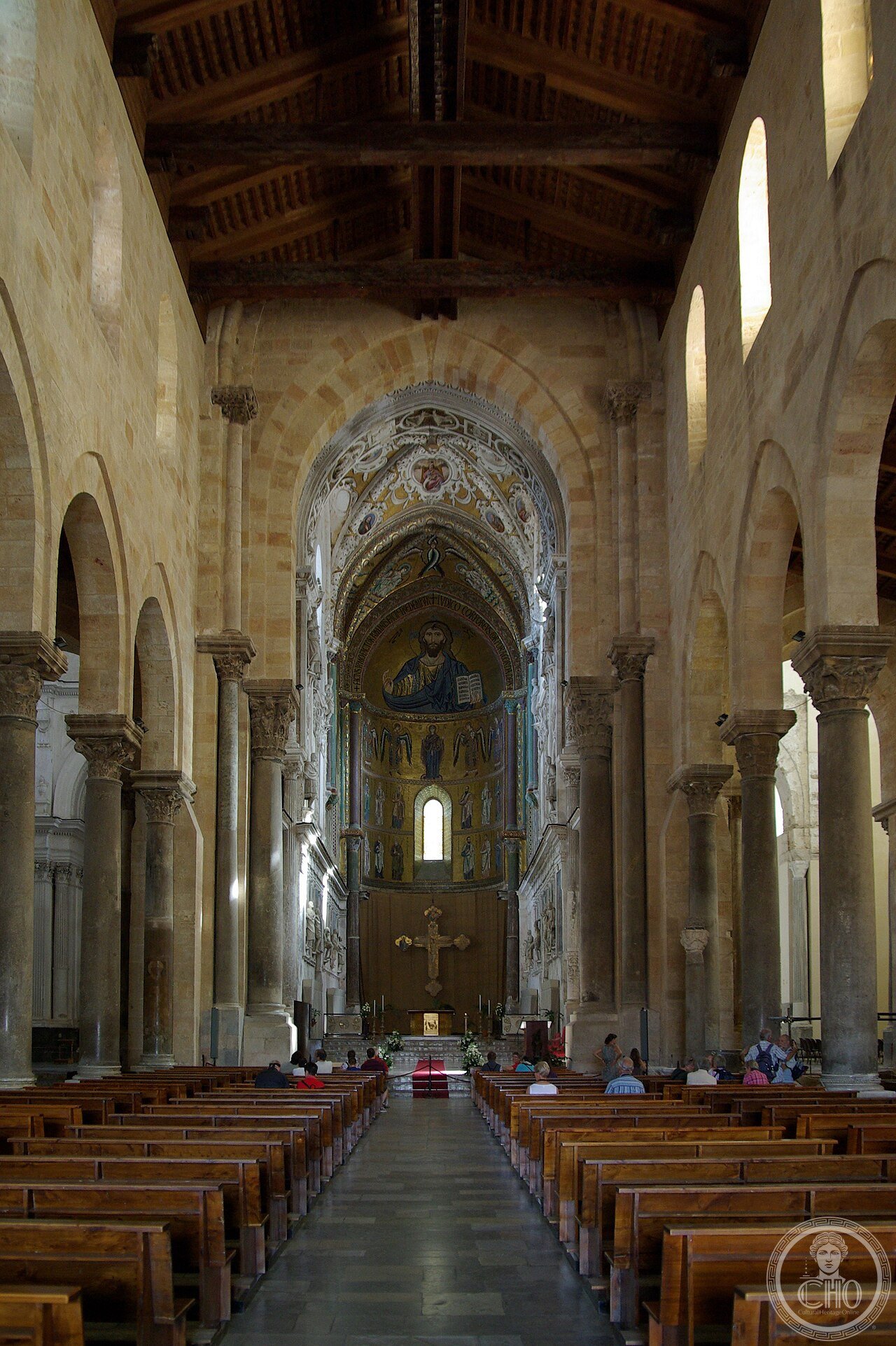
Between the 16th and 18th centuries the nave columns were encased in Baroque stucco, the wooden ceiling was replaced and the floor repaved. A restoration carried out between the 1920s and 1950s removed these Baroque additions and uncovered the original Norman columns and capitals.
What you see
Inside, the nave runs the length of the building toward the apse, where the mosaic of Christ Pantocrator dominates the conch above the altar. The figure, roughly seven metres high with a halo some 2.8 metres across, raises its right hand in the Greek gesture of blessing and holds an open Bible in its left, inscribed in Greek on one page and Latin on the other, a visible sign of the bilingual kingdom Roger ruled. Because the cathedral has no dome, the mosaic occupies the most prestigious space available, the semicircular apse behind the altar, rather than the ceiling position usual in Byzantine churches. The tesserae are set at an angle designed to catch candlelight from the altar and throw it back toward the congregation.
The nave itself is lined with sixteen granite columns, eight to a side, topped by Corinthian capitals reused from Roman buildings of the 4th to 6th centuries; no two capitals are quite alike, since each came from a different original structure.
A path beside the cathedral apse climbs the Rocca di Cefalù to the Tempio di Diana, a megalithic terrace of uncertain date and function, and to the summit, from which the coast is visible in both directions on clear days. In the town itself, the Piazza del Duomo and the seafront lead to the Osteria Magno on Via Vittorio Emanuele, which preserves a 12th-century Arab loggia.
Practical information
- Access: the cathedral stands on Piazza del Duomo in the centre of Cefalù; current opening times and any entrance conditions should be checked on the cathedral’s own channels before visiting
- Rocca di Cefalù: the path to the summit starts beside the cathedral apse and takes roughly half an hour on foot
- Best light: the apse mosaic is said to be most vividly lit in the morning, when direct sunlight reaches it through the clerestory windows
Getting there
Cefalù is reached by train from Palermo Centrale on the Trenitalia line, a journey of about an hour; the railway station is a short walk from Piazza del Duomo and the cathedral.
Nearby
- Rocca di Cefalù — the cliff behind the cathedral, climbed on a path starting at its apse, with the Tempio di Diana near the summit
- Osteria Magno — on Via Vittorio Emanuele, a building with a surviving 12th-century Arab loggia above the seafront
- Palermo’s Arab-Norman monuments — about an hour away by train, including the Palatine Chapel, other components of the same serial UNESCO inscription
Sources
- UNESCO
- Trenitalia
Gallery
Find it on the map
See this place and what’s around it →📷 Become a Cultural Heritage Online photographer
Share your photos of places: they stay published under your name as the author. The more they're seen, the more you get noticed — and soon a contest will reward the most appreciated photos.
Log in or sign up free to add a photoIs this page about you?
This page is read by travellers and heritage enthusiasts who find it on Google. Tell us how you are connected to this place and we will take it from there.