
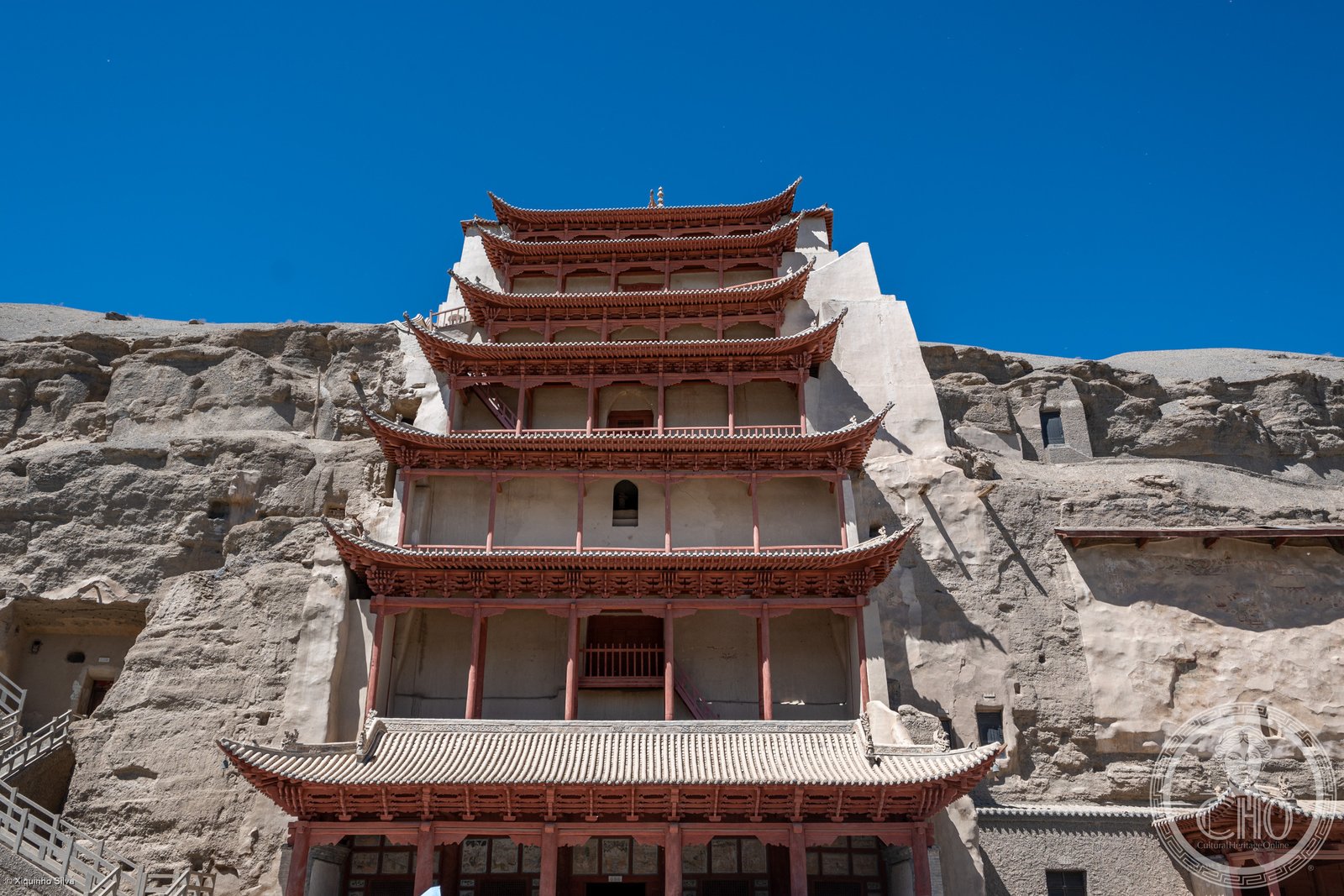
A system of 500 Buddhist temples carved into desert cliffs, the Mogao Caves preserve a thousand years of religious art along the Silk Road and contain treasures that shaped the scholarly understanding of medieval Asia.
At a glance
Located 25 kilometers southeast of Dunhuang, an oasis city in Gansu province, the Mogao Caves form one of China’s three most significant ancient Buddhist sculptural complexes. The caves span from 366 CE to the 14th century, representing an unparalleled record of Buddhist artistic evolution. Strict visitor quotas now protect the site from degradation.
History
The first caves were excavated in 366 CE as spaces for Buddhist meditation and worship, taking advantage of Dunhuang’s position as a religious and cultural crossroads on the Silk Road. Over a millennium, monks and pilgrims expanded the complex, with construction continuing until the 14th century. In the 11th century, one chamber—later called the “Library Cave”—was sealed, preserving thousands of manuscripts that remained hidden until their discovery in 1900. These documents subsequently dispersed to major collections in Beijing, London, Paris, and Berlin, fundamentally reshaping Western understanding of medieval Chinese, Tibetan, and Central Asian civilization.
What you see
The 500 temples showcase diverse Buddhist sculptural styles and painting techniques developed across ten centuries. Architectural forms range from simple meditation cells to elaborate multi-chambered sanctuaries. The caves contain some of the finest examples of Buddhist art surviving from this period, with vibrant pigments and intricate carvings still visible despite the arid climate and centuries of use.
Cultural significance
The Mogao Caves represent the most comprehensive visual record of Buddhist religious expression and artistic innovation in China. Along with the Longmen and Yungang grottoes, they constitute a triad of supreme importance in East Asian cultural history. The 1900 manuscript discovery—now the focus of the International Dunhuang Project—transformed knowledge of medieval literacy, trade networks, and religious practice across Asia.
Key facts
- Location: Dunhuang, Gansu province, China (40.0372°, 94.8042°)
- Number of caves: approximately 500
- Date range: 366 CE–14th century
- UNESCO World Heritage Site: yes
- Notable discovery: Library Cave manuscripts (1900)
Practical information & getting there
The caves are situated 25 kilometers southeast of Dunhuang city center. Visitor numbers are capped daily to ensure conservation of the paintings and sculptures. You should check current access restrictions and visiting hours in advance, as preservation requirements may affect availability.
Sources & resources
Find it on the map
See this place and what’s around it →📷 Become a Cultural Heritage Online photographer
Share your photos of places: they stay published under your name as the author. The more they're seen, the more you get noticed — and soon a contest will reward the most appreciated photos.
Log in or sign up free to add a photo