
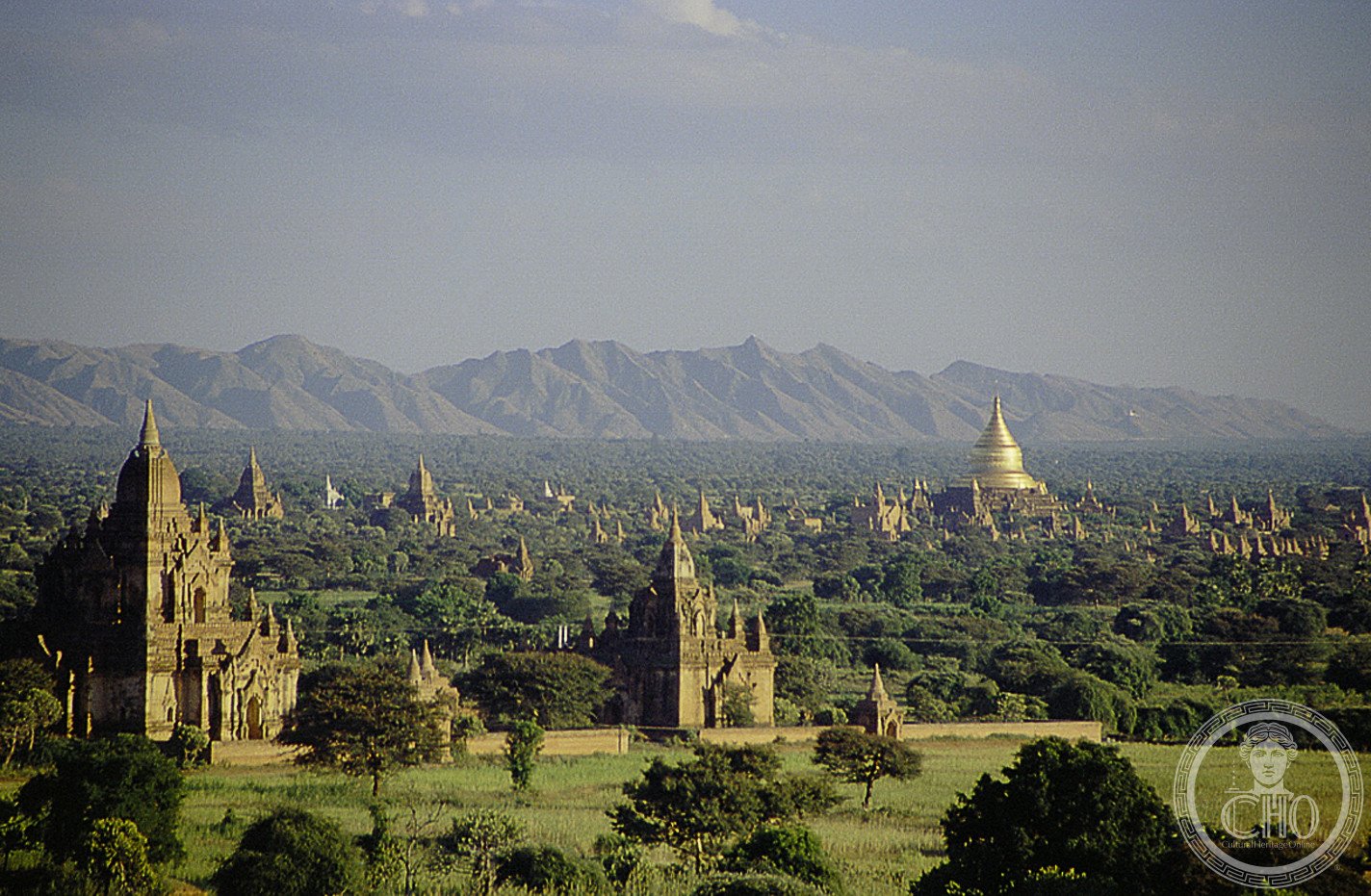
The greatest concentration of Buddhist temples on earth: 2,200 surviving structures across 42 square kilometres of Irrawaddy plain, the remains of an empire that built so obsessively for religious merit that it spent itself into collapse.
At a glance
Bagan occupies a flat alluvial plain on the eastern bank of the Irrawaddy River in central Myanmar, and was the capital of the Pagan Kingdom from the 9th to the 13th century. At the height of the building programme, between approximately 1000 and 1300 AD, the kings and queens of Pagan constructed an estimated 10,000 Buddhist temples, pagodas, and monasteries across this plain in a sustained act of collective religious devotion. Today 2,200 survive, spread across 42 square kilometres — the highest concentration of Buddhist monuments anywhere in the world. Inscribed as a UNESCO World Heritage Site in 2019.
Key facts
- Period: 849–1297 AD (Pagan Kingdom; main building phase 11th–13th century)
- Area: 42 km² of archaeological zone; 2,200 surviving structures out of an estimated 10,000 built
- UNESCO WHS: Inscribed 2019
- Location: Mandalay Region, central Myanmar; eastern bank of the Irrawaddy River
- Collapse: Mongol invasions of 1277–1287 ended the Pagan Kingdom; the last Bagan king, Narathihapate, fled and the capital was abandoned
- Major damage: 1975 earthquake (4,000 structures destroyed or damaged); 2016 earthquake (additional damage); controversial 1990s cement restoration by the military junta
History
The Pagan Kingdom consolidated control of the Irrawaddy valley in the 9th century, unifying for the first time the territories that would eventually become modern Myanmar. The first king to rule from Bagan as a unified capital is traditionally held to be Pyinbya (c. 849 AD), though the city’s political significance grew decisively under Anawrahta, who seized the throne in 1044 and converted to Theravada Buddhism. Anawrahta’s conquest of the Mon kingdom of Thaton in 1057 brought skilled Mon craftsmen to Bagan and inaugurated the great temple-building era.
The logic of construction was theological. In Theravada Buddhist practice, building a temple accumulated merit — a form of spiritual credit that would improve the donor’s position in future rebirths. Larger, more elaborate temples generated more merit. Kings built to secure their dynasties and futures; nobles built to rival their neighbours; merchants built to launder commercial success into spiritual standing. The result, over two centuries of compounding expenditure, was a landscape unlike anything in the Buddhist world: not one or a dozen great temples but thousands of them, built so close together that the horizon in every direction was punctuated by stupas.
The resource cost was ruinous. Temple construction consumed tax revenue, corvee labour, and agricultural land donated in perpetuity to support temple maintenance. By the late 13th century, the Pagan state had weakened itself through a century of monumental building. When the Mongol forces of Kublai Khan invaded in 1277, the kingdom could not resist. The Pagan Kingdom collapsed after a series of Mongol incursions between 1277 and 1287. The capital was abandoned. The temples remained, empty, slowly reclaimed by vegetation, until the plains were rediscovered by the modern world.
What you see
The 2,200 surviving structures at Bagan range from massive temple complexes that dominate the plain to small solitary stupas barely distinguishable from the surrounding scrub. The forms divide broadly into two types: pahto (hollow temples with vaulted interiors, designed to be entered and used for prayer and meditation) and zedi (solid stupas designed to contain sacred relics and to be circumambulated rather than entered).
The Ananda Temple (1105 AD), built by King Kyanzittha, is the finest surviving example of Mon-influenced Pagan architecture. Standing 51 metres tall with a perfectly symmetrical Greek-cross plan, the temple houses four standing Buddha images in the four cardinal directions, each 9.5 metres high. The central corridors are lit by narrow windows angled to focus light on the Buddha faces. The whitewashed exterior and gilded spire are among the most recognisable images in Myanmar.
The Dhammayangyi Temple (c. 1170 AD), the largest temple in Bagan, carries a dark legend. Its builder, King Narathu, reportedly ordered workers whose brick-laying he considered sloppy to have their hands cut off. The craftsmanship is correspondingly exceptional: the brick joints in the Dhammayangyi are the narrowest recorded in Burmese architecture, no more than one centimetre — so tight that legend says not even a pin could pass between them. The Shwezigon Pagoda, begun by Anawrahta and completed by Kyanzittha, was the prototype for the Burmese stupa form that spread across mainland Southeast Asia.
Damage and restoration
Bagan’s monuments have been damaged by both natural disaster and human intervention. The earthquake of 8 July 1975 (magnitude 6.5) destroyed or damaged approximately 4,000 structures. Many were subsequently rebuilt with concrete rather than the original handmade bricks. The military government’s restoration programme of the 1990s, which added cement stupas and a modern observation tower visible across the plain, was widely criticised by archaeologists and was cited as one reason UNESCO delayed the site’s World Heritage inscription until 2019. The earthquake of August 2016 (magnitude 6.8) caused further damage to scores of temples.
Cultural significance
Bagan is the founding monument of Burmese Buddhist civilisation. Every subsequent Burmese kingdom looked back to the Pagan era as the standard against which political and religious legitimacy was measured. The temples are not simply historical artefacts: many remain active places of worship, tended by local monks, decorated with fresh flowers and votive offerings. The site’s inscription as a UNESCO World Heritage Site in 2019 — after decades of delay partly due to the junta’s botched restoration and the forced relocation of Old Bagan village in 1990 — recognised both its universal value and the complexity of its management history.
Practical information
- Entry: Archaeological Zone entry fee required; covers multiple days
- Getting around: Electric scooter hire is the most practical way to cover the 42 km² zone; horse carts available for smaller areas; bicycle hire possible but demanding in the heat
- Best time: November–February (cool season: 20–30°C); avoid April–June (extreme heat, 40°C+); monsoon June–October offers dramatic skies but muddy tracks
- Balloon flights: Hot-air balloon flights over the temples at dawn are a signature Bagan experience; bookable through local operators (October–April only)
- Duration: Allow a minimum of two full days; serious exploration warrants three or four
Getting there
Bagan is served by Nyaung-U Airport (NYU), with domestic flights from Yangon (45 minutes) and Mandalay (30 minutes). The nearest rail station is Bagan Railway Station in Nyaung-U town. Buses run overnight from Yangon (9–10 hours) and from Mandalay (4–5 hours). Slow-boat services on the Irrawaddy connect Mandalay and Bagan in approximately 10–12 hours downstream; the upstream return journey takes 16–20 hours and is itself considered a scenic attraction.
Nearby
- Ananda Temple (within zone) — the finest Mon-period temple; gilded spire visible from across the plain
- Bagan Archaeological Museum — Nyaung-U town; artefacts and an excellent scale model of the ancient city
- Mount Popa — 50 km southeast; extinct volcanic cone with a hilltop nat (spirit) shrine; pre-Buddhist site of continuing importance
- Salay — 38 km south; preserved 19th-century Burmese teak town with carved wooden monasteries, far less visited than Bagan
Sources
- Wikipedia — Bagan
- UNESCO World Heritage Centre — Bagan
- Strachan, Paul. Pagan: Art and Architecture of Old Burma. Kiscadale, 1989.
Find it on the map
See this place and what’s around it →Historical events at this place (1)
📷 Become a Cultural Heritage Online photographer
Share your photos of places: they stay published under your name as the author. The more they're seen, the more you get noticed — and soon a contest will reward the most appreciated photos.
Log in or sign up free to add a photo