
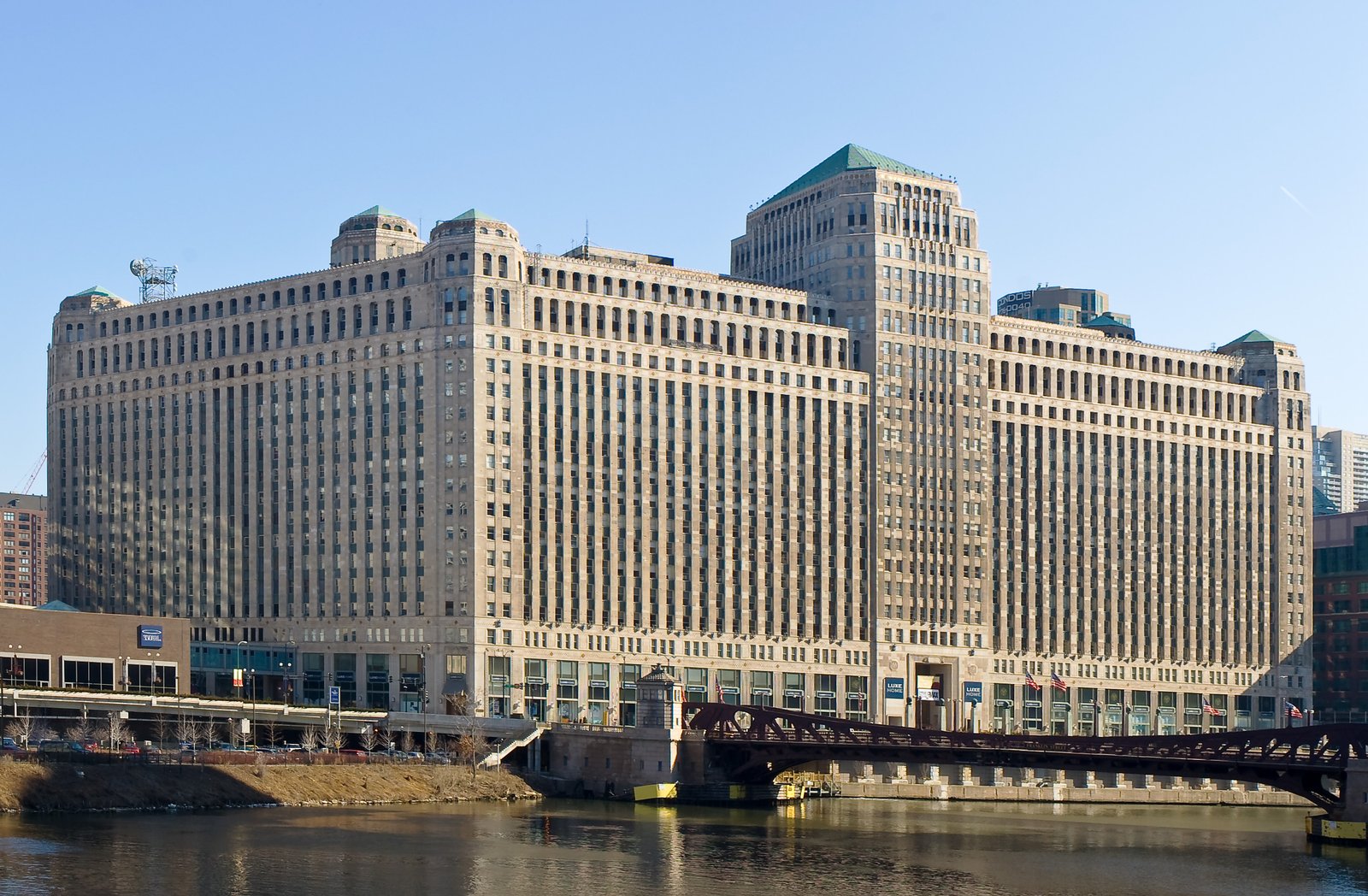
For thirteen years after it opened, no building on earth enclosed more floor space than this Art Deco colossus on the Chicago River.
At a glance
When it opened along the north bank of the Chicago River in 1930, the Merchandise Mart was the largest building in the world. Designed by Graham, Anderson, Probst & White — the same firm responsible for Chicago Union Station — the building assembled an entire city block into a single Art Deco structure housing wholesale showrooms for furniture and home furnishings. Its enormous horizontal mass, articulated by shallow setbacks and Art Deco geometric ornament, stretches along the river in a composition that reads less like a skyscraper than a city condensed into one address. It remains one of the defining features of Chicago’s riverfront and a functioning centre of the design industry.
Key facts
- Location: 222 Merchandise Mart Plaza, Chicago, Illinois
- Completed: 1930
- Architect: Graham, Anderson, Probst & White
- Style: Art Deco
- Size: approximately 4 million sq ft (370,000 m²) — world’s largest building from 1930 until the Pentagon opened in 1943
- Status: National Register of Historic Places
- Function: design and trade centre, office and retail
History
The concept emerged in the mid-1920s as Marshall Field & Company sought to consolidate its wholesale operations — then scattered across dozens of Chicago locations — into a single, purpose-built complex. The commission went to Graham, Anderson, Probst & White, the dominant Chicago commercial firm of the era, which had already reshaped the Loop with the Continental Illinois National Bank building and Chicago Union Station. Ground broke in 1926 and the building opened in 1930. The timing proved unfortunate: within months of opening, the national economy was in freefall, and the wholesale trade the building served contracted sharply.
Marshall Field’s eventually sold the property to Joseph P. Kennedy in 1945, at a price widely reported as a bargain for such scale. The Kennedy family retained ownership for more than five decades, during which the building evolved from wholesale showroom complex toward the design industry hub it remains today, housing showrooms for furniture makers, interior designers, and home goods manufacturers. Along the river walk, a series of bronze busts known as the Merchandise Mart Hall of Fame commemorates figures from American retail history — one of Chicago’s more idiosyncratic civic monuments.
What you see
From the Chicago River, the Merchandise Mart presents the longest unbroken Art Deco facade in the city. A two-level base of polished granite gives way to a limestone tower rising in shallow setbacks toward a flat crown flanked by matching corner towers. The horizontal emphasis — setbacks that widen rather than taper, cornice lines that carry across the full block — suits a building whose function is vast horizontal floor space rather than vertical office prestige. The profile reads as a low mesa rather than a spike, and is recognisable from every bridge over this stretch of the river.
The main river-level entrance retains its original bronze doors and Art Deco lobby with geometric ornament in marble and metal. At the base of the river walk, the bronze busts of the Hall of Fame face the water — eight figures cast in the decades after the building opened, an unusual decision to permanently attach a gallery of retail worthies to one of the city’s great facades.
Practical information
- Hours: public areas, retail floors, and the river walk are accessible daily
- Note: wholesale design showrooms on upper floors are trade-only (open to design professionals and their clients)
- Access from CTA: Brown and Purple Lines stop at Merchandise Mart station, which opens directly onto the building’s lower level
- Time needed: 30–45 minutes for lobby, river walk, and exterior
Getting there
The Merchandise Mart is served by its own CTA el station (Brown and Purple Lines) which opens directly onto the building’s main floor. From the Loop, the building is a ten-minute walk north across the Chicago River via Wacker Drive. A public riverside walk at the building’s south base connects it to the broader waterfront; the Chicago Riverwalk proper runs along the south bank of the river, accessible via any of the nearby bridges. The nearest major transit hub is Millennium Park, roughly fifteen minutes on foot.
Nearby
- Chicago City Hall (1911) — two blocks south across the river
- Marina City (1964) — corncob towers immediately east on the river
- 333 N. Michigan Avenue — 1920s Art Deco skyscraper on the south bank
Sources
- National Register of Historic Places nomination file, Merchandise Mart, Chicago, Illinois
- Architectural Forum, coverage of Merchandise Mart opening, 1930
- Chicago Architecture Center documentation and tours
Find it on the map
See this place and what’s around it →📷 Become a Cultural Heritage Online photographer
Share your photos of places: they stay published under your name as the author. The more they're seen, the more you get noticed — and soon a contest will reward the most appreciated photos.
Log in or sign up free to add a photoIs this page about you?
This page is read by travellers and heritage enthusiasts who find it on Google. Tell us how you are connected to this place and we will take it from there.