
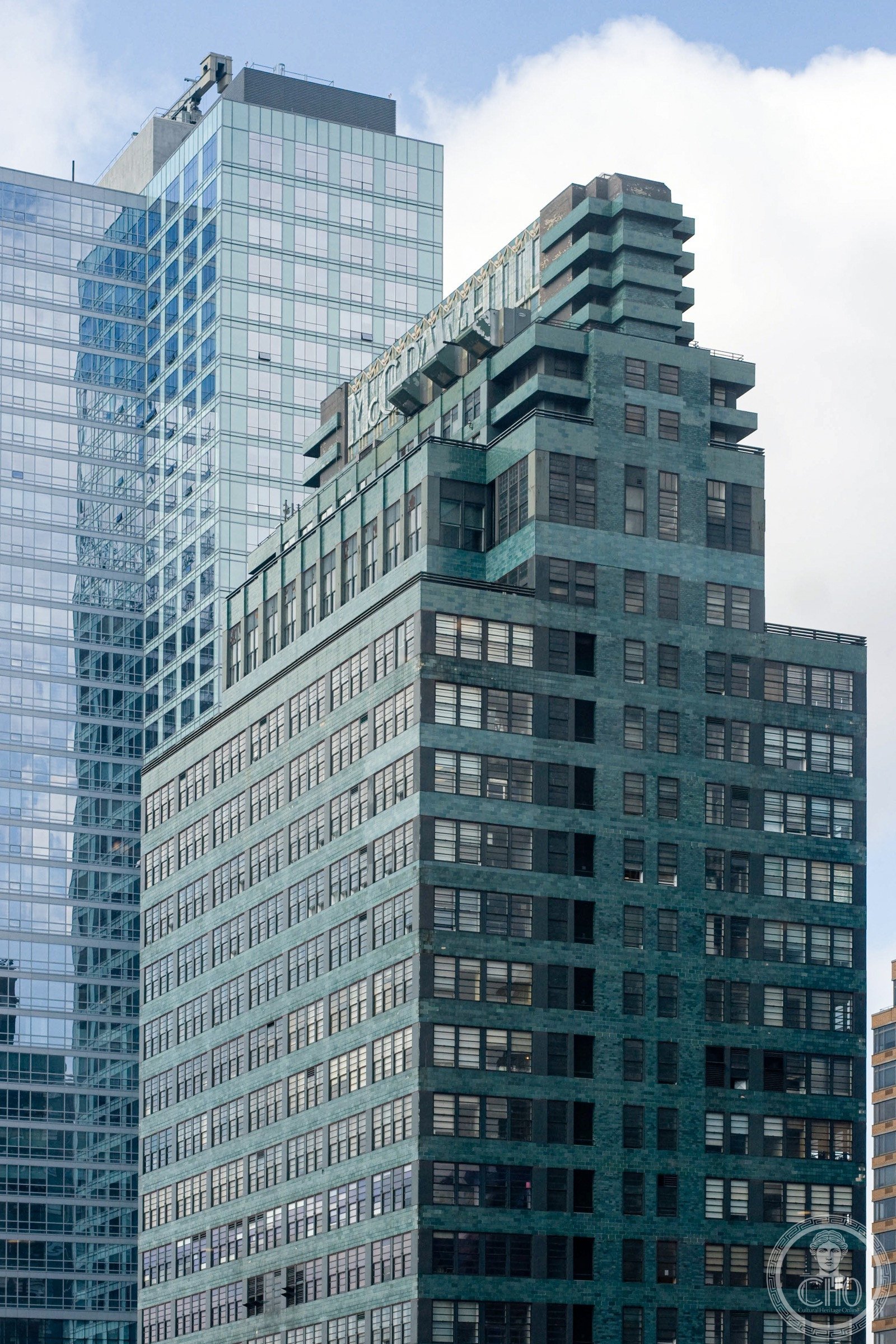
Raymond Hood’s 33-story tower at 330 West 42nd Street breaks every rule of the New York skyscraper tradition: blue-green terracotta panels run horizontally across the facade, blending into the sky rather than racing it.
At a glance
The McGraw-Hill Building at 330 West 42nd Street stands as one of the most radical statements in American commercial architecture. Designed by Raymond Hood with Frederick Godley and J. André Fouilhoux, the 33-story tower was constructed in 1930–1931 and originally served as the headquarters of the McGraw-Hill Companies. Its facade of blue-green terracotta ceramic tile panels with green metal-framed windows was controversial at the time of construction for its insistently horizontal orientation — an explicit break from the vertical emphasis every contemporary skyscraper in New York deployed. The building is a National Historic Landmark and New York City designated landmark.
Key facts
- Built: 1930–1931
- Architect: Raymond Hood, Frederick Godley, J. André Fouilhoux
- Style: Art Deco / International Style / Art Moderne
- Height: 33 stories, 485 ft (148 m)
- National Historic Landmark: June 29, 1989; NRHP March 28, 1980
- Facade: Blue-green terracotta ceramic tile, green metal-framed windows
- Address: 330 West 42nd Street, Hell’s Kitchen, Manhattan
History
Raymond Hood came to the McGraw-Hill Building commission at the peak of his New York career, having already designed the American Radiator Building (1924) and, with John Mead Howells, the Daily News Building (completed 1930). Each commission had moved Hood further toward the horizontal surface treatment and industrial materials that he believed expressed the true character of modern commercial architecture. At the McGraw-Hill Building he pushed the experiment to its logical conclusion: a facade designed to read as a continuous field of color rather than as a stack of vertical piers reaching for height.
McGraw-Hill Companies had acquired the site in early 1930 to replace smaller headquarters in midtown. The company originally occupied three-quarters of the building’s space, renting out the remaining floors. As the surrounding Hell’s Kitchen neighborhood declined in the postwar decades, the company relocated to 1221 Avenue of the Americas in 1972. The building subsequently served as headquarters for Group Health Insurance before passing through multiple ownerships. A complete renovation by Moed de Armas and Shannon was completed in 2021; the upper stories were converted to residential apartments beginning in 2023.
The building’s reception by critics shifted dramatically over the decades. At its opening, the horizontal facade was considered provocative and un-New-Yorklike — architectural historians noted that no contemporary skyscraper had opted so deliberately for the horizontal over the vertical. By the 1980s, the same facade was recognized as an early, fully realized example of the International Style in American commercial construction, earning the building its National Register listing in 1980 and National Historic Landmark status in 1989.
What you see
The facade presents an unbroken field of blue-green terracotta panels interspersed with windows framed in matching green metal. The color was not ornamental but meteorological: Hood intended the facade to merge with the sky under varying atmospheric conditions, eliminating the hard boundary between building and air that stone-clad towers maintained. The building’s massing follows the stepped setbacks required by the 1916 Zoning Resolution, but the horizontal surface treatment overrides the visual effect of those setbacks, keeping the eye moving laterally rather than upward.
The entrance and original lobby were decorated with light blue and dark green panels — a continuation of the exterior palette into the building’s public spaces. The lobby was substantially renovated in 2021, but the building’s exterior maintains its original terracotta cladding intact. From the street, the blue-green mass sits in striking contrast to the gray stone towers of midtown, its color shifting with the light from teal in morning sun to gray-green on overcast days.
Practical information
- Status: Mixed-use (office + residential); lobby accessible during business hours
- Photography: Exterior unrestricted from 42nd Street and 41st Street sidewalks
- Best view: Across 42nd Street from the south side; afternoon light enriches the terracotta color
- Nearest transit: 42nd Street–Port Authority Bus Terminal (A/C/E), one block east; Times Square–42nd Street (1/2/3/7/N/Q/R/S), two blocks east
Getting there
The McGraw-Hill Building is on the south side of 42nd Street between Eighth and Ninth Avenues in Hell’s Kitchen, Manhattan. It is one block west of the Port Authority Bus Terminal and two blocks west of Times Square. John F. Kennedy International Airport (JFK) is approximately 16 miles southeast; Newark Liberty Airport (EWR) is approximately 16 miles west. GPS: 40.7575°N, 73.99167°W.
Nearby
- Times Square — one block east; major Art Deco theater district
- Daily News Building (1930) — Hood’s earlier Art Deco commission, East 42nd Street
- Port Authority Bus Terminal — the blocks east of the building, 42nd Street
- Hell’s Kitchen neighborhood — surrounding residential blocks retain 1920s–1930s character
Sources
- Wikipedia: 330 West 42nd Street (McGraw-Hill Building)
- National Register of Historic Places: March 28, 1980
- National Park Service, National Historic Landmark: June 29, 1989
- New York City Landmarks Preservation Commission — designated landmark
Find it on the map
See this place and what’s around it →Record researched and written by Luigi De Marchi for Cultural Heritage Online, 2026.
📷 Become a Cultural Heritage Online photographer
Share your photos of places: they stay published under your name as the author. The more they're seen, the more you get noticed — and soon a contest will reward the most appreciated photos.
Log in or sign up free to add a photoIs this page about you?
This page is read by travellers and heritage enthusiasts who find it on Google. Tell us how you are connected to this place and we will take it from there.