

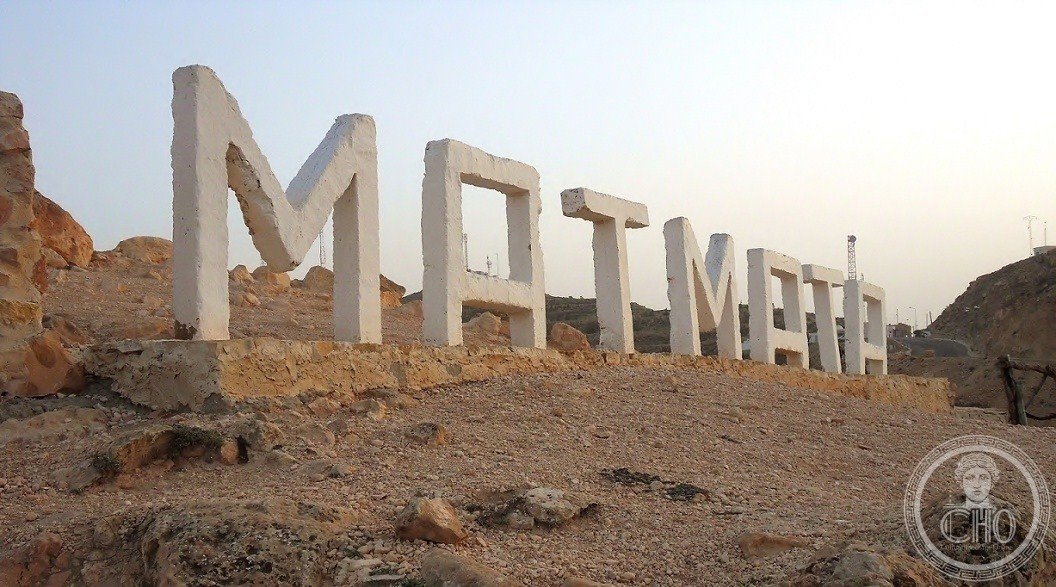
A Berber village in southern Tunisia where homes are dug vertically into the earth — central sky-wells ringed by cave rooms that stay cool in summer and warm in winter. The Hotel Sidi Driss here became Luke Skywalker’s home planet Tatooine in Star Wars: Episode IV – A New Hope (1977).
At a glance
Matmata sits on the edge of the Sahara, roughly 45 km south of Gabès. Instead of building upward, the Berber inhabitants excavated large circular pits — typically 10 m in diameter and 6–8 m deep — and carved rooms directly into the encircling walls. A trench connects pit to pit, and a second trench leads to the surface. The design has no blueprint on paper: it is millennia of desert wisdom made tactile. Daytime temperatures outside can exceed 40°C; inside a pit-house, it rarely climbs above 22°C.
Key facts
- Location
- Gabès Governorate, southern Tunisia (33.5456°N, 9.9720°E)
- Architecture type
- Troglodyte pit-dwelling (semi-subterranean cave houses)
- Cultural group
- Berber (Amazigh), Berber-speaking community
- Building tradition
- Predates Islam in North Africa; structures documented at least to the medieval period
- Notable building
- Hotel Sidi Driss — used as Star Wars filming location, 1976–77 and 2000
- UNESCO status
- Not individually inscribed; broader Ksar/ksour culture in the region under consideration
- 2023 earthquake
- A tremor caused damage to several pit-house structures
History
The pit-house form is among the oldest recorded in North Africa. Archaeologist and historian Professor Slimane-Mustapha Zbiss documented Berber habitation patterns across southern Tunisia, tracing the troglodyte tradition to at least the early medieval period — though oral tradition and evidence from comparable sites in the Matmata highlands suggest much earlier occupation. The technique requires no fired brick, no timber, no quarried stone: only labour and the soft sedimentary rock of the plateau.
In the 1960s the Tunisian government offered modern housing in a new settlement — Nouvelle Matmata — about 15 km to the north, and many families relocated. The original village did not empty entirely; a community chose to stay. Their choice preserved one of the most unusual built landscapes in the Mediterranean world.
In 1976, George Lucas’s location scouts arrived. The interior courtyard and carved rooms of the Hotel Sidi Driss became the Lars Homestead on the desert planet Tatooine for Star Wars: Episode IV – A New Hope (released May 1977). The same hotel was revisited during filming of Star Wars: Episode II – Attack of the Clones (2002). A 2023 earthquake damaged a number of structures, adding urgency to preservation efforts.
What you see
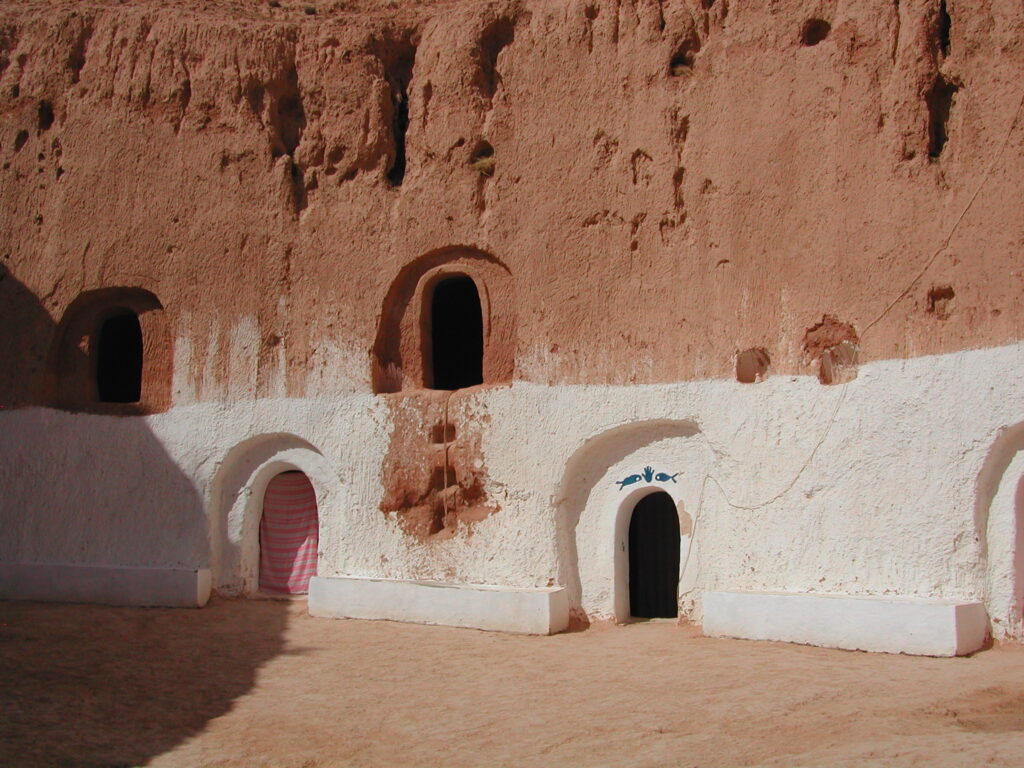
Walking into Matmata means walking downward. You cross a threshold and descend a ramp into a courtyard open to the sky — a circle of pale rock framing a disc of blue above. The rooms around you are carved clean: arched doorways, smooth plaster walls, niches for lamps and provisions. The light changes through the day as the sun tracks across that circular opening.
At the Hotel Sidi Driss, a corridor of Star Wars memorabilia leads to the rooms used as the Skywalker homestead interior. Props, stills, and the original set dressings survive. Beyond the hotel, several families still live in working pit-houses and are accustomed to visitors — a small tip or a purchase from a local artisan is the appropriate etiquette.
Star Wars connection
Star Wars: Episode IV – A New Hope (George Lucas, 1977) — The interior scenes of the Lars Homestead (“Uncle Owen’s place”) on Tatooine were filmed at the Hotel Sidi Driss, Matmata, in 1976. The pit-house courtyard doubled perfectly as a subterranean dwelling on a desert planet. The exterior Tatooine scenes — moisture vaporators, twin suns — were filmed near Tataouine (a separate town, ~150 km to the south), which gave the planet its name.
Star Wars: Episode II – Attack of the Clones (George Lucas, 2002) — The production returned to Hotel Sidi Driss for additional Tatooine sequences. Today the hotel maintains a dedicated Star Wars museum wing, and the rooms where filming took place can be visited.
Practical information
- Access
- Open village; no entry fee for the village itself
- Hotel Sidi Driss
- Can be visited as a museum; small entrance fee; overnight stays available
- Best time to visit
- October–April; summer temperatures above 40°C outside the pit-houses
- Language
- Berber (Shelha), Arabic, some French; limited English
- Accommodation
- Hotel Sidi Driss (original troglodyte rooms) or guesthouses in Gabès
Getting there
Fly to Sfax or Jerba-Zarzis airport, then rent a car — Matmata is not on a main rail line. From Gabès (45 km north) there are shared taxis (louages) to Matmata. The road from Gabès climbs onto the Matmata plateau through a dramatic series of switchbacks. Allow a full day from Tunis (≈ 400 km south); the drive via the A1/GP1 takes roughly 4 hours.
Nearby
- Ksar Ouled Soltane — fortified Berber granary (ksar), ~100 km south; one of the best preserved in Tunisia
- Douz — “Gateway to the Sahara,” camel treks and desert festivals
- Tataouine — the town whose name Lucas adapted for “Tatooine”; exterior Star Wars filming locations nearby (Ksar Hadada, Ksar Medenine)
- El Jem Amphitheatre — Roman colosseum, UNESCO WHS, ~200 km north
Sources
- Zbiss, Slimane-Mustapha — documented Berber habitation patterns in southern Tunisia
- Wikipedia: Matmata, Tunisia
- Rinzler, J.W. The Making of Star Wars (2007) — location scouting documentation
- UNESCO: Ksar troglodyte villages of Southern Tunisia (reference file)
Frequently asked questions
Was Star Wars filmed in Matmata?
Yes. The interior of the Lars Homestead, Luke Skywalker's boyhood home in Star Wars: A New Hope (1977), was filmed at the Hotel Sidi Driss in Matmata in 1976. The sunken courtyard of the Berber pit-house doubled as an underground dwelling on Tatooine.
Can you visit the Star Wars location in Matmata?
Yes. The Hotel Sidi Driss is still a working hotel. Its courtyard and rooms keep set decoration from the films, and you can stay there overnight.
Where is Matmata?
Matmata is in southern Tunisia, in the Gabes Governorate. It is a Berber village where homes are dug down into the earth around open central sky-wells.
What is a troglodyte house in Matmata?
It is a semi-subterranean cave dwelling carved into the rock around a courtyard open to the sky. The form stays cool in summer and warm in winter, a Berber tradition documented since the medieval period.
Was all of Tatooine filmed in Matmata?
No. Matmata provided the Lars Homestead interior. The exterior desert scenes were shot elsewhere in southern Tunisia, near Tataouine and Ksar Hadada, the area whose name George Lucas adapted for "Tatooine".
See this location in context: Set-Jetting: Six Famous Film & TV Locations You Can Actually Visit.
Inside the pit-houses
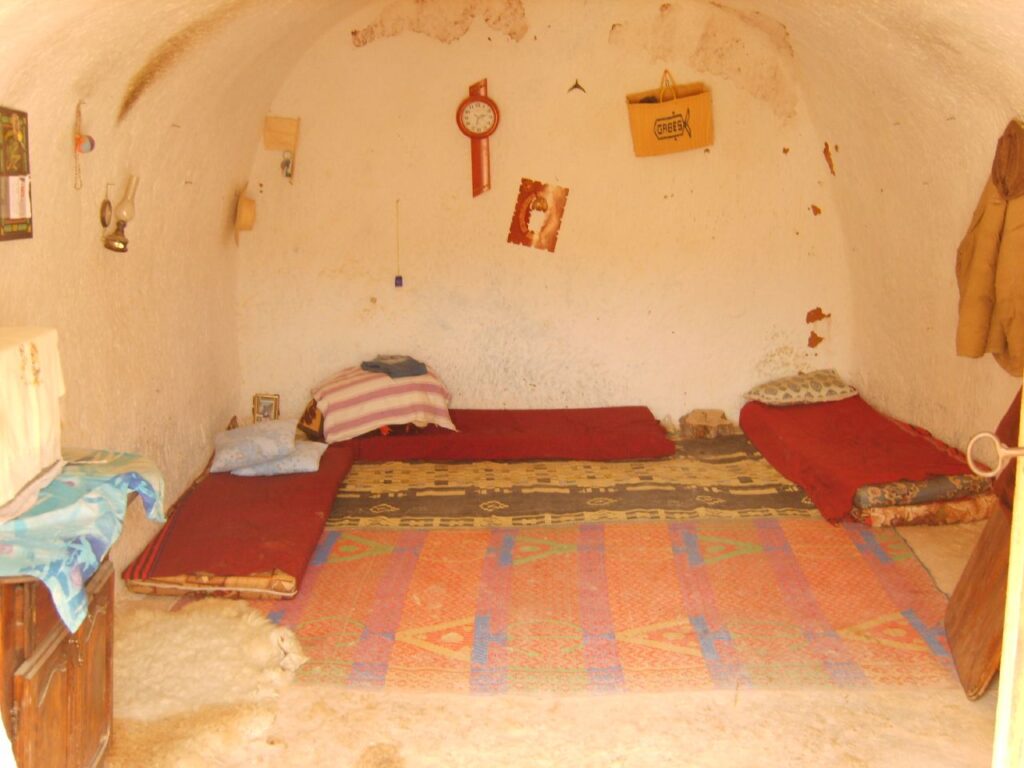
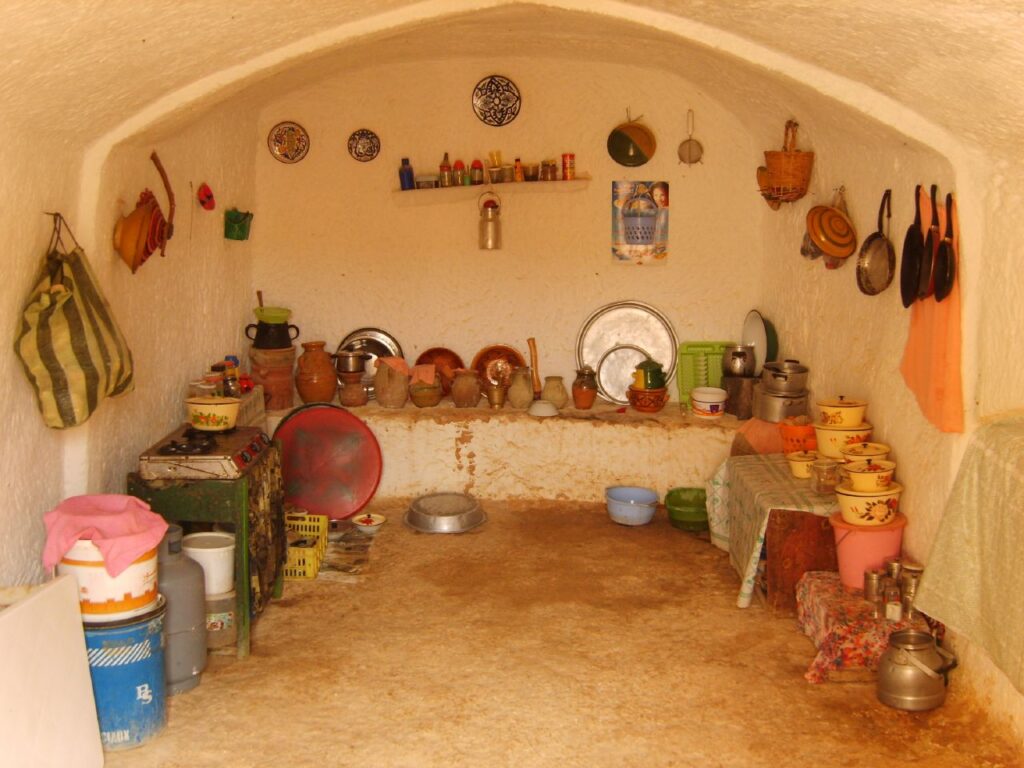
The hero photo above shows the pits from outside; these show what it looks like to stand inside one.
See the place
Find it on the map
See this place and what’s around it →
📷 Become a Cultural Heritage Online photographer
Share your photos of places: they stay published under your name as the author. The more they're seen, the more you get noticed — and soon a contest will reward the most appreciated photos.
Log in or sign up free to add a photo