

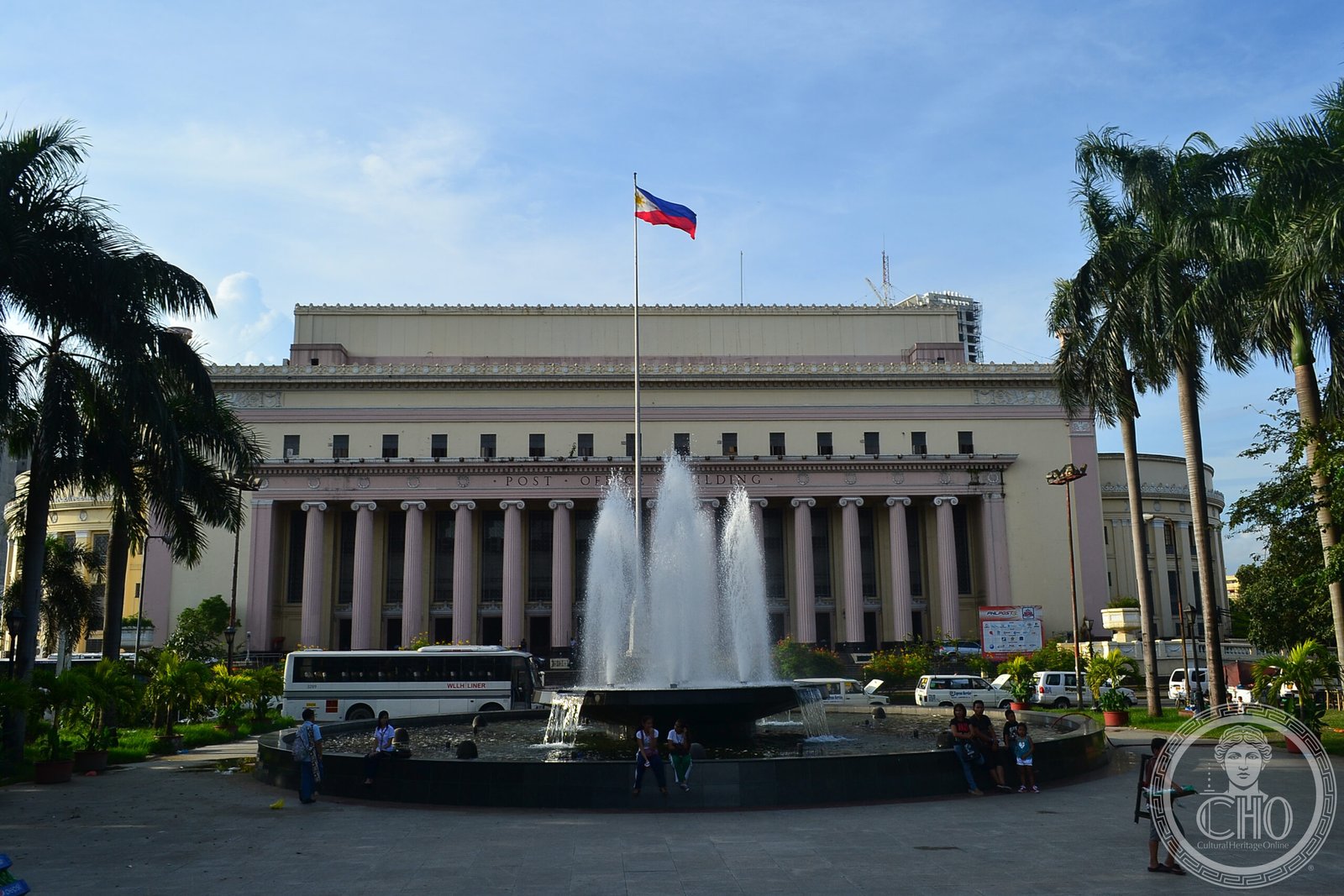
Rising above the Pasig River on Liwasang Bonifacio, the Manila Central Post Office is one of the grandest public buildings ever raised under the American colonial administration. Designed by a trio of architects — Juan M. Arellano, Tomás Mapúa, and Ralph Doane — and completed in February 1928, the structure presents a commanding colonnaded facade of sixteen Ionic pillars that march across the riverside elevation, framing a sequence of arched windows and a recessed attic storey. The building served as the nerve centre of Philippine postal communications for nearly a century, surviving the apocalyptic Battle of Manila in 1945, then reconstruction and decades of heavy daily use. In May 2023 a catastrophic fire gutted its interior, but the reinforced concrete shell endured, and restoration works estimated at 1.5 billion pesos are under way. Designated an Important Cultural Property by the National Museum of the Philippines in 2018, the post office stands as a defining landmark of historic Ermita and a testament to the ambitions of early-twentieth-century Manila.
At a glance
- Type
- Public civic building
- Period
- 1926–1928
- Style
- Neoclassical
- Location
- Liwasang Bonifacio, Magallanes Drive, Ermita, Manila, Philippines
- Coordinates
- 14.5955° N, 120.9791° E
- Architect(s)
- Juan M. Arellano, Tomás Mapúa, Ralph Doane
Overview
The Manila Central Post Office occupies a prime position on the north bank of the Pasig River, directly facing Jones Bridge. Its monumental Neoclassical composition — a long rusticated base, a full colonnade of Ionic columns, semi-circular end wings, and domed corner pavilions — was conceived to project stability and civic pride during the era of American colonial governance. The building functions to this day as the headquarters of the Philippine Postal Corporation, handling national and international mail distribution for the archipelago’s more than one hundred million residents.
History
Manila’s postal services trace their origin to 1767 under Spanish colonial rule. The present edifice replaced an earlier post office demolished to make way for a more ambitious structure befitting the growing city. Construction ran from 1926 to February 1928 under the Bureau of Public Works. During the Battle of Manila in early 1945, the building suffered severe damage when fighting swept through Ermita, but it was rebuilt by 1946 with its original design scrupulously preserved. Decades of steady service followed until 21 May 2023, when a fire igniting in the basement spread through the structure, destroying interior fittings and archival materials. The exterior shell survived, and the government launched a phased restoration programme targeting completion in 2026.
Architecture & Design
Arellano, Mapúa, and Doane produced a Beaux-Arts-inflected Neoclassical scheme that foregrounds a colonnade of sixteen Ionic pillars rising from a broad flight of steps along the principal river-facing elevation. The flanking wings curve gently inward, each capped by a low dome, creating a unified U-shaped plan that embraces the main entrance court. Reinforced concrete construction — still innovative in the Philippines of the 1920s — allowed the architects to achieve large, column-free interior spans suited to mail-sorting halls, while the stone-clad exterior conveys the permanence expected of a national institution.
Cultural significance
The National Museum of the Philippines formally recognised the building as an Important Cultural Property in 2018, acknowledging its architectural integrity and its role in national memory. Across the twentieth century the post office appeared as a backdrop in Filipino films, television productions, and press photographs, embedding itself in the popular imagination as a symbol of government and civic order. Its survival through world war, fire, and repeated reconstruction embodies Manila’s tenacious relationship with its colonial-era architectural heritage.
Visiting today
The building is undergoing restoration following the 2023 fire; visitor access to the interior may be limited or restricted depending on the stage of works. The riverside esplanade and the exterior colonnade remain publicly accessible and provide excellent views across the Pasig River and Jones Bridge. The surrounding Liwasang Bonifacio plaza hosts informal markets and commemorative events year-round. Check the Philippine Postal Corporation’s announcements for updates on reopening timelines.
Getting there
The post office stands on Magallanes Drive at Liwasang Bonifacio in Ermita, Manila. It is within walking distance of the Carriedo LRT 1 station and easily reached by jeepney routes running along Quezon Boulevard and P. Burgos Street. Tricycles and ride-hailing services (Grab) connect the building to Binondo, Quiapo, and Malate. Parking is available along adjacent side streets.
Sources & resources
Find it on the map
See this place and what’s around it →📷 Become a Cultural Heritage Online photographer
Share your photos of places: they stay published under your name as the author. The more they're seen, the more you get noticed — and soon a contest will reward the most appreciated photos.
Log in or sign up free to add a photoIs this page about you?
This page is read by travellers and heritage enthusiasts who find it on Google. Tell us how you are connected to this place and we will take it from there.