
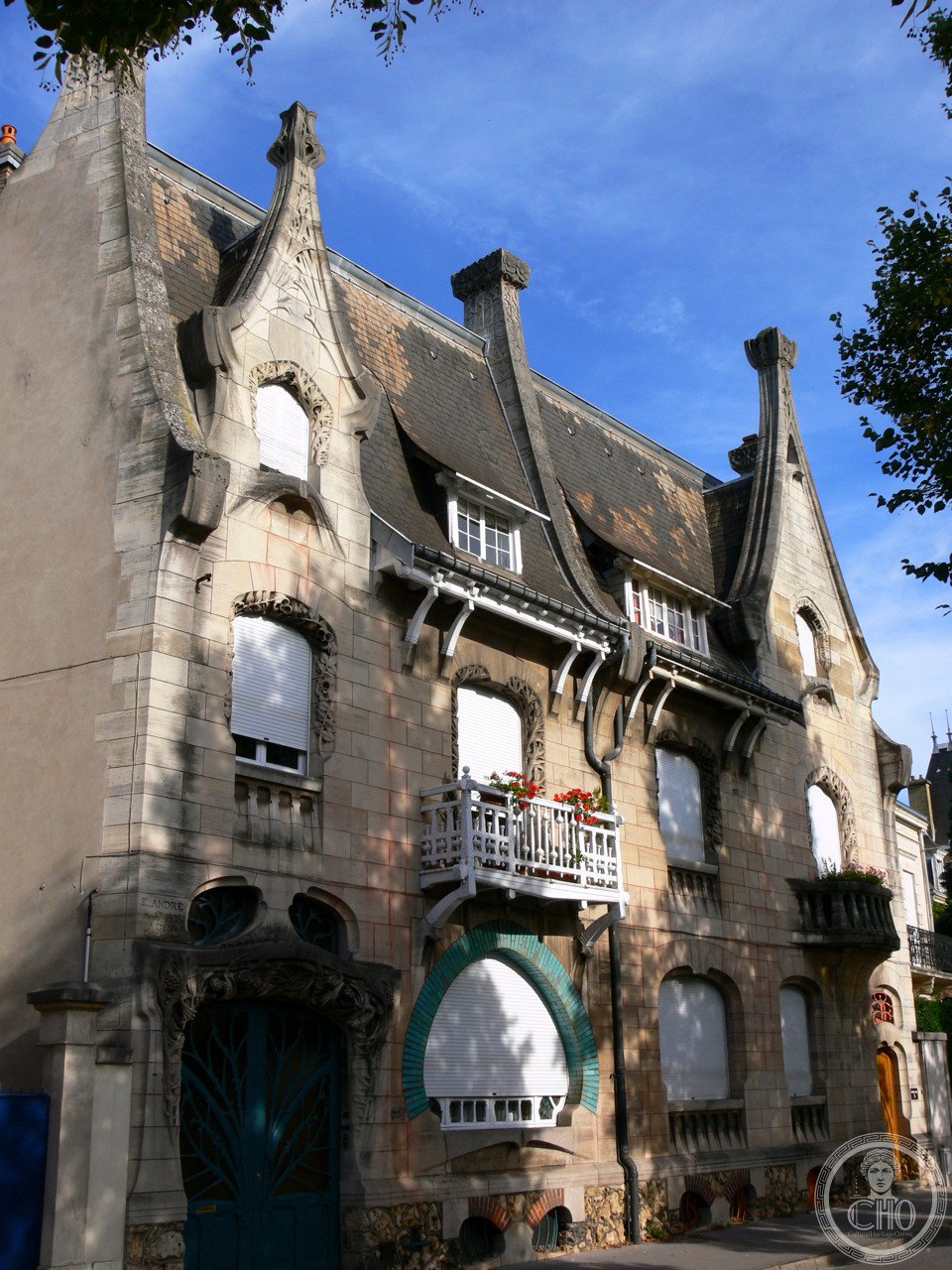
Twins, but not identical. André let the École de Nancy borrow a medieval face.
At a glance
The Maisons Huot are a pair of semi-detached town houses at 92 and 92bis quai Claude-le-Lorrain in Nancy, built in 1903 by the architect Émile André for Frédéric Huot. Designed in the École de Nancy style, they fold the movement’s flowing plant ornament into a silhouette that also borrows from neo-Gothic and neo-Baroque sources, giving the pair an unexpectedly medieval air. Though joined, the two houses differ in size and design. Their street facade and roof are listed monuments.
Key facts
- Architect: Émile André
- Built: 1903
- Client: Frédéric Huot
- Address: 92 and 92bis quai Claude-le-Lorrain, Nancy
- Style: École de Nancy, with neo-Gothic and neo-Baroque notes
- Form: two semi-detached houses, deliberately unequal
- Listed: facade and roof, monument historique (4 May 1994)
History
The two houses were built in 1903 for Frédéric Huot, a man of private means. Émile André, a younger architect of the École de Nancy, took the commission and treated the pair as a single composition divided into two unequal halves.
By 1903 the École de Nancy was at its height, and André belonged to the generation that pushed its vocabulary beyond pure plant ornament. At the Maisons Huot he reached back to medieval and Baroque forms, combining steep roofs and carved detail with the sinuous lines of the new style.
The street facade and roof of the houses were inscribed as a historic monument by decree of 4 May 1994, protecting one of the most distinctive residential groups of Art Nouveau Nancy.
What you see
The pair presents a restless, picturesque front to the quai. Where many École de Nancy houses keep to flowing botanical lines, the Maisons Huot add pointed, almost fortified elements — the medieval effect noted in every account of the building — alongside curves drawn from nature.
The deliberate inequality of the two halves is the point. Rather than mirror one house in the other, André varied their proportions and detail, so the group reads as a small streetscape in itself rather than a single symmetrical block.
Practical information
- These are private residences; only the exterior is open to view.
- The facade faces the quai Claude-le-Lorrain and can be seen at any time.
- Combine with a walk along the canal and toward the École de Nancy quarter.
- Time needed: 10 minutes.
Getting there
The houses stand on the quai Claude-le-Lorrain, beside the canal west of the city centre. They are a walkable distance from central Nancy, and city bus lines serve the nearby streets.
Nearby
- Villa Majorelle and the Musée de l’École de Nancy.
- The canal and the parks west of the centre.
Sources
- Wikipedia (FR), “Maisons Huot”.
- Base Mérimée (French Ministry of Culture) listing.
- Musée de l’École de Nancy resources.
Find it on the map
See this place and what’s around it →Record researched and written by Luigi De Marchi for Cultural Heritage Online, 2026.
📷 Become a Cultural Heritage Online photographer
Share your photos of places: they stay published under your name as the author. The more they're seen, the more you get noticed — and soon a contest will reward the most appreciated photos.
Log in or sign up free to add a photoIs this page about you?
This page is read by travellers and heritage enthusiasts who find it on Google. Tell us how you are connected to this place and we will take it from there.