
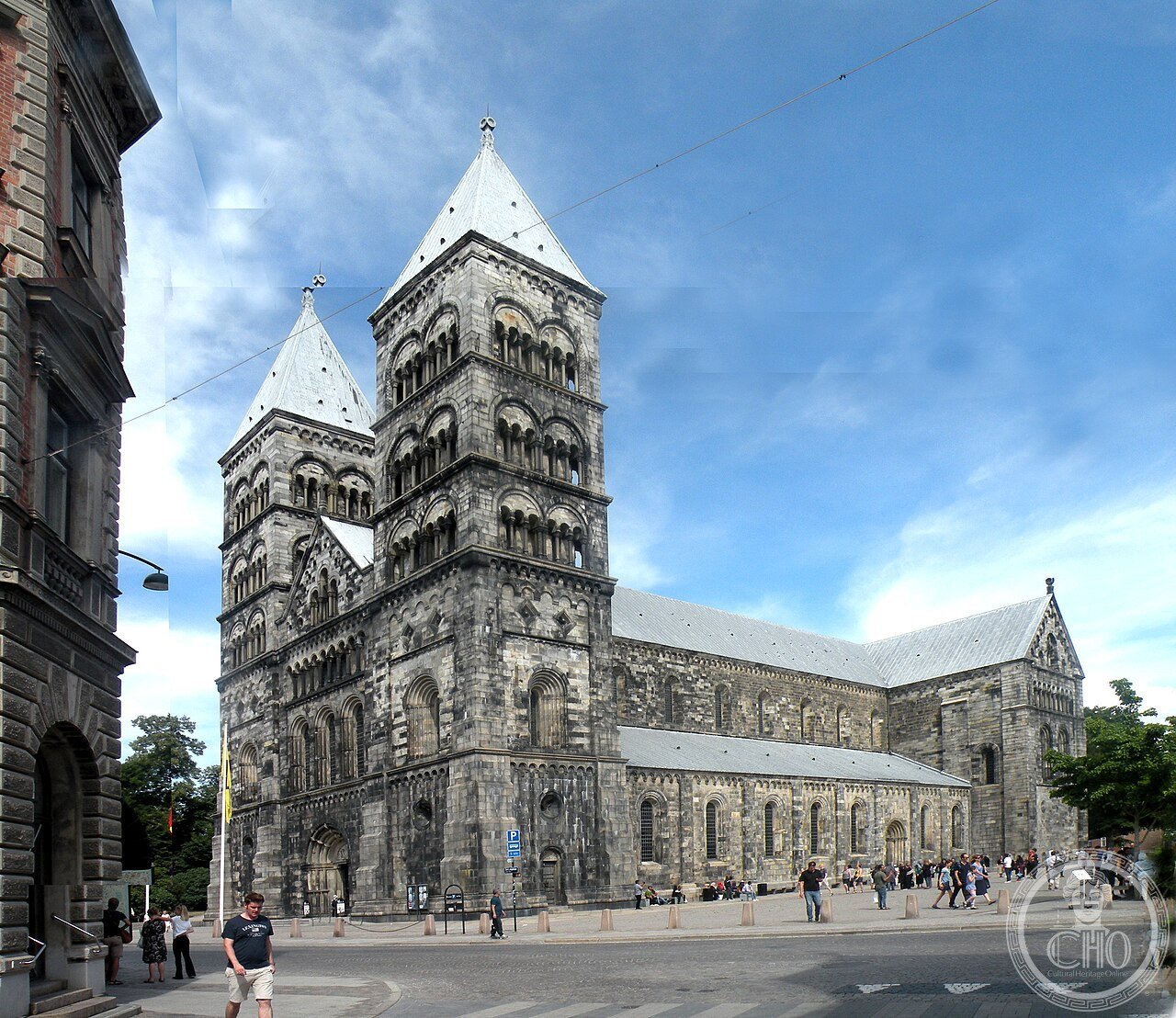
According to an old Scandinavian legend, a giant named Finn offered to build the cathedral in exchange for the sun, the moon, or the architect’s eyes; when the architect refused to pay the agreed price, the giant went down into the crypt to bring the building down by shaking its load-bearing pillars — but he was turned to stone on the spot, along with his wife. The two sculptures still visible in the crypt, probably representing Samson, carry the name of that legend.
About Lund Cathedral
A church dedicated to Saint Lawrence is documented at the site by 1085, and construction of the stone cathedral began soon afterward; the crypt altar was inaugurated on 30 June 1123, following Lund’s elevation to Archbishopric of the Nordic countries in 1103, and the main altar, dedicated to Saint Mary and Saint Lawrence, was consecrated on 1 September 1145. Lund Cathedral has been called the most powerful representative of Romanesque architecture anywhere in the Nordic countries, its lavish stone sculptural decoration showing clear influences from contemporary northern Italian architecture, transmitted via the Rhine Valley. In the crypt stand two carved stone figures traditionally known as “the giant Finn and his wife”: according to local legend, the giant offered to build the cathedral in exchange for the sun, the moon, or the architect’s own eyes, and when denied his payment descended into the crypt to bring the building down by shaking its pillars — only to be turned to stone on the spot, along with his wife. Most scholars today believe the larger figure actually depicts the biblical Samson, though the identity of the smaller figure remains uncertain. The cathedral also houses a celebrated astronomical clock, first mentioned in written sources in 1442 but probably constructed and installed around 1423-1425, possibly by Nikolaus Lilienfeld; heavily restored in 1923, the clock displays the signs of the zodiac and the phases of the moon, and chimes twice daily as figures of the three wise men and their attendants process past and bow before the Virgin Mary and the infant Jesus. Much of the cathedral’s present exterior, including its distinctive twin towers, results from an extensive late 19th-century restoration carried out by the architect Helgo Zettervall in the 1860s-1880s.
Key facts
- By 1085: a church dedicated to Saint Lawrence documented at the site
- 1103: Lund elevated to Archbishopric of the Nordic countries
- 30 June 1123: crypt altar inaugurated
- 1 September 1145: main altar consecrated to Saint Mary and Saint Lawrence
- c. 1423-1425: the astronomical clock built, first documented in 1442
- The giant Finn legend: two carved crypt figures, likely depicting Samson
- 1860s-1880s: major restoration by architect Helgo Zettervall shapes the present exterior
- 1923: the astronomical clock heavily restored
History
The legend of the giant Finn, offering to build the cathedral in exchange for an impossible or ruinous payment before being petrified in the attempt to destroy it, situates Lund Cathedral within a broader Scandinavian folkloric tradition of supernatural builders bargaining with human architects for monumental construction — a narrative pattern echoed in similar tales attached to other major Nordic churches, here permanently commemorated by the crypt’s own carved stone figures. The cathedral’s documented elevation to seat of the first Nordic archbishopric in 1103 gave Lund an ecclesiastical authority extending across the whole of medieval Scandinavia, a status reflected in the exceptional scale and quality of its Romanesque construction relative to other contemporary Nordic churches.
The astronomical clock’s continuous mechanical performance since the early 15th century, its wise men still processing past the Virgin and Child twice daily after a 1923 restoration, gives the cathedral a rare functioning medieval automaton alongside its architectural and legendary heritage — one of a select few such clocks anywhere in Northern Europe to remain in working order across nearly six centuries.
What you see
The cathedral’s twin towers and much of its present exterior reflect Helgo Zettervall’s extensive 1860s-1880s restoration, while the oldest surviving elements — the high altar and crypt — date to the original 12th-century construction. Within the crypt, the carved stone figures of the “giant Finn and his wife” remain among the cathedral’s most visited sculptural features. The astronomical clock, dating to around 1425 and restored in 1923, continues to chime twice daily with its procession of the three wise men before the Virgin and Child.
Practical information
- Opening hours: generally open daily with seasonal variation; check current hours before visiting; free admission
- Address: Lilla Kyrkogatan, 222 22 Lund, Sweden
Getting there
Lund Cathedral is reachable on foot within the historic centre of Lund, Skåne County, southern Sweden. GPS: 55.7041° N, 13.1936° E.
Nearby
- Lund University — one of Scandinavia’s oldest universities, adjacent to the cathedral
- Kulturen open-air museum — a nearby museum of Swedish cultural history
- Malmö — approximately 20 minutes away by train; the region’s largest city
Sources
- Wikipedia — “Lund Cathedral” and “Lund astronomical clock” (en.wikipedia.org)
- Visit Skåne — “Lund Cathedral” (visitskane.com)
- Kulturportal Lund — “Lund Cathedral” (kulturportallund.se)
Find it on the map
See this place and what’s around it →📷 Become a Cultural Heritage Online photographer
Share your photos of places: they stay published under your name as the author. The more they're seen, the more you get noticed — and soon a contest will reward the most appreciated photos.
Log in or sign up free to add a photo