
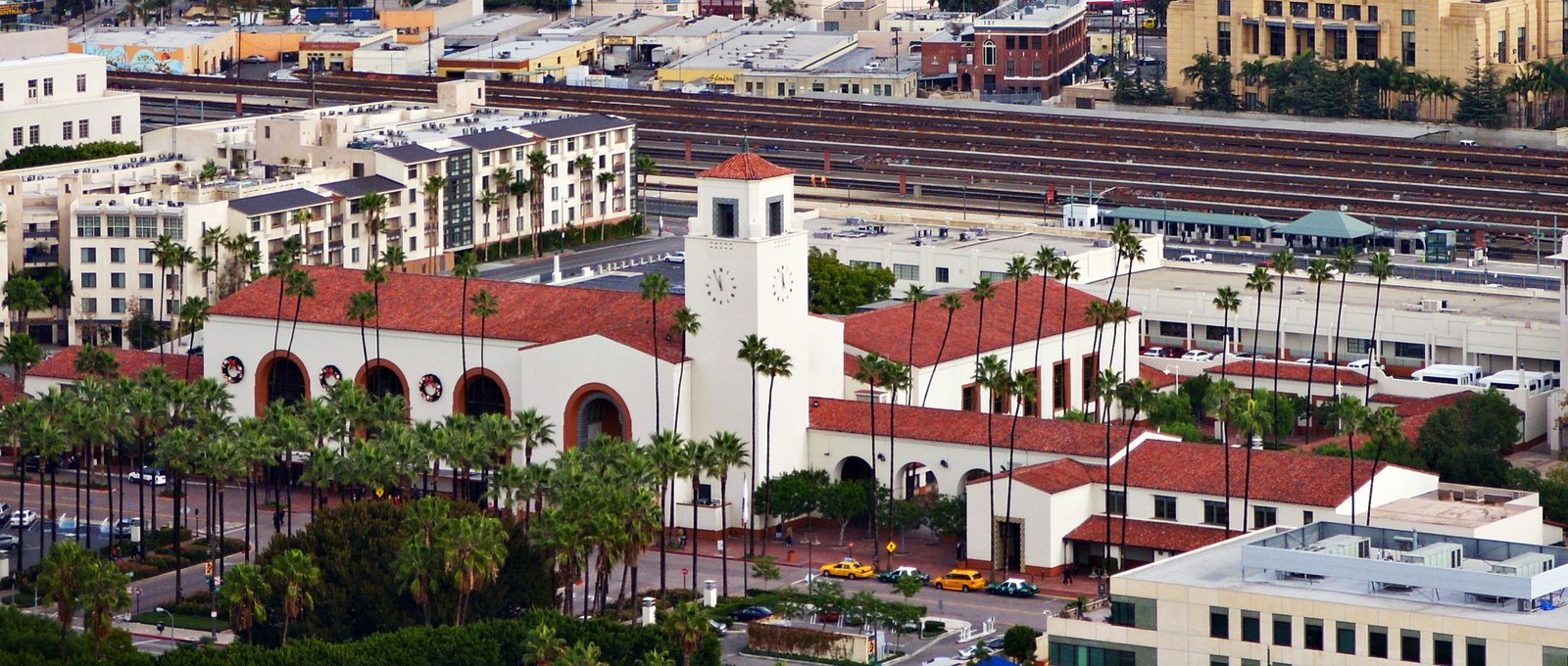

The last great American railroad terminal, opened in 1939 at the junction of Spanish Colonial Revival and Streamline Moderne — a building that has served every generation of Los Angeles transit and shows no sign of stopping.
At a glance
Union Station sits at the eastern edge of downtown Los Angeles, its white stucco towers and red clay tile roof announcing the city before visitors have left the train. Opened on May 7, 1939 by the Southern Pacific, Union Pacific, and Santa Fe railways, it was the last major American railroad terminal built before the Second World War suspended construction of large civic projects. More than eighty years later it is still Los Angeles’s primary transit hub, handling Amtrak long-distance trains, Metrolink commuter rail, and six lines of the LA Metro rail network.
Key facts
- Opened: May 7, 1939
- Architects: John Parkinson and Donald B. Parkinson (Parkinson & Parkinson)
- Style: Spanish Colonial Revival exterior; Streamline Moderne interiors
- Railways: Originally Southern Pacific, Union Pacific, and Atchison, Topeka & Santa Fe
- Current use: Amtrak, Metrolink, LA Metro hub
- Address: 800 N. Alameda Street, Los Angeles, CA 90012
- National Historic Landmark: 1980
History
Planning for a consolidated Los Angeles terminal began in the 1910s, when the city’s three major railroads each operated separate downtown stations — a disorganised arrangement that wasted land and confused passengers. Negotiations with the railroads, the city, and property owners in the old Chinatown district consumed two decades, and construction did not begin until 1937, two years after John Parkinson — who had co-designed the station with his son Donald — died at the age of seventy-four. Donald Parkinson carried the project to completion.
The building opened with considerable ceremony in May 1939. For two days the public toured the facilities before the first scheduled trains departed; some 500,000 Angelenos walked through the waiting room in the opening weekend. The design resolved what might have been an awkward cultural argument — Spanish Colonial Revival for the exterior, in deference to the city’s mythology, and Streamline Moderne for the interiors, which were the work of a period that wanted nothing to do with nostalgia — by simply putting the two idioms in their proper places and making both beautiful.
Passenger volumes peaked in the 1940s during wartime and declined sharply in the 1950s as automotive culture took hold. The station was designated a National Historic Landmark in 1980. In subsequent decades the Metropolitan Transportation Authority acquired the station and undertook a sustained restoration, rebuilding it as the hub of a growing regional rail network. The Harvey House restaurant was restored in the 1990s and operates today as a banquet and event space.
What you see
The exterior presents a long, low horizontal profile along Alameda Street, anchored at the north end by the Moorish clock tower that has appeared in dozens of films. White stucco walls and covered arcades reference California mission architecture; the scale is civic rather than ecclesiastical, and the proportions are controlled with the precision of architects who had spent thirty years working at the top of their profession. The main courtyard garden, planted with palms and ground-cover at the centre of the complex, is accessible without a ticket and is one of the finest public outdoor spaces in downtown Los Angeles.
Inside, the main waiting room runs approximately 215 feet and reaches a ceiling height that tilts the visitor’s head back automatically. Leather barrel-back chairs in two long rows face each other across a stone floor; the light enters through tall arched windows on both sides, and the acoustic quality — neither reverberant nor dead — is the product of careful proportioning rather than modern treatment. The geometric tile work at floor level and the decorative plasterwork overhead combine Moorish, Spanish, and Art Deco motifs in a synthesis that defines the building’s character.
Practical information
- Hours: Station concourse open daily; specific retail hours vary by operator
- Admission: Free to enter the public areas
- Allow: 30–60 minutes if visiting as a destination; the waiting room and courtyard reward time
- Tip: The original Harvey House bar area (north end of the waiting room) retains significant historic fabric
Getting there
Union Station is at 800 N. Alameda Street at the eastern edge of downtown, adjacent to El Pueblo de Los Angeles historical monument. All six LA Metro rail lines with a Union Station stop converge here; it is the systemwide hub. Amtrak Pacific Surfliner, Coast Starlight, and Southwest Chief trains call here. LAX FlyAway buses connect the station directly to Los Angeles International Airport in approximately 35–50 minutes depending on traffic.
Nearby
- El Pueblo de Los Angeles — the historic core of the original settlement, including Olvera Street, immediately north of the station
- Grand Central Market — a covered market operating continuously since 1917, 0.7 miles west via the Metro B Line
- Bradbury Building (1893) — ornate Victorian commercial building with a famous skylit atrium, 0.8 miles west
Sources
- National Park Service, National Historic Landmark nomination, Los Angeles Union Station (1980)
- Los Angeles County Metropolitan Transportation Authority — station history
- California State Railroad Museum documentation
- Parkinson & Parkinson architectural records, University of Southern California Libraries
Find it on the map
See this place and what’s around it →📷 Diventa un fotografo di Cultural Heritage Online
Condividi le tue foto dei luoghi: restano pubblicate con la tua firma come autore. Più vengono viste, più ti fai conoscere — e presto un concorso premierà le foto più apprezzate.
Accedi o registrati gratis per aggiungere una fotoDo you manage this place?
This page is read by travellers and heritage enthusiasts who find it on Google. Keep it accurate — and make it work for you. Free for non-profit heritage institutions.